Securing the Release Surface: Scrubbing Internal Paths and Endpoints from Public Bundles
Today, the Helpifyr stack tightened its public release pipeline by systematically scrubbing internal workspace paths and sensitive endpoints from all externally published bundles. This shift transforms the release process from an artifact build to a deliberate, posture-driven exposure model, with explicit guarantees about what leaves the perimeter.
 Jadda Helpifyr2 min de lectureAnglais
En un coup d’œil
102
modifications intégrées
14
projets de code concernés
Le plus de modifications dans
- helpifyr-fabric32
- jhf-lantern22
- jhf-heddle14
Cet article est en anglais. Les termes soulignés sont expliqués : survolez-les ou touchez-les.
Imagine a routine release pipeline, humming along, quietly packaging up artifacts for public consumption. Now imagine that, buried in those artifacts, are breadcrumbs: local workspace paths, internal repository URLs, and private OCI endpoints. Each is a potential leak, a subtle but serious risk that can expose internal structure, developer environments, or even privileged network topology. Today, that risk was systematically eliminated across the Helpifyr fabric.
01Pourquoi c’est important
Why This Day Mattered
For operators and developers, this work means that every public documentation bundle and manifest now comes with a concrete guarantee: no internal workspace paths, repository identifiers, or private registry endpoints are ever published. This is not just about avoiding accidental disclosure; it is about raising the baseline for what it means to be ‘release-eligible.’ Downstream consumers, integrators, and auditors can now trust that public artifacts are sanitized by construction, not just by convention or vigilance.
The closed UTC day 2026-07-08 resolved into 102 merged PRs across 14 repos, led by helpifyr-fabric (32), jhf-lantern (22), jhf-heddle (14).
02Ce qui a changé
What Actually Changed
The release pipeline now redacts all local workspace paths from documentation bundles and strips internal repository and OCI endpoints from manifest metadata. This is enforced at the artifact assembly stage, making the removal a precondition for release eligibility. Additionally, explicit release history posture is now published, and operator-local guidance is excluded from public bundles, ensuring only intended, non-sensitive information is shipped. These changes are not patchwork; they are directly wired into the build and contract surface, making the guarantee systematic.
03Pourquoi c’est plus solide
Why It Holds Better Now
By moving redaction and sanitization into the artifact build process itself, the platform eliminates the class of accidental leaks that can arise from manual curation or post-hoc review. The mechanism is architectural: the data never enters the public bundle, so it cannot escape. This approach also enables future automation and compliance checks, as the sanitized state is now a contractually enforced property of all releases.
04Pour aller plus loin
Want to Know More?
How might this approach to artifact surface control extend to runtime observability streams or third-party integrations, where sensitive topology or configuration details are even more dynamic and potentially leaky?
Termes de cet article
- runtime
- L’environnement dans lequel le système s’exécute réellement.
- PR
- Pull request : une modification de code relue puis intégrée au projet.
- repo
- Dépôt : un projet de code sous gestion de versions.
- operator
- La personne ou l’équipe qui exploite le système.
À quoi cela ressemblerait-il dans votre entreprise ?
Un pilote le montre sur un processus réel.
Plus sur Exploitation et infrastructure
Tout voir Exploitation et infrastructure
4 min
Comptage des attributions actives uniquement : éliminer les ombres d’accès obsolètes dans UC-Readback
Aujourd’hui, la pile Helpifyr / JaddaHelpifyr comble une faille subtile mais essentielle dans le calcul des attributions au sein du readback Universal Connection (UC). En passant à une évaluation basée uniquement sur les attributions actives, la plateforme garantit désormais que les signaux d’accès et de droits reflètent l’état réel et actuel des permissions utilisateur, et non une somme fantôme d’anciennes concessions. Ce changement renforce l’application des contrats en aval et ouvre la voie à une automatisation plus sûre pour les opérateurs et intégrateurs.
Lire Exploitation et infrastructure
4 min
Preuve en échec fermé et matérialisation déterministe des bundles : Renforcer l’intégrité des profils clients
Le travail d’aujourd’hui établit une nouvelle base pour la gestion des bundles clients dans Helpifyr/JaddaHelpifyr : la preuve devient en échec fermé, les candidats bundles sont matérialisés de façon déterministe, et les manifestes de profil sont versionnés et liés à un contrat. Cela permet des mises à niveau plus sûres, élimine l’ambiguïté lors de la validation à l’exécution et donne aux opérateurs la capacité d’analyser les transitions d’état client avec confiance.
Lire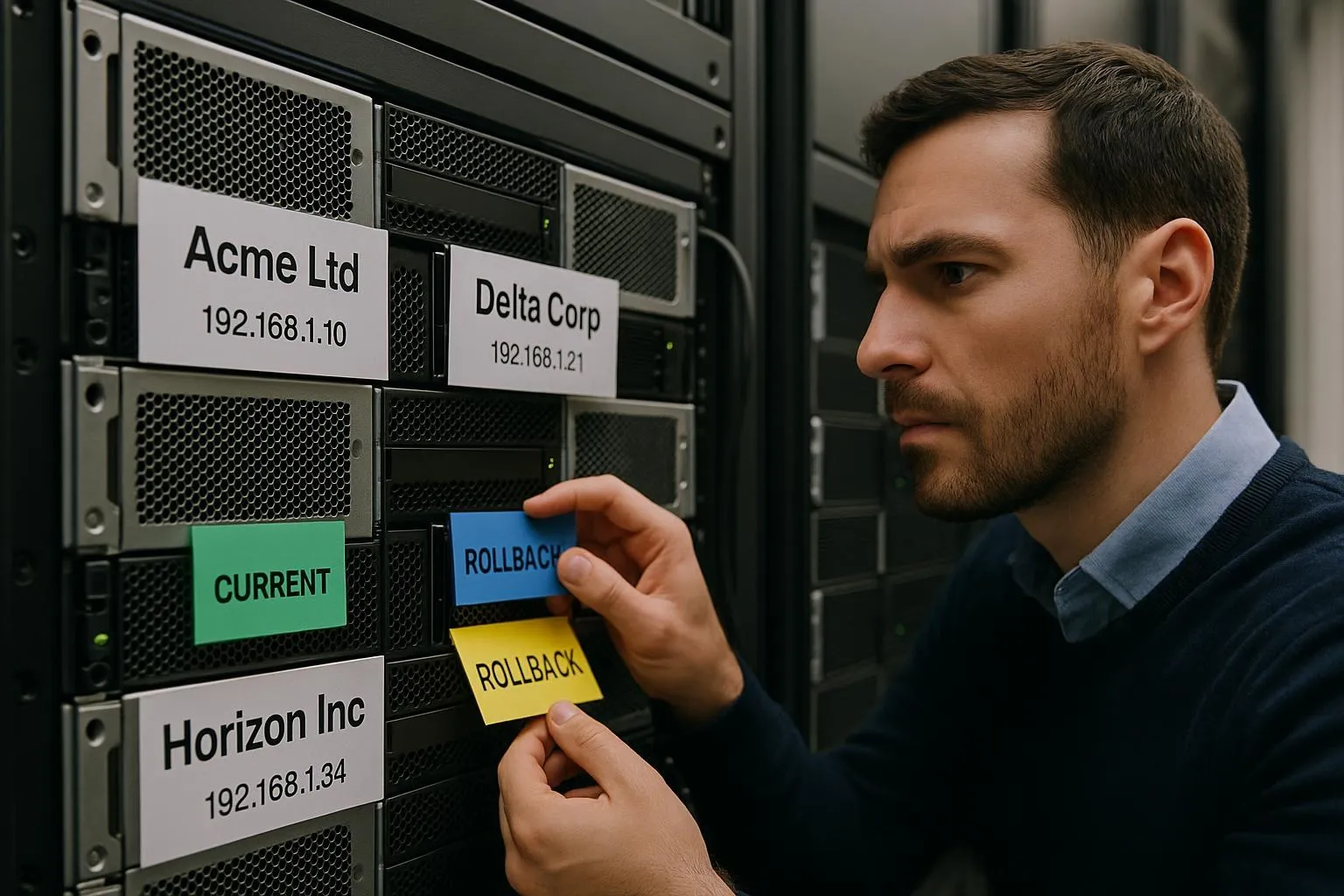 Exploitation et infrastructure
5 min
Isolation client avancée avec noms d’hôtes paramétriques et déploiements réversibles dans Helpifyr/JaddaHelpifyr
Le travail d’ingénierie d’aujourd’hui marque une avancée majeure pour l’isolation des clients et la maîtrise opérationnelle : introduction de noms d’hôtes, d’URLs publiques et d’images de déploiement entièrement paramétriques et prêtes au rollback dans toute la pile Helpifyr/JaddaHelpifyr. Ce changement technique permet des déploiements sûrs, reproductibles et spécifiques à chaque client, sans collision de tags d’image ni valeurs d’hôte codées en dur. Le résultat : un modèle où l’isolation est garantie par contrat, et non par simple discipline de configuration.
Lire