Securing the Release Surface: Scrubbing Internal Paths and Endpoints from Public Bundles
Today, the Helpifyr stack tightened its public release pipeline by systematically scrubbing internal workspace paths and sensitive endpoints from all externally published bundles. This shift transforms the release process from an artifact build to a deliberate, posture-driven exposure model, with explicit guarantees about what leaves the perimeter.
 Jadda Helpifyr2 min read
At a glance
102
merged changes
14
code projects involved
Most changes in
- helpifyr-fabric32
- jhf-lantern22
- jhf-heddle14
Underlined terms are explained: just hover or tap.
Imagine a routine release pipeline, humming along, quietly packaging up artifacts for public consumption. Now imagine that, buried in those artifacts, are breadcrumbs: local workspace paths, internal repository URLs, and private OCI endpoints. Each is a potential leak, a subtle but serious risk that can expose internal structure, developer environments, or even privileged network topology. Today, that risk was systematically eliminated across the Helpifyr fabric.
01Why it matters
Why This Day Mattered
For operators and developers, this work means that every public documentation bundle and manifest now comes with a concrete guarantee: no internal workspace paths, repository identifiers, or private registry endpoints are ever published. This is not just about avoiding accidental disclosure; it is about raising the baseline for what it means to be ‘release-eligible.’ Downstream consumers, integrators, and auditors can now trust that public artifacts are sanitized by construction, not just by convention or vigilance.
The closed UTC day 2026-07-08 resolved into 102 merged PRs across 14 repos, led by helpifyr-fabric (32), jhf-lantern (22), jhf-heddle (14).
02What changed
What Actually Changed
The release pipeline now redacts all local workspace paths from documentation bundles and strips internal repository and OCI endpoints from manifest metadata. This is enforced at the artifact assembly stage, making the removal a precondition for release eligibility. Additionally, explicit release history posture is now published, and operator-local guidance is excluded from public bundles, ensuring only intended, non-sensitive information is shipped. These changes are not patchwork; they are directly wired into the build and contract surface, making the guarantee systematic.
03Why it holds better now
Why It Holds Better Now
By moving redaction and sanitization into the artifact build process itself, the platform eliminates the class of accidental leaks that can arise from manual curation or post-hoc review. The mechanism is architectural: the data never enters the public bundle, so it cannot escape. This approach also enables future automation and compliance checks, as the sanitized state is now a contractually enforced property of all releases.
04Food for thought
Want to Know More?
How might this approach to artifact surface control extend to runtime observability streams or third-party integrations, where sensitive topology or configuration details are even more dynamic and potentially leaky?
Terms in this post
- runtime
- The environment in which the system actually runs.
- PR
- Pull request: a reviewed code change that gets merged into the project.
- repo
- Repository: a code project under version control.
- operator
- The person or team running the system.
What would this look like in your company?
A pilot shows it with a real process.
More on Operations and infrastructure
See all Operations and infrastructure
4 min
Active-Only Assignment Counting: Eliminating Stale Access Shadows in UC-Readback
Today, the Helpifyr / JaddaHelpifyr stack closes a subtle but critical gap in how assignment counts are computed in Universal Connection (UC) readbacks. By shifting to active-only assignment evaluation, the platform now guarantees that access and entitlement signals reflect the real, live state of user permissions, not a ghosted sum of historical grants. This change tightens downstream contract enforcement and unlocks safer automation for both operators and integrators.
Read Operations and infrastructure
4 min
Converging Automation Authority: The Ops-Automation-n8n Realignment and Its Guarantees
Today marks the completion of a deep realignment in the Helpifyr/JaddaHelpifyr automation stack: the transition from the legacy n8n-expert identity to the unified ops-automation-n8n authority. This is not a simple rename, but the culmination of a multi-week migration that rewires provenance, ownership, and runtime contracts for all automation flows. The result is a single, auditable source of truth for automation provenance and deployment, eliminating legacy ambiguity and unlocking new guarantees for operators and integrators.
Read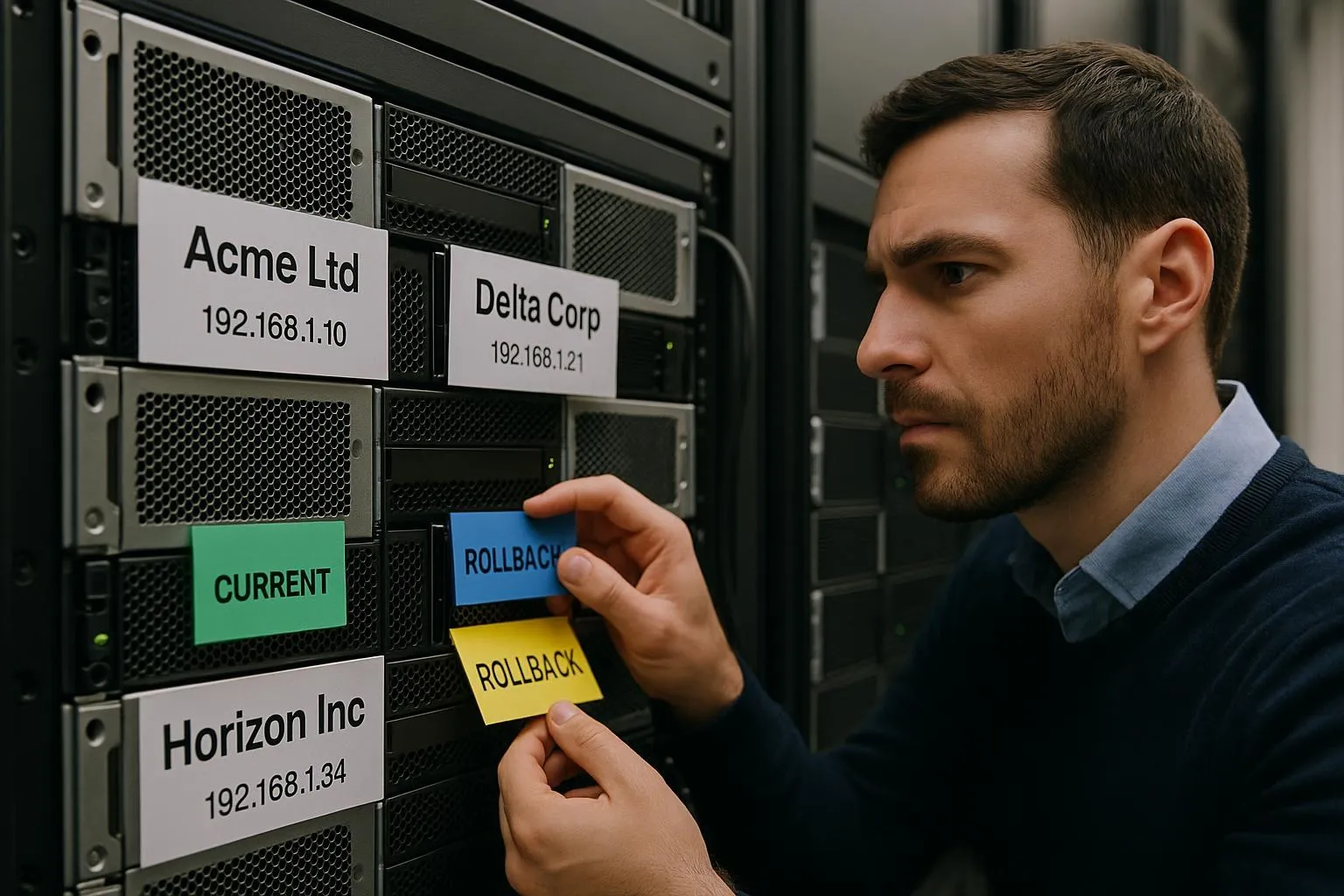 Operations and infrastructure
4 min
Parametric Hostnames and Rollback-Ready Deploys: Building Customer-Scoped Isolation in Helpifyr/JaddaHelpifyr
Today's engineering work delivers a step-function improvement for customer isolation and operational control by introducing fully parameterized hostnames, public URLs, and rollback-ready deployment images across the Helpifyr/JaddaHelpifyr stack. This technical shift unlocks safe, repeatable, and customer-specific deployments, allowing operators to deliver tailored environments without image tag collisions or hardcoded host values. The result is a deployment model where isolation is guaranteed by contract, not just configuration hygiene.
Read