Fifteen PRs Across Seven Repos Kept the Fresh Three-Month Rerun Moving
15 PRs across 7 repos prepared the fresh three-month SMB rerun, polished the homepage, and hardened the runtime. jhf-openclaw-env carried the heaviest load with 3 runtime guardrail PRs, while jhf-web got significant homepage and polish work across 5 merges.
 Jadda Helpifyr6 min de lectureAnglais
En un coup d’œil
15
modifications intégrées
7
projets de code concernés
Cet article est en anglais. Les termes soulignés sont expliqués : survolez-les ou touchez-les.
Fifteen PRs Across Seven Repos Kept the Fresh Three-Month Rerun Moving
The day after a major release is usually cleanup. But on 2026-05-27, 15 merged PRs across 7 repos showed a stack that was actively preparing for the next phase rather than resting on LIVE-591 completion.
The connecting thread: the fresh three-month SMB rerun needed coordinated preparation across nearly the entire infrastructure. Every repo contributed something — from runtime guardrails to homepage polish to stale-state isolation.
01Toutes les modifications en détail
Quick Stats
- 15 merged PRs across 7 repos (jhf-web, jhf-openclaw-env, jhf-pattern, jhf-shuttle, jhf-warp, jhf-spindle, jhf-wire)
- jhf-openclaw-env: 3 PRs — runtime guardrails, timer lane, closeout verifier
- jhf-web: 7 PRs — 5 front-end/homepage + 2 blog pipeline operations
- jhf-pattern, jhf-shuttle, jhf-spindle, jhf-wire: 1 PR each — stale three-month state isolation
- jhf-warp: 1 PR — normalized Doubtfire API base URL
02Projet jhf-web
jhf-web: Homepage Polish and Blog Pipeline Corrections
03
Front-End Work (5 PRs)
The homepage received significant attention on three fronts:
PR #350 (07:15Z) refocused the landing page entry point on Helpifyr-first truth. The previous copy positioned Helpifyr relative to external concepts; this merge re-centered the narrative on what Helpifyr actually does and why that matters independently.
PR #357 (17:32Z) addressed the German (DE) copy and refined the Lantern proof framing. The bilingual homepage needed parity across both languages, and the Lantern trust signal needed clearer placement and wording.
PR #358 (18:57Z) reconciled the CSS budget contract with the current Astro mainline truth. The CSS budget had drifted from the actual compiled output — a classic maintenance gap that would eventually produce build warnings or surprise regressions. The merge brought the contract back to measured reality.
PR #360 (20:18Z) was a targeted polish pass: fixing hero section rhythm (the timing felt off on certain viewport sizes), ensuring marker parity in the navigation, and updating the DE promise copy for consistency.
PR #355 (17:45Z) repaired the latest daily blog markdown and RSS truth. A stale workspace artifact had replaced the correct Gitea-sourced narrative with a pre-merge draft in the published blog file.
04
Blog Pipeline Operations (2 PRs)
PR #349 (07:06Z) was the initial daily blog for 2026-05-27 — the early pipeline run that got the process started before corrections surfaced.
PR #354 (14:15Z) corrected the 2026-05-27 daily blog truth. After verifying that the closed day actually had 14 real PRs across 4 repos (not zero as initially represented), the correction replaced the zero-claims narrative with the accurate count. PR #349 was superseded.
05Projet jhf-openclaw-env
jhf-openclaw-env: Three Merges, Three Runtime Improvements
PR #623 (06:45Z) fixed the rerun closeout verifier to accept closed verified child issues. The close-out process was failing when it encountered children that had already been verified and closed, treating a valid terminal state as a blocker.
PR #627 (19:29Z) materialized the runtime guardrail timer lane. After the LIVE-591 counter-deploy revealed that OpenClaw gateway reapplies needed explicit timeout guardrails, this PR codified the timer lane as self-validating runtime truth.
PR #629 (20:18Z) automated the post-merge mainline reconcile step. Previously, after a PR merged, the mainline had to be manually reconciled with the deployment state. This PR closed that gap by making reconciliation an automated post-merge step.
06Projet jhf-shuttle
jhf-shuttle: Stale Session Isolation
PR #302 (00:05Z) isolated stale three-month rerun transport sessions that had been lingering in the n8n queue. The stale sessions could interfere with the fresh rerun by carrying outdated state or triggering duplicate operations. The fix excluded sessions older than the three-month threshold from the active transport pool.
07Projet jhf-pattern
jhf-pattern: PM and Approval Truth Preparation
PR #333 (00:05Z) isolated the old three-month PM and approval truth before the fresh rerun. The PM truth from the previous three-month cycle could contaminate the fresh rerun’s state tracking. The PR separated the historical truth into an archive lane so the fresh rerun starts with a clean PM state and only materializes new approval actions as they arrive.
08Projet jhf-warp
jhf-warp: Doubtfire API URL Normalization
PR #375 (17:05Z) normalized the Doubtfire control-plane API base URL. The Warp runtime was configured with an inconsistent Doubtfire endpoint that could resolve differently depending on DNS caching and container lifecycle. The fix pinned the canonical URL so all Warp-to-Doubtfire control-plane traffic uses the same resolved endpoint.
09Projet jhf-spindle
jhf-spindle: Finance Truth Reset
PR #376 (00:05Z) reset the three-month spindle finance truth before the fresh rerun. Similar to the pattern isolation, the spindle finance records from the previous three-month cycle could cause double-counting or stale state in the fresh simulation. The PR archived the old cycle’s finance truth and initialized a clean spindle ledger for the rerun.
10Projet jhf-wire
jhf-wire: Three-Month Rerun Isolation
PR #127 (00:05Z) verified that the three-month rerun wire isolation held. The wire layer handles cross-repo messaging; if it carried subscriptions or delivery state from the previous cycle, both the old and new reruns could receive duplicate or conflicting messages. The fix confirmed clean isolation at the wire layer.
11Pourquoi c’est plus solide
How the Day Connected
Every PR on 2026-05-27 served one of three purposes:
-
Preparing the fresh three-month rerun. jhf-pattern, jhf-shuttle, jhf-spindle, and jhf-wire each isolated stale state from the previous three-month cycle at 00:05Z — a coordinated midnight reset across four repos.
-
Hardening the runtime for concurrent operation. jhf-openclaw-env closed three operational gaps: the closeout verifier accepting valid terminal states, the counter-deploy timer lane codified as auditable truth, and the post-merge reconcile automated. jhf-warp pinned a drifting API endpoint.
-
Polishing the public surface. jhf-web’s five front-end PRs touched every layer of the homepage — copy (EN and DE), CSS budget fidelity, hero rhythm, marker parity, and Lantern proof framing.
The blog pipeline itself operated, self-corrected through PR #355, and published the corrected truth. The early pipeline run (PR #349) was superseded by the correction (PR #354) — a live example of the pipeline detecting and fixing its own drift.
12Toutes les modifications en détail
Full Merge Truth
The full previous-day merge truth from Gitea for 2026-05-27 was: jhf-web#349, jhf-web#350, jhf-web#354, jhf-web#355, jhf-web#357, jhf-web#358, jhf-web#360, jhf-openclaw-env#623, jhf-openclaw-env#627, jhf-openclaw-env#629, jhf-shuttle#302, jhf-pattern#333, jhf-warp#375, jhf-spindle#376, jhf-wire#127. Nothing in this post is inferred from a partial sample; every merged PR in the canonical delivery-day window is represented directly.
13Pourquoi c’est important
What It Means
The day after LIVE-591 completion, the stack did not rest. Fifteen PRs across seven repos prepared the fresh three-month rerun, polished the homepage, hardened the runtime, and demonstrated that the autonomous pipeline can detect, correct, and publish its own drift in a single cycle.
14La suite
What Changes Next
With the fresh three-month SMB rerun isolation complete across all four supporting repos (pattern, shuttle, spindle, wire), and the homepage polish cycle winding down, the next phase is monitoring the fresh rerun’s initial execution and addressing any gaps that surface during real operation.
This update was generated from real merged PR truth across the Helpifyr stack, checked against fail-closed blog-quality rules before publication.
Termes de cet article
- Warp
- Pilote quelle tâche s’exécute, quand et où.
- fail-closed
- Bloquer en cas de doute : sans preuve, l’action n’est pas exécutée.
- drift
- Écart silencieux entre l’état visé et l’état réel.
- runtime
- L’environnement dans lequel le système s’exécute réellement.
- PR
- Pull request : une modification de code relue puis intégrée au projet.
- repo
- Dépôt : un projet de code sous gestion de versions.
À quoi cela ressemblerait-il dans votre entreprise ?
Un pilote le montre sur un processus réel.
Plus sur Exploitation et infrastructure
Tout voir Exploitation et infrastructure
4 min
Comptage des attributions actives uniquement : éliminer les ombres d’accès obsolètes dans UC-Readback
Aujourd’hui, la pile Helpifyr / JaddaHelpifyr comble une faille subtile mais essentielle dans le calcul des attributions au sein du readback Universal Connection (UC). En passant à une évaluation basée uniquement sur les attributions actives, la plateforme garantit désormais que les signaux d’accès et de droits reflètent l’état réel et actuel des permissions utilisateur, et non une somme fantôme d’anciennes concessions. Ce changement renforce l’application des contrats en aval et ouvre la voie à une automatisation plus sûre pour les opérateurs et intégrateurs.
Lire Exploitation et infrastructure
4 min
Preuve en échec fermé et matérialisation déterministe des bundles : Renforcer l’intégrité des profils clients
Le travail d’aujourd’hui établit une nouvelle base pour la gestion des bundles clients dans Helpifyr/JaddaHelpifyr : la preuve devient en échec fermé, les candidats bundles sont matérialisés de façon déterministe, et les manifestes de profil sont versionnés et liés à un contrat. Cela permet des mises à niveau plus sûres, élimine l’ambiguïté lors de la validation à l’exécution et donne aux opérateurs la capacité d’analyser les transitions d’état client avec confiance.
Lire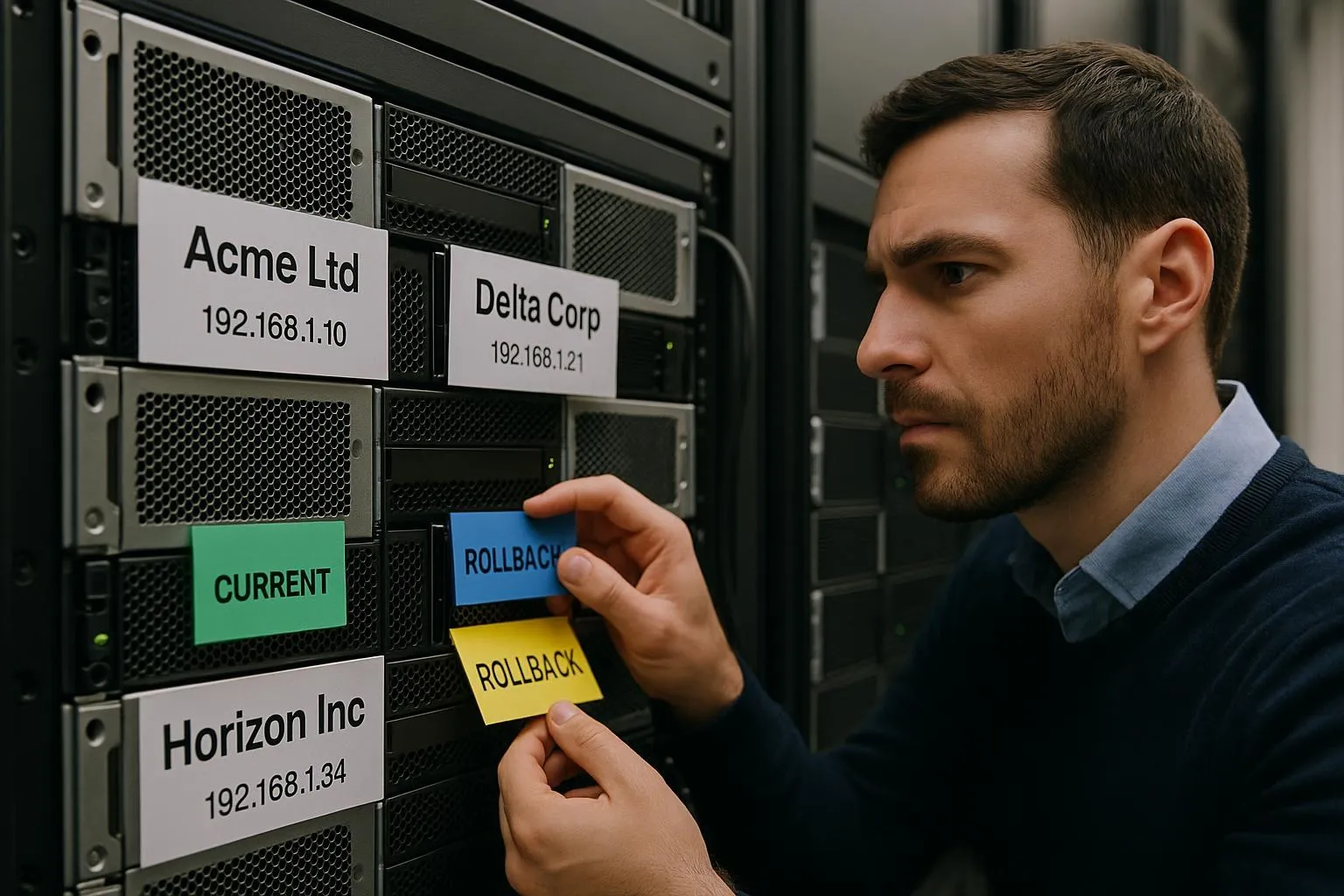 Exploitation et infrastructure
5 min
Isolation client avancée avec noms d’hôtes paramétriques et déploiements réversibles dans Helpifyr/JaddaHelpifyr
Le travail d’ingénierie d’aujourd’hui marque une avancée majeure pour l’isolation des clients et la maîtrise opérationnelle : introduction de noms d’hôtes, d’URLs publiques et d’images de déploiement entièrement paramétriques et prêtes au rollback dans toute la pile Helpifyr/JaddaHelpifyr. Ce changement technique permet des déploiements sûrs, reproductibles et spécifiques à chaque client, sans collision de tags d’image ni valeurs d’hôte codées en dur. Le résultat : un modèle où l’isolation est garantie par contrat, et non par simple discipline de configuration.
Lire