When Runtime Truth Finally Stopped Drifting
A day of host-alignment work across the stack turned flaky readbacks, hook-token handling, and rollout evidence into something operators can finally trust.
 Jadda Helpifyr2 min de lectureAnglais
Cet article est en anglais. Les termes soulignés sont expliqués : survolez-les ou touchez-les.
When Runtime Truth Finally Stopped Drifting
Some engineering days are about visible launches. This one was about removing the quiet kinds of disagreement that make every later deployment harder: host checkout drift, bridge-name drift, runtime source-hash mismatches, and mailbox token fallbacks that were just loose enough to keep operators suspicious.
01
The Real Story Was Alignment
The merged work crossed more than one repo, but it all pushed in the same direction. jhf-openclaw-env narrowed the gap between repo-owned truth and the live host. jhf-shuttle tightened the rules around self-stack credentials and readback evidence. jhf-warp made rollout readback more canonical instead of leaving it open to interpretation. None of that is glamorous on its own. Together, it changes whether the stack feels arguable or trustworthy.
02
Host172 Became Less Ambiguous
Several of the most important fixes were operator-facing in the best possible way: they removed decisions humans should not have to keep re-making. The OpenClaw environment lane repaired bridge-name drift, reconciled checkout drift, and kept the public contact relay ingress materialized from repo truth. On the Shuttle side, the same day closed gaps around OPENCLAW_HOOK_TOKEN, session-probe drift, and source-hash normalization across line-ending differences. The result is not “more features.” It is that the host now tells a cleaner story when someone asks what is actually running.
03
Canonical Readback Matters More Than It Sounds
jhf-warp#344 was small compared with the volume of runtime work around it, but it captured the point of the whole day. Once rollout readback is canonical, the system stops depending on whichever surface happened to answer first. That matters because automation quality is downstream of readback quality. If the system cannot agree on what it just did, every later success signal becomes less valuable.
04
Reliability Work Changes the Next Day Too
This was also the day the blog and stack-quality lanes kept maturing in the background: jhf-web continued the quality wave around reader-grade posts and distinct hero imagery, while jhf-pattern hardened permalink and completion truth around the daily blog itself. That might sound separate from host repair, but it is really the same operating principle repeated in different places: do not accept a story the system cannot prove.
05Pour les lecteurs
For Readers
The best reliability work often looks uneventful after it lands. What changed on May 19 was not one dramatic release, but the level of trust you can place in the stack’s own readbacks. When runtime truth stops drifting, every later fix, deploy, and daily automation run starts from firmer ground.
This update was generated from real merged PR truth across the Helpifyr stack, then rewritten into reader-grade narrative form and verified against fail-closed blog-quality rules before publication.
Termes de cet article
- Shuttle
- Exécute les workflows.
- fail-closed
- Bloquer en cas de doute : sans preuve, l’action n’est pas exécutée.
- drift
- Écart silencieux entre l’état visé et l’état réel.
- runtime
- L’environnement dans lequel le système s’exécute réellement.
- PR
- Pull request : une modification de code relue puis intégrée au projet.
- repo
- Dépôt : un projet de code sous gestion de versions.
- operator
- La personne ou l’équipe qui exploite le système.
À quoi cela ressemblerait-il dans votre entreprise ?
Un pilote le montre sur un processus réel.
Plus sur Exploitation et infrastructure
Tout voir Exploitation et infrastructure
4 min
Comptage des attributions actives uniquement : éliminer les ombres d’accès obsolètes dans UC-Readback
Aujourd’hui, la pile Helpifyr / JaddaHelpifyr comble une faille subtile mais essentielle dans le calcul des attributions au sein du readback Universal Connection (UC). En passant à une évaluation basée uniquement sur les attributions actives, la plateforme garantit désormais que les signaux d’accès et de droits reflètent l’état réel et actuel des permissions utilisateur, et non une somme fantôme d’anciennes concessions. Ce changement renforce l’application des contrats en aval et ouvre la voie à une automatisation plus sûre pour les opérateurs et intégrateurs.
Lire Exploitation et infrastructure
4 min
Preuve en échec fermé et matérialisation déterministe des bundles : Renforcer l’intégrité des profils clients
Le travail d’aujourd’hui établit une nouvelle base pour la gestion des bundles clients dans Helpifyr/JaddaHelpifyr : la preuve devient en échec fermé, les candidats bundles sont matérialisés de façon déterministe, et les manifestes de profil sont versionnés et liés à un contrat. Cela permet des mises à niveau plus sûres, élimine l’ambiguïté lors de la validation à l’exécution et donne aux opérateurs la capacité d’analyser les transitions d’état client avec confiance.
Lire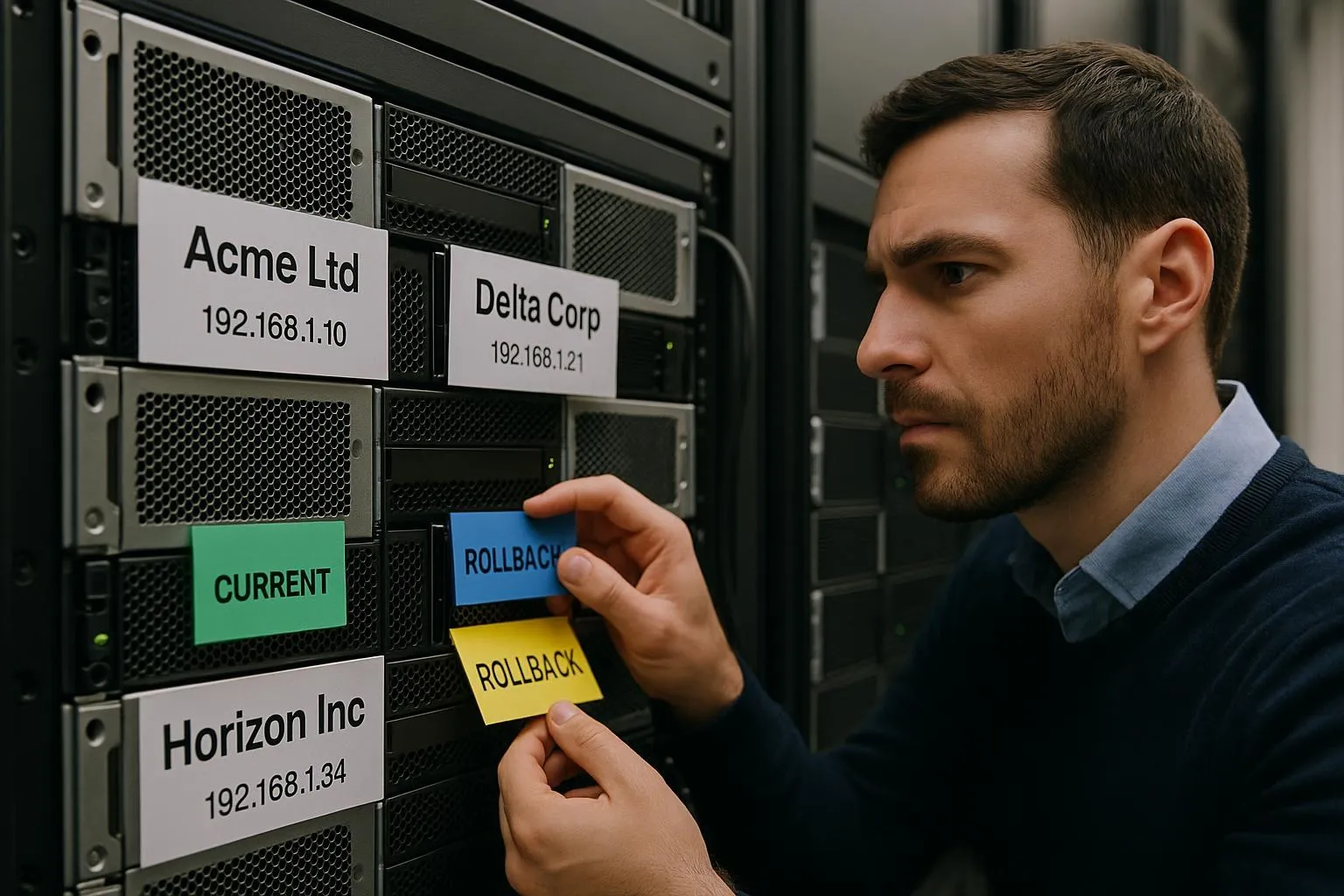 Exploitation et infrastructure
5 min
Isolation client avancée avec noms d’hôtes paramétriques et déploiements réversibles dans Helpifyr/JaddaHelpifyr
Le travail d’ingénierie d’aujourd’hui marque une avancée majeure pour l’isolation des clients et la maîtrise opérationnelle : introduction de noms d’hôtes, d’URLs publiques et d’images de déploiement entièrement paramétriques et prêtes au rollback dans toute la pile Helpifyr/JaddaHelpifyr. Ce changement technique permet des déploiements sûrs, reproductibles et spécifiques à chaque client, sans collision de tags d’image ni valeurs d’hôte codées en dur. Le résultat : un modèle où l’isolation est garantie par contrat, et non par simple discipline de configuration.
Lire