The AI understood the email. The payment still went to fraudsters.
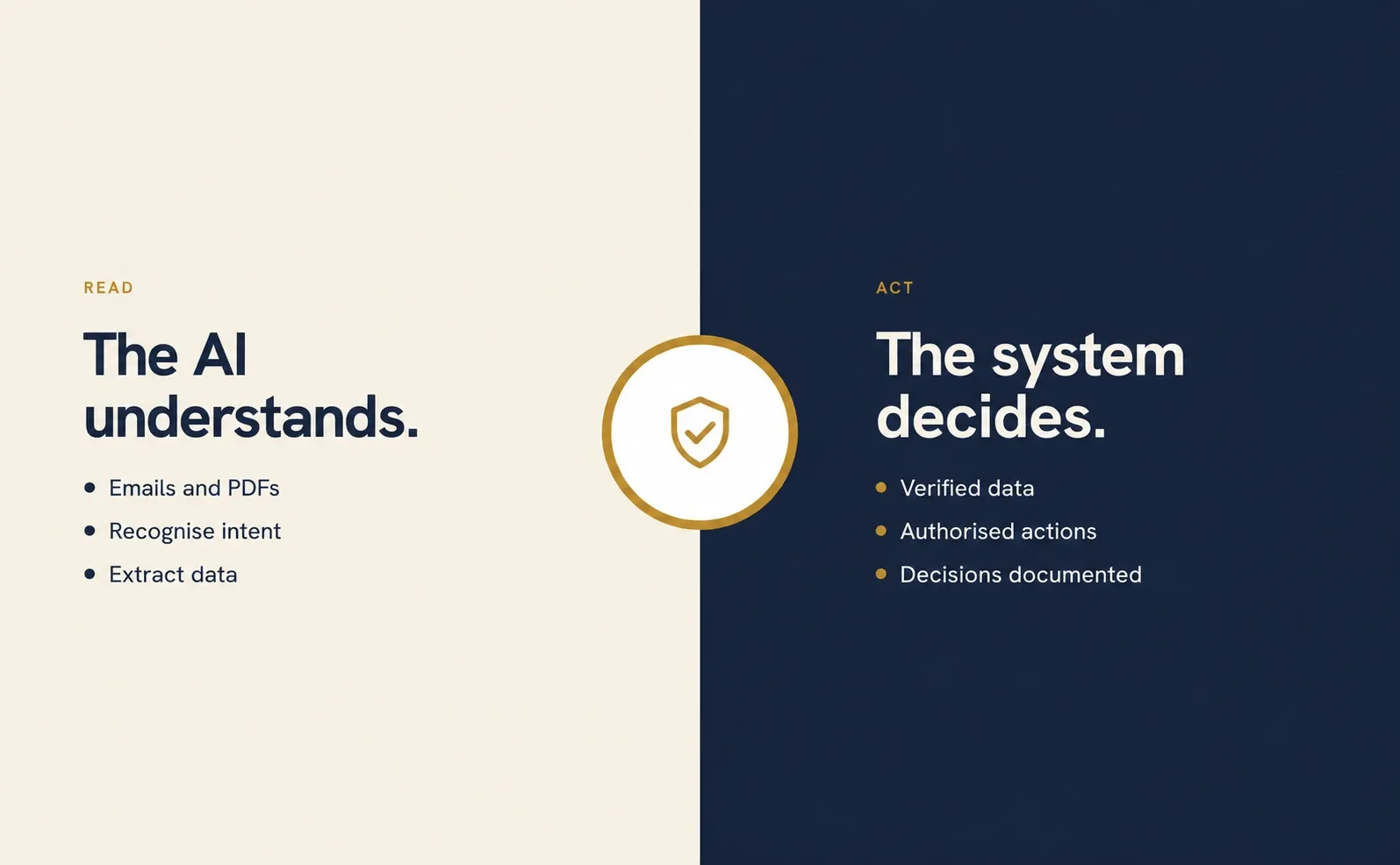
AI agents can take work off a team’s hands. Whether they may act on a request is a separate business decision.
 Helpifyr editorial team5 min read
Underlined terms are explained: just hover or tap.
AI agents can relieve back-office teams of work. What matters is which work they may perform and how critical actions are checked.
Expert article · Helpifyr Editorial Team · 7 November 2026
The following scenario is fictional and reflects a real fraud pattern.
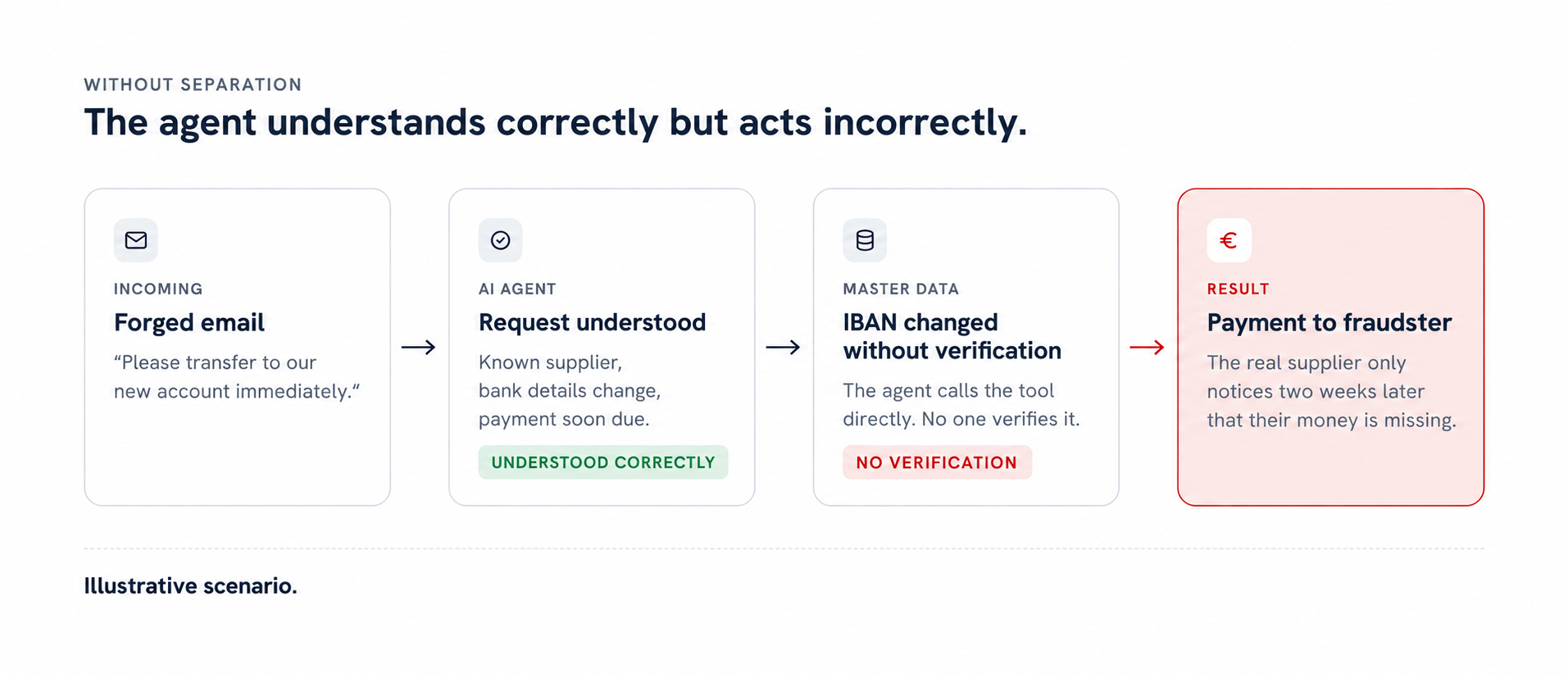
Friday, 4:42 p.m. An email arrives in the accounts department. A familiar supplier asks to change its bank details before the next payment. An AI agent reads the message, recognises the supplier and correctly understands the request. It changes the IBAN in the ERP. On Monday, the payment goes to a fraudster.
The AI understood the message. The agent had technical access to make the change. Whether the request actually came from the supplier and was authorised for the business had not been adequately checked.
01
What the heise article brings into focus
The heise developer article discusses secure architecture for back-office AI agents and raises a fundamental question: how can businesses process information from external sources without automatically treating it as authority to act?
Four risks deserve particular attention:
- Prompt injection: instructions in an email or PDF attempt to steer an agent.
- Excessive agency: an agent has broader access than its task requires.
- Agent goal hijacking: a sequence of inputs redirects the agent towards another goal.
- Memory and context poisoning: manipulated information influences later decisions.
A forged supplier email is not necessarily prompt injection. Ordinary payment fraud can succeed when an unverified request is treated as permission to act. Better prompts and guardrails help, but they are not a sufficient boundary for critical actions.
A robust approach combines several elements: rules-based decisions outside the model, human approval for sensitive transactions, minimum privileges and independent verification. The degree of autonomy an agent should have is an organisational design decision.
02
How Helpifyr addresses this challenge
Helpifyr is a Business Execution System designed to connect people, AI agents and existing business software within defined boundaries. Its architecture distinguishes between interpreting information, admitting capabilities, authorising business decisions and actually executing actions.
The following mapping describes the intended control principles. Which controls are enforced must be verified for each integration and use case:
| Risk | Control approach |
|---|---|
| Prompt injection | Treat external content as data and do not execute instructions solely because they appear in a document. |
| Excessive privileges | Separate capabilities from permissions and limit access to the task. |
| Redirected goals | Check critical actions outside the model in the context of the entire process. |
| Manipulated context | Use authoritative business systems for master data and check changes. |
| Missing traceability | Document the request, decision, approval and outcome as appropriate for the process. |
03
The bank-details case as a target process
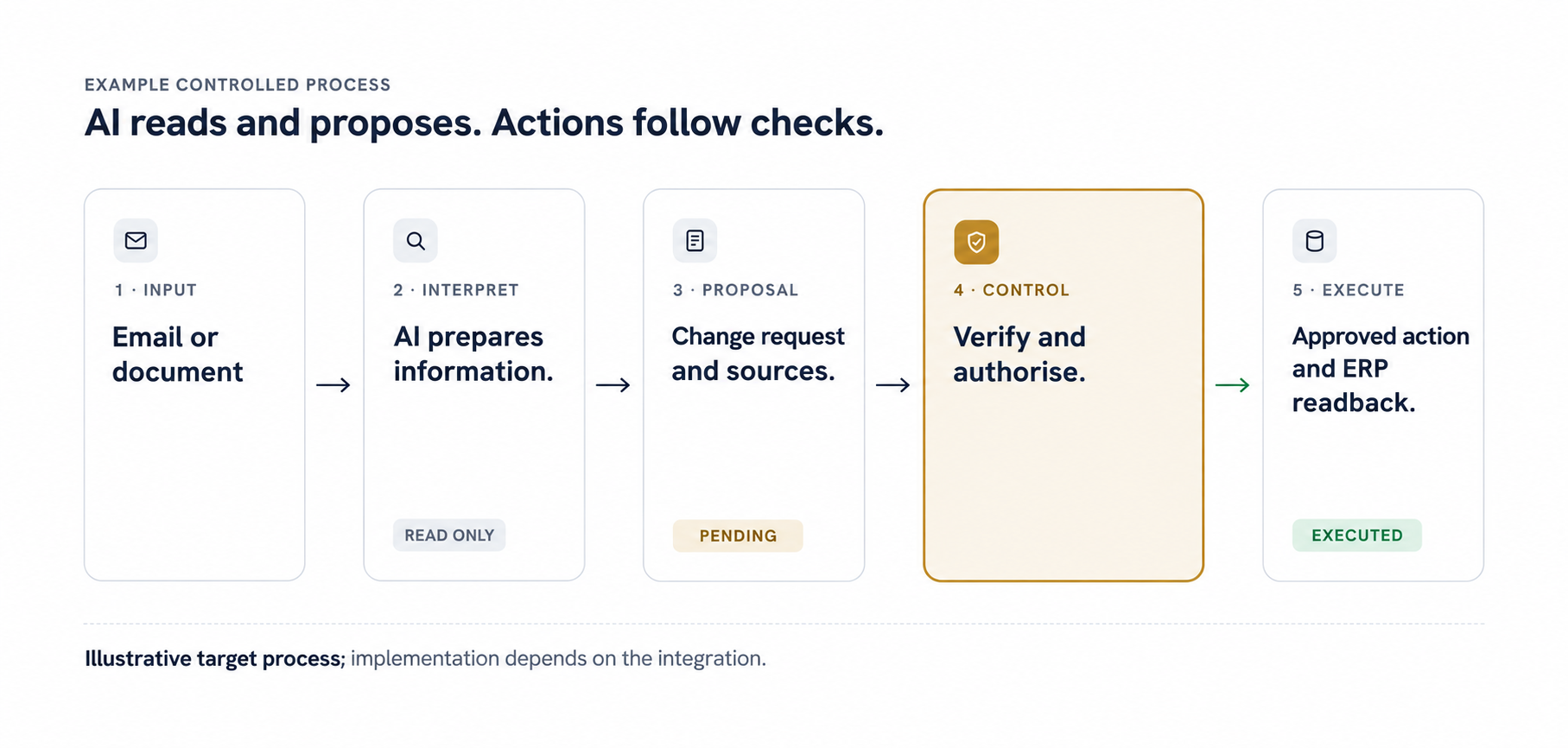
What might the same request look like with such controls? Jadda reads the email, recognises the supplier, the proposed IBAN and the upcoming payment, and prepares a change request with sources and risk indicators.
The request stays pending while accounting independently verifies the change using established contact details, not a number from the suspicious email. An authorised person then approves that specific transaction and data version. If the IBAN changes after approval, it must be checked again.
For this kind of change, the applicable process should also account for payments already prepared and subsequent payments. An authorised integration can execute the approved change and read the result back from the ERP. In the fraud scenario, the independent call would reveal that the supplier had requested no change.
This is an illustrative target process, not evidence that every control is already operational in every integration. A pilot checks the actual chain and its alternative access paths.
04
Limited rights instead of a master key
A shared technical account with every privilege any agent might need magnifies the impact of an error. An agent that reads invoices does not automatically need permission to change bank details or initiate payments. The matrix illustrates one possible division of responsibilities.
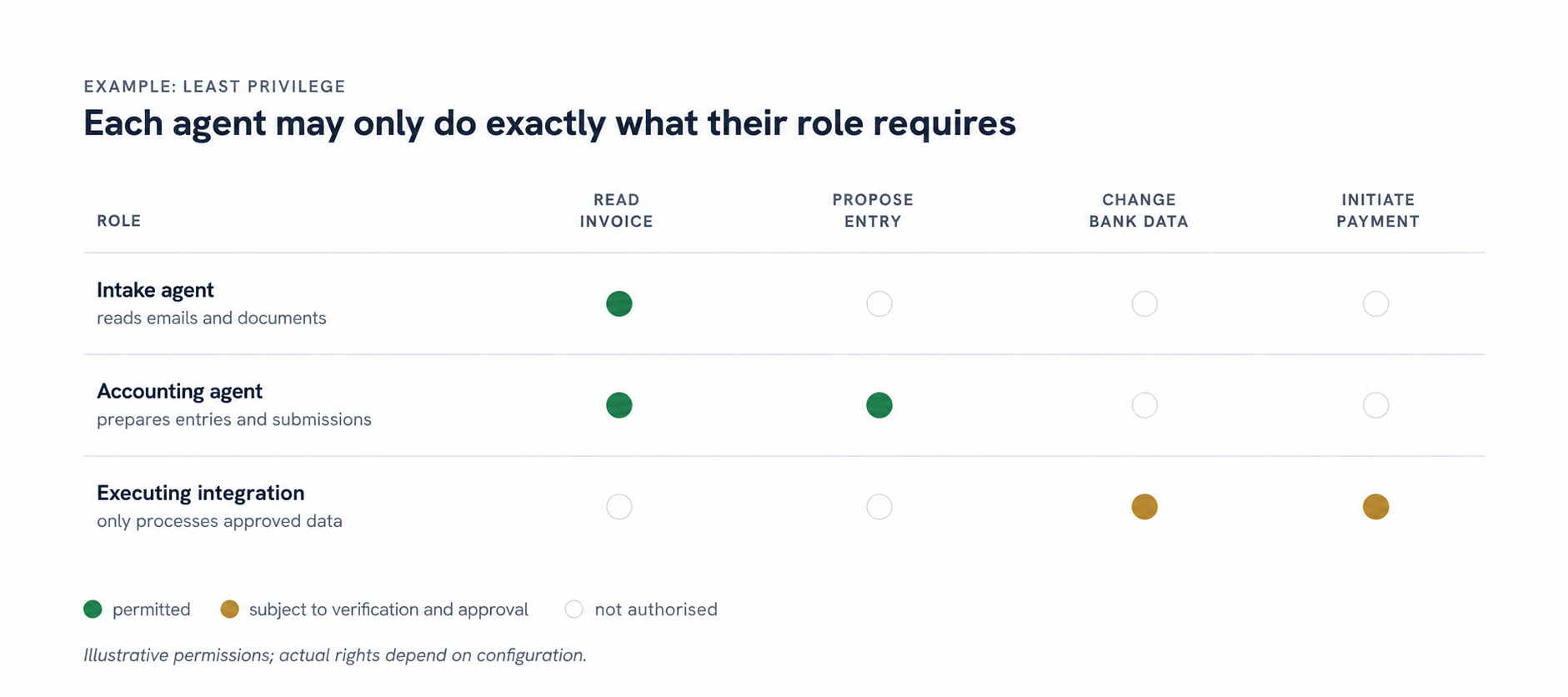
This also creates business value: suitable routine work can be automated while the team focuses on decisions affecting money and master data. It creates the basis for more output with the same team, without inventing savings figures.
05
Traceability and security testing
Depending on the process, useful evidence can include the original request and its provenance, the data version reviewed, the approving identity, the decision, the execution attempt and the result in the target system. Access and retention rules must fit the data. The EU AI Act also imposes human oversight and documentation requirements on certain AI systems; applicable obligations depend on the use case.
A security test should do more than demonstrate the intended flow. What happens if a change is attempted without approval, with expired approval or after the IBAN has been altered? Do rules also apply across API, browser and workflow paths? What does the target system actually report? A passed test demonstrates its specific scope, not absolute security.
06
Three questions for your AI provider
- What can the AI actually change? The consequential effect on data and business processes is what matters.
- What stops an incorrect or manipulated action? Look for a control independent of the model and effective across relevant access paths.
- Can you establish what happened? Who requested and approved the action, and what did the target system actually execute?
07
Your process in a pilot
Choose a specific process, such as invoice handling or supplier master-data changes. Together, we can examine manual work, automation opportunities, critical decisions and the boundaries to verify in a pilot.
08
Sources
heise developer: Secure architecture for AI agents in the back office · OWASP: Prompt Injection · OWASP: Excessive Agency · OWASP: Agentic Security · UK NCSC: Prompt injection is not SQL injection
Editorial note: The opening scenario is fictional. heise is an independent source and has not assessed Helpifyr.
Terms in this post
- provenance
- Proof of origin: where a piece of information or an artefact comes from.
What would this look like in your company?
A pilot shows it with a real process.
More on Security
See all Security
4 min
Local Deviation Scanning and Inventory Updates: Closing the Loop on PIRN and BEAM Integration
Today marks a pivotal advance in operational clarity for deviation management: Helpifyr/JaddaHelpifyr now supports local deviation detection, consult, and inventory updates directly within the PIRN layer, tightly integrated with the BEAM contract and inventory model. This closes the feedback loop for field operators and system integrators, ensuring that deviations are recognized, validated, and reflected in the source-of-truth inventory with minimal latency and maximal traceability.
Read Security
3 min
No More Shortcuts: Enforcing Canonical Mail Preview and Readback Paths via Fabric Admission
Today's work closes a subtle but critical loophole in the Helpifyr / JaddaHelpifyr stack: all mail preview, M365 Exchange, and Weft readbacks now flow strictly through the Fabric admission layer. This architectural enforcement eliminates direct backend shortcuts, ensuring that every access is policy-governed, auditable, and consistent with the platform's security guarantees. The result is a single, reliable source of truth for mail data access and a foundation for future capability extensions.
Read Security
3 min
Route-Bound Admission: Locking Down Context Consumer Tokens at the API Edge
Today’s work closes a subtle but critical gap in context consumer admission, binding token issuance and validation directly to the route and server connection. This shift redefines the security perimeter for Fabric’s Warp context API, making lateral privilege escalation and token replay attacks substantially harder. The platform’s ability to guarantee that tokens are valid only for their intended route and consumer is now enforced at the most granular level yet, tightening the loop between admission, identity, and operational context.
Read