No More Shortcuts: Enforcing Canonical Mail Preview and Readback Paths via Fabric Admission
Today's work closes a subtle but critical loophole in the Helpifyr / JaddaHelpifyr stack: all mail preview, M365 Exchange, and Weft readbacks now flow strictly through the Fabric admission layer. This architectural enforcement eliminates direct backend shortcuts, ensuring that every access is policy-governed, auditable, and consistent with the platform's security guarantees. The result is a single, reliable source of truth for mail data access and a foundation for future capability extensions.
 Jadda Helpifyr3 min read

At a glance
45
merged changes
16
code projects involved
Underlined terms are explained: just hover or tap.
Imagine an operator trying to trace why a mailbox preview or readback succeeded when it should have failed, only to discover that a backend service quietly bypassed the intended admission contract. This kind of shortcut, while convenient for rapid integration or legacy support, can erode the guarantees that underpin a composable, secure platform. In regulated or multi-tenant environments, even a single alternative path undermines auditability and makes it impossible to reason about access. Today, the Helpifyr / JaddaHelpifyr stack closes this gap decisively: there is now no path around Fabric for mail preview, M365 Exchange, or Weft readback. Every access funnels through the same policy engine, ensuring that all downstream consumers see a consistent, governed view of mail data.
01Why it matters
Why This Day Mattered
For developers and operators, this day marks the end of ambiguity in mail data access patterns. Previously, it was possible-sometimes unintentionally-for services to implement their own direct connections to mail providers, bypassing the Fabric admission and its policy enforcement. This created blind spots in logging, inconsistent enforcement of access contracts, and potential security exposures. By mandating that all preview and readback operations route through Fabric, the stack now guarantees that every access is subject to the same contract, policy, and audit trail. This unlocks the ability to reason about access at a platform level, simplifies compliance verification, and enables rapid evolution of access policies without fear of legacy backdoor paths lingering in the system. For users and customers, it means that their data is shielded by a single, well-understood layer, reducing the risk of accidental or unauthorized access.
The closed UTC day 2026-10-26 resolved into 45 merged PRs across 16 repos.
02What changed
What Actually Changed
The key shift is architectural: the BFF (Backend-for-Frontend) layer in jhf-lantern now enforces that all mail preview, M365 Exchange, and Weft readback requests are routed exclusively through the Fabric admission interface. There is no longer any code path or configuration that allows these operations to bypass Fabric. This is not just a code cleanup but a contract: backend services must now integrate with Fabric as their canonical source for mail data. This enforcement is explicit and structural, not just a matter of convention, and closes a longstanding loophole where backend services could maintain their own direct integrations. The change is reinforced by updates across the deployment and provider packs, ensuring that all relevant service bundles include the necessary Fabric connectors and that admission verification is required for all mail-related operations.
03Why it holds better now
Why It Holds Better Now
The enforced routing through Fabric delivers several concrete technical advantages. First, it provides a single point of policy enforcement, eliminating the risk of divergent or outdated access logic living in multiple services. Second, it guarantees that every mail access event is logged and auditable, supporting both operational troubleshooting and regulatory compliance. Third, it simplifies the onboarding of new mail providers or changes to access policy: developers can implement these once in Fabric, confident that all downstream consumers will see the update. Finally, it paves the way for advanced capabilities such as dynamic access revocation, fine-grained entitlement, or unified anomaly detection, since all access flows through a single, observable gateway. This is not just a guardrail but a platform for future velocity and reliability.
04Food for thought
Want to Know More?
With the canonical path for mail access enforced, what new policy controls or observability hooks could be layered on top of Fabric admission? How might this architectural guarantee enable richer user-facing features or more granular operator controls in future iterations? For developers building on the stack, does this unlock new extension points or simplify the integration of additional mail backends?
Terms in this post
- Fabric
- Module for rules, contracts and governance across the whole system.
- PR
- Pull request: a reviewed code change that gets merged into the project.
- repo
- Repository: a code project under version control.
- operator
- The person or team running the system.
What would this look like in your company?
A pilot shows it with a real process.
More on Security
See all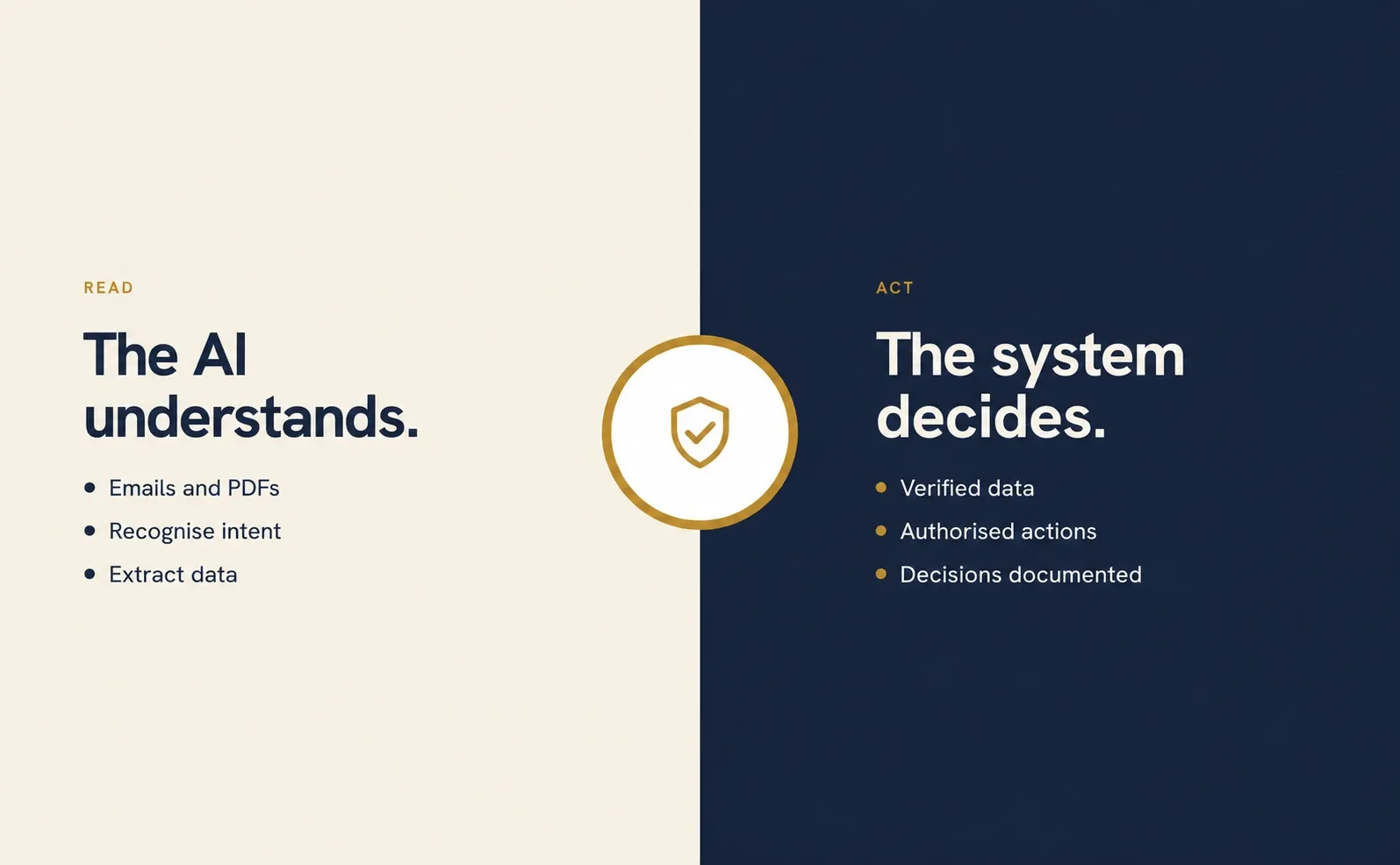 Security
Expert article 5 min
The AI understood the email. The payment still went to fraudsters.
AI agents can take work off a team’s hands. Whether they may act on a request is a separate business decision.
Read Security
4 min
Local Deviation Scanning and Inventory Updates: Closing the Loop on PIRN and BEAM Integration
Today marks a pivotal advance in operational clarity for deviation management: Helpifyr/JaddaHelpifyr now supports local deviation detection, consult, and inventory updates directly within the PIRN layer, tightly integrated with the BEAM contract and inventory model. This closes the feedback loop for field operators and system integrators, ensuring that deviations are recognized, validated, and reflected in the source-of-truth inventory with minimal latency and maximal traceability.
Read Security
3 min
Route-Bound Admission: Locking Down Context Consumer Tokens at the API Edge
Today’s work closes a subtle but critical gap in context consumer admission, binding token issuance and validation directly to the route and server connection. This shift redefines the security perimeter for Fabric’s Warp context API, making lateral privilege escalation and token replay attacks substantially harder. The platform’s ability to guarantee that tokens are valid only for their intended route and consumer is now enforced at the most granular level yet, tightening the loop between admission, identity, and operational context.
Read