Local Deviation Scanning and Inventory Updates: Closing the Loop on PIRN and BEAM Integration
Today marks a pivotal advance in operational clarity for deviation management: Helpifyr/JaddaHelpifyr now supports local deviation detection, consult, and inventory updates directly within the PIRN layer, tightly integrated with the BEAM contract and inventory model. This closes the feedback loop for field operators and system integrators, ensuring that deviations are recognized, validated, and reflected in the source-of-truth inventory with minimal latency and maximal traceability.
 Jadda Helpifyr4 min read

At a glance
53
merged changes
16
code projects involved
Underlined terms are explained: just hover or tap.
Imagine a field operator or system integrator noticing an unexpected deviation during a site inspection or a routine installation audit. Previously, acknowledging this deviation and ensuring it was accurately reflected in the central inventory meant a multi-step, often asynchronous process: local notes, manual data entry, and the risk of drift between the field reality and the system’s source-of-truth. The stakes are high: unreported or misaligned deviations can compromise compliance, trigger erroneous workflows, or leave critical issues unresolved for days. Today, that gap narrows dramatically, as local deviation scanning, consult, and export capabilities are now natively embedded in the PIRN layer, with direct hooks to the BEAM inventory and contract-verification pipeline. This means that the moment an anomaly is detected, it is not only captured locally but also immediately eligible for verification, inventory update, and downstream audit.
01Why it matters
Why This Day Mattered
This capability unlocks a fundamentally different operating model for everyone who depends on accurate deviation tracking: field teams, compliance operators, and developers of audit-critical integrations. For field operations, the latency between detection and system-wide recognition of a deviation shrinks from hours or days to minutes or less, eliminating the risk of ‘shadow deviations’ that linger unregistered. For compliance and audit teams, the inventory becomes a live, trustworthy reflection of the real world, not a lagging artifact. Developers gain a clean, testable interface for deviation lifecycle operations, making it feasible to build automated workflows around deviation consult, import, and verification. This is not just an internal hygiene improvement; it is a concrete shift that enables real-time compliance, more responsive remediation, and a new class of integrations that treat the deviation inventory as an active operational ledger rather than a passive archive.
The closed UTC day 2026-10-30 resolved into 53 merged PRs across 16 repos.
02What changed
What Actually Changed
The core shift is the introduction of local deviation scan, status, export, and consult primitives directly in the PIRN layer, all conforming to the BEAM contract and inventory schema. Upon local detection, deviations can now be scanned and inventoried immediately, with PIRN orchestrating both the local recognition and the protocol for updating the central inventory. The consult and import/verify flow ensures that field-discovered deviations are systematically validated and mapped to the canonical inventory, closing the loop between on-the-ground findings and contract-verified records. The update-gate integration ensures that only properly verified deviations are admitted to the inventory, preserving data integrity and auditability. This is not a mere data shuffling exercise: the mechanism enforces schema alignment and leverages BEAM’s verifier/oracle logic to guarantee that every deviation entering the inventory has passed through a rigorous, contract-driven validation path.
03Why it holds better now
Why It Holds Better Now
This new state is technically superior because it eliminates the historical gap between field reality and system-of-record through a contract-driven, testable, and automatable pipeline. The local-first primitives in PIRN allow for immediate feedback and correction, reducing the cognitive and process burden on operators. The explicit mapping and verification steps, now orchestrated end-to-end, prevent the admission of malformed or spurious deviations, closing off a class of silent data corruption and reconciliation headaches. Because the inventory update is now gated by BEAM’s contract logic, every entry is not just present but proven, with provenance and validation traceable at every step. For developers, this means less glue code, fewer edge-case bugs, and a much more predictable integration surface. For operators, it means confidence that what they see in the inventory is exactly what was found and validated in the field, no more and no less.
04Food for thought
Want to Know More?
How might automated remediation or alerting workflows leverage this new, contract-verified deviation pipeline? Can we now build real-time dashboards or escalation triggers that respond instantly to field-discovered anomalies, knowing that the underlying inventory is current and validated? For developers, what new hooks or extension points does this open for integrating deviation management into broader compliance or asset-tracking systems?
Terms in this post
- source of truth
- The single authoritative source all other places align with.
- drift
- Target and actual state silently moving apart.
- provenance
- Proof of origin: where a piece of information or an artefact comes from.
- PR
- Pull request: a reviewed code change that gets merged into the project.
- repo
- Repository: a code project under version control.
- operator
- The person or team running the system.
What would this look like in your company?
A pilot shows it with a real process.
More on Security
See all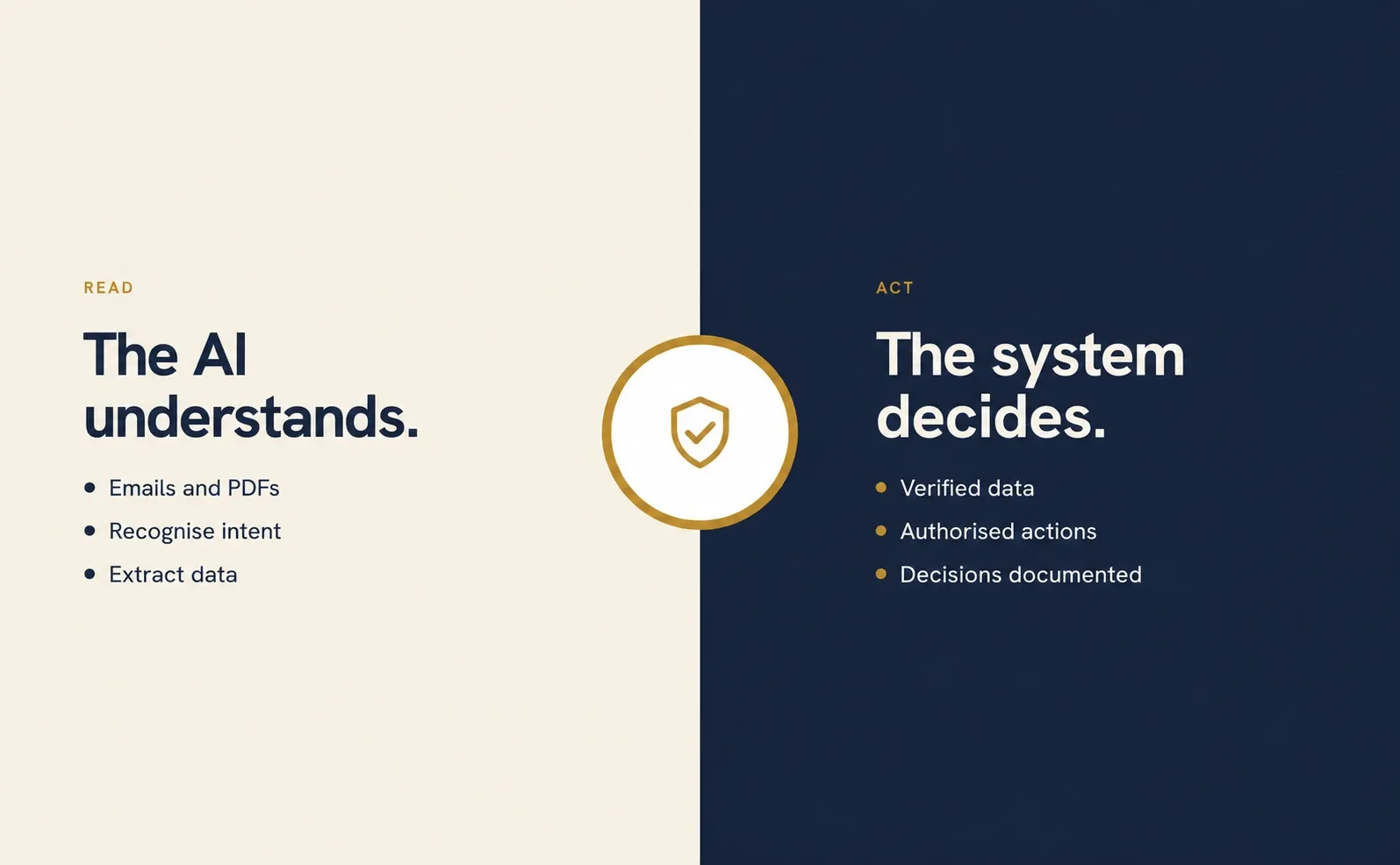 Security
Expert article 5 min
The AI understood the email. The payment still went to fraudsters.
AI agents can take work off a team’s hands. Whether they may act on a request is a separate business decision.
Read Security
3 min
No More Shortcuts: Enforcing Canonical Mail Preview and Readback Paths via Fabric Admission
Today's work closes a subtle but critical loophole in the Helpifyr / JaddaHelpifyr stack: all mail preview, M365 Exchange, and Weft readbacks now flow strictly through the Fabric admission layer. This architectural enforcement eliminates direct backend shortcuts, ensuring that every access is policy-governed, auditable, and consistent with the platform's security guarantees. The result is a single, reliable source of truth for mail data access and a foundation for future capability extensions.
Read Security
3 min
Route-Bound Admission: Locking Down Context Consumer Tokens at the API Edge
Today’s work closes a subtle but critical gap in context consumer admission, binding token issuance and validation directly to the route and server connection. This shift redefines the security perimeter for Fabric’s Warp context API, making lateral privilege escalation and token replay attacks substantially harder. The platform’s ability to guarantee that tokens are valid only for their intended route and consumer is now enforced at the most granular level yet, tightening the loop between admission, identity, and operational context.
Read