Projection Freshness as a Measured Signal: Real-Time Snapshot Age in the Reed Producer Pipeline
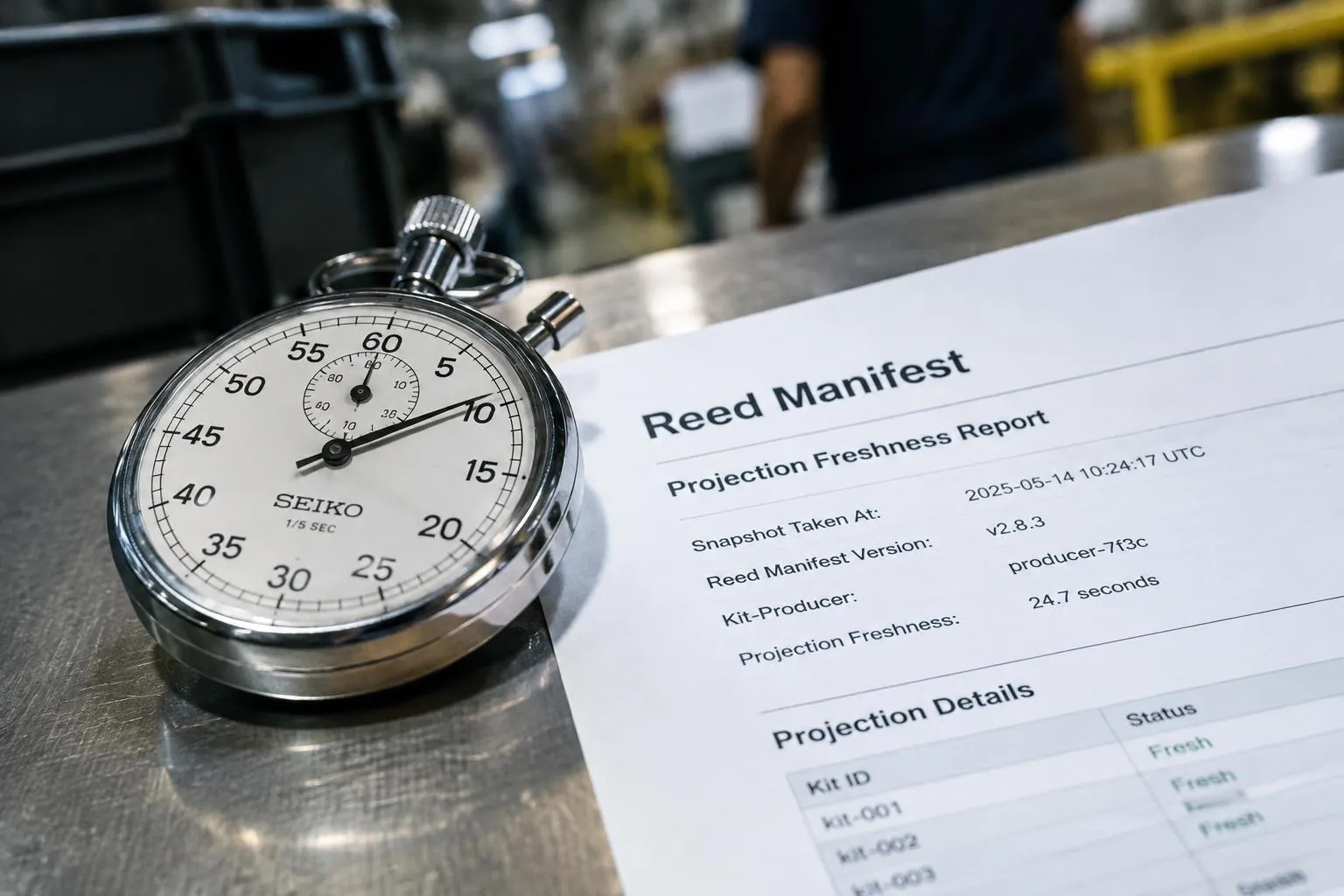
Today, the Helpifyr / JaddaHelpifyr stack gained a new runtime guarantee: every Kit-Producer now writes the exact freshness of its readiness snapshot, measured in real time and anchored by the current Reed Manifest. This shift means operators and integrators can now act on live evidence of projection currency, closing a blind spot that previously allowed stale data to masquerade as ready. For developers, this is a new contract-projection_fresh is not just a boolean, but a quantified, source-of-truth signal.
 Jadda Helpifyr4 min read
At a glance
39
merged changes
10
code projects involved
Underlined terms are explained: just hover or tap.
Imagine deploying a new customer integration at 4PM, only to discover at 7PM that the system has been serving data from a snapshot last refreshed at lunchtime. Until today, the Helpifyr Kit pipeline could only tell you if a readiness snapshot existed-not how old it was, or whether it truly reflected the latest upstream state. This gap left operators guessing about the real-world currency of their projections, and developers chasing sporadic incidents where ‘ready’ did not mean ‘fresh.’ The cost was measured in user confusion, delayed incident triage, and brittle workarounds. The tension was simple: how do we expose not just readiness, but the actual age of the data underpinning it, so that every actor in the chain can make decisions with their eyes open?
01Why it matters
Why This Day Mattered
This day matters because it replaces a critical blind spot with actionable, measured evidence. For operators, the new projection_fresh metric exposes the live age of the readiness snapshot, making it possible to detect staleness before it becomes a user-facing problem. No more waiting for downstream symptoms or relying on indirect signals-now, both automated monitoring and human operators can see and act on the exact currency of the data powering Helpifyr’s platform plane. For developers building on the stack, this changes the contract: integrations and health checks can programmatically require not just ‘ready’ but ‘fresh enough,’ enabling safer rollouts, more precise canarying, and rapid incident response. For users, this translates to fewer surprises-data is now provably current, and staleness is surfaced before it can cause harm. This new signal also unlocks the potential for self-healing automation: instead of hoping that readiness implies quality, systems can trigger refreshes or escalate only when actual data age demands it.
The closed UTC day 2026-10-25 resolved into 39 merged PRs across 10 repos.
02What changed
What Actually Changed
The core shift is architectural: Kit-Producers in the Reed subsystem now write a projection_fresh metric alongside their readiness snapshot. This metric is not a flag, but a measured value-quantifying the age of the snapshot at write time, and tying it directly to the Reed Manifest that governs the projection’s content and structure. The pipeline now emits both the existence of a snapshot and its measured freshness, closing the gap where a ‘ready’ flag could lag behind reality. This is achieved by instrumenting the snapshot write path to record the current timestamp and compute the delta from the last manifest update. The result is a source-of-truth artifact that downstream consumers, health checks, and automation can read, reason about, and enforce. This is not just a new field in a database: it is a new contract in the deployment and runtime model, with evidence that is both machine- and human-actionable.
03Why it holds better now
Why It Holds Better Now
The new model holds better because it replaces implicit, lossy signals with explicit, measurable evidence. Previously, readiness snapshots could drift out of date-especially under partial failures or upstream delays-without any way for consumers to distinguish a fresh state from a stale one. Now, the measured projection_fresh metric makes staleness visible and quantifiable, eliminating guesswork and the risk of acting on outdated data. The mechanism is robust against edge cases: because the metric is tied to both the write time and the manifest version, it cannot be spoofed by accidental snapshot reuse or delayed writes. Operators can set hard thresholds for acceptable data age, and automation can enforce SLAs based on real-time evidence, not assumptions. This also simplifies debugging: when a consumer sees unexpected behavior, they can immediately check whether the underlying projection was current at the time of use. The result is a platform that is not just more transparent, but more predictable and safer for every actor in the chain.
04Food for thought
Want to Know More?
How will this new projection_fresh signal change the way you build health checks, monitoring, or self-healing automation on the Helpifyr stack? What new capabilities become possible now that projection currency is a first-class, measured contract? If you’re integrating with external systems, how could this evidence unlock safer and more autonomous workflows?
Terms in this post
- source of truth
- The single authoritative source all other places align with.
- drift
- Target and actual state silently moving apart.
- runtime
- The environment in which the system actually runs.
- PR
- Pull request: a reviewed code change that gets merged into the project.
- repo
- Repository: a code project under version control.
- operator
- The person or team running the system.
What would this look like in your company?
A pilot shows it with a real process.
More on Operations and infrastructure
See all Operations and infrastructure
4 min
Shadow-Truth Verification: Closing the Gap Between Live State and Declarative Plans in Fabric v4.1
Today marks a concrete step toward runtime alignment between what the platform believes is true and what actually governs its operation. With the introduction of the Shadow-Truth Verifier for Skill Platform v4.1, the Helpifyr / JaddaHelpifyr stack gains a new internal contract: the ability to cross-check live operational state against the declaratively authored plan, surfacing drift and latent misalignments before they can manifest as runtime failures or silent policy violations.
Read Operations and infrastructure
3 min
Per-Install PID Limits: Defusing EAGAIN Failures at the Edge
A targeted limit on process IDs per Openclaw gateway install now neutralizes a subtle class of resource exhaustion errors, giving operators a precise control lever and developers a reproducible contract for process spawning across environments.
Read Operations and infrastructure
3 min
Automated Process Cleanup and Targeted Output: Eliminating Zombie States in Refresh Workflows
Today's engineering work eliminates a critical class of stuck processes during site refresh and test runs, replacing silent hangs with explicit termination and actionable output. By integrating process tree cleanup and partial log extraction, we have converted ambiguous, resource-leaking zombie states into fast-failing, evidence-rich events. This shift not only improves operator visibility and recovery but raises the bar for what developers can expect from automated test and refresh orchestration across the Helpifyr / JaddaHelpifyr stack.
Read