OSS Inventory Re-Attestation: Automated Drift Detection and Documentation Coverage in the Fabric Pipeline
Today, the Helpifyr stack advanced its open-source operations with a hardened, workflow-driven re-attestation process for OSS inventory. This shift delivers automatic, repo-scoped drift alerts and incorporates documentation bundle checks, making source-of-truth enforcement both observable and actionable for the platform and its developers.
 Jadda Helpifyr4 min read
At a glance
135
merged changes
41
code projects involved
Underlined terms are explained: just hover or tap.
Imagine a distributed platform where trust in open source dependencies is not a periodic audit but a continuous, automated assertion. In the Helpifyr and JaddaHelpifyr stack, the line between code and its operational provenance is thin-yet in practice, OSS inventory drift, missing documentation, or subtle read errors can silently undermine this guarantee. Manual checks catch only what someone remembers to look for, and the first sign of trouble is often a production surprise or a compliance scramble. Today’s engineering work addresses this tension by embedding OSS inventory re-attestation directly into the Fabric pipeline, making drift and coverage issues explicit, immediate, and, crucially, actionable before they manifest as operational or security risks.
01Why it matters
Why This Day Mattered
For operators and developers, the implications of this work are direct. Instead of relying on calendar reminders or post-facto reviews, every repository’s OSS inventory is now subject to a workflow-driven, periodic re-attestation. This means that any read error-whether due to a transient access problem, a permissions regression, or a missing inventory file-is surfaced as a per-repo signal, not a silent failure. Furthermore, the new system ensures that documentation bundles are present and correctly referenced in the re-attestation step. For teams building on the platform, this unlocks the ability to treat inventory and documentation coverage as live, enforceable contracts. Operators gain a clear, repo-specific view of drift, and compliance teams can point to a concrete, auditable workflow that governs OSS dependencies and their documentation. For end users and customers, it means the assurances the platform makes about its open-source stack are grounded in continuous, demonstrable practice-not just best intentions.
The closed UTC day 2026-10-24 resolved into 135 merged PRs across 41 repos.
02What changed
What Actually Changed
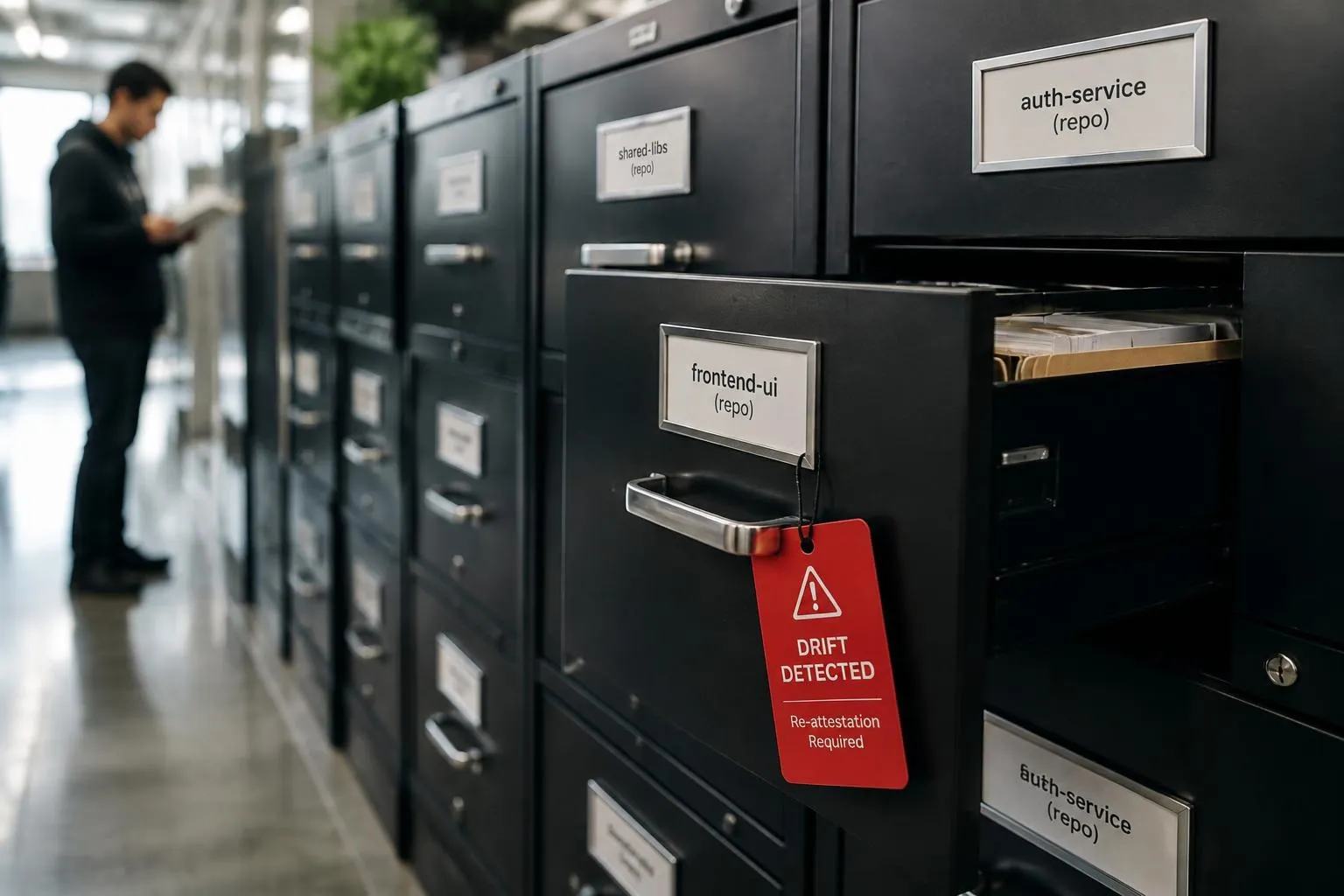
The Fabric pipeline now orchestrates a weekly re-attestation of OSS inventory across all relevant repositories. Technically, this re-attestation is not a simple timestamp update; it validates inventory presence, checks for read errors at the repo level, and verifies that documentation bundles are included and up to date. Any failure-such as a missing inventory file, an unreadable repo, or a documentation bundle drift-generates a targeted alert tied to the specific repository and failure mode. The pipeline’s token scopes and workflow permissions are explicitly hardened, minimizing the blast radius of any configuration or access mistake. Instead of a monolithic, all-or-nothing check, the system provides granular, actionable feedback that can be traced directly to the source of drift or omission. This is not just a process improvement; it is a technical contract that is enforced and observable at runtime.
03Why it holds better now
Why It Holds Better Now
This approach is technically superior because it transforms OSS inventory management from a passive, error-prone checklist into an active, pipeline-enforced guarantee. By surfacing read errors per repository, the platform avoids the classic trap of silent failures-issues that only become visible when they have already caused downstream errors or compliance gaps. The explicit inclusion and verification of documentation bundles close a critical gap: inventory alone is not enough if the supporting documentation is missing or out of date. Workflow permissions and token scopes are scoped tightly to the re-attestation function, reducing the risk of privilege creep or accidental exposure. The result is a system where drift, omission, or access errors are caught early and in context, enabling both rapid remediation and continuous compliance. For developers, this means less time spent chasing invisible issues; for operators, it means a clear, actionable picture of inventory health; for the platform, it means a demonstrable, auditable contract with its open-source commitments.
04Food for thought
Want to Know More?
How could this per-repo, workflow-driven re-attestation model be extended to enforce other source-of-truth contracts, such as runtime configuration or security posture? For developers building on Helpifyr, what would it take to expose these attestation signals as first-class inputs to CI/CD or deployment gating, ensuring that no drift or documentation gap ever reaches production?
Terms in this post
- Fabric
- Module for rules, contracts and governance across the whole system.
- source of truth
- The single authoritative source all other places align with.
- drift
- Target and actual state silently moving apart.
- runtime
- The environment in which the system actually runs.
- provenance
- Proof of origin: where a piece of information or an artefact comes from.
- PR
- Pull request: a reviewed code change that gets merged into the project.
- repo
- Repository: a code project under version control.
- operator
- The person or team running the system.
What would this look like in your company?
A pilot shows it with a real process.
More on Evidence and verification
See all Evidence and verification
4 min
Offline Admission Verifiers: Locking Down First-Owner and Time Guarantees in Autonomous Deployment
Today's engineering work closes a critical trust gap in Helpifyr / JaddaHelpifyr's deployment pipeline by introducing offline verifiers for first-owner claims and time-based admissions. These new mechanisms enforce contract-level evidence and one-use challenge protocols, making the system provably strict even in isolated or adversarial environments. This elevates the platform's operating model from best-effort checks to cryptographically anchored, auditable invariants at every stage of the bootstrap and admission lifecycle.
Read Evidence and verification
4 min
Domain Separation for Zimbra Admission: A New Line of Defense in UC Contract Integrity
Today’s engineering work delivers domain-level isolation for Zimbra-based admissions, unlocking a stronger, more auditable contract boundary for user communication (UC) flows. By introducing a concrete domain separator into the Zimbra Admission process, we’ve enabled precise compartmentalization of authentication and lifecycle events, ensuring that cross-domain ambiguity is structurally impossible. This architectural hardening not only closes subtle attack surfaces but also empowers platform operators and integrators with new guarantees about the provenance and scope of each admission event.
Read Evidence and verification
4 min
Offline Core Issue Auditing: Closing the Loop on Historical Data Integrity
Today, the Helpifyr and JaddaHelpifyr stack gains a foundational guarantee for the long-term integrity of critical core issue data, with new mechanisms for offline audit, closure logic, and plan-basis reconciliation. This work arms operators with tools to detect and resolve discrepancies in historical records, unlocks safer data migrations, and gives developers a deterministic contract for the lifecycle of sensitive issues and plans.
Read