Parametric Hostnames and Rollback-Ready Deploys: Building Customer-Scoped Isolation in Helpifyr/JaddaHelpifyr
Today's engineering work delivers a step-function improvement for customer isolation and operational control by introducing fully parameterized hostnames, public URLs, and rollback-ready deployment images across the Helpifyr/JaddaHelpifyr stack. This technical shift unlocks safe, repeatable, and customer-specific deployments, allowing operators to deliver tailored environments without image tag collisions or hardcoded host values. The result is a deployment model where isolation is guaranteed by contract, not just configuration hygiene.
 Jadda Helpifyr4 min read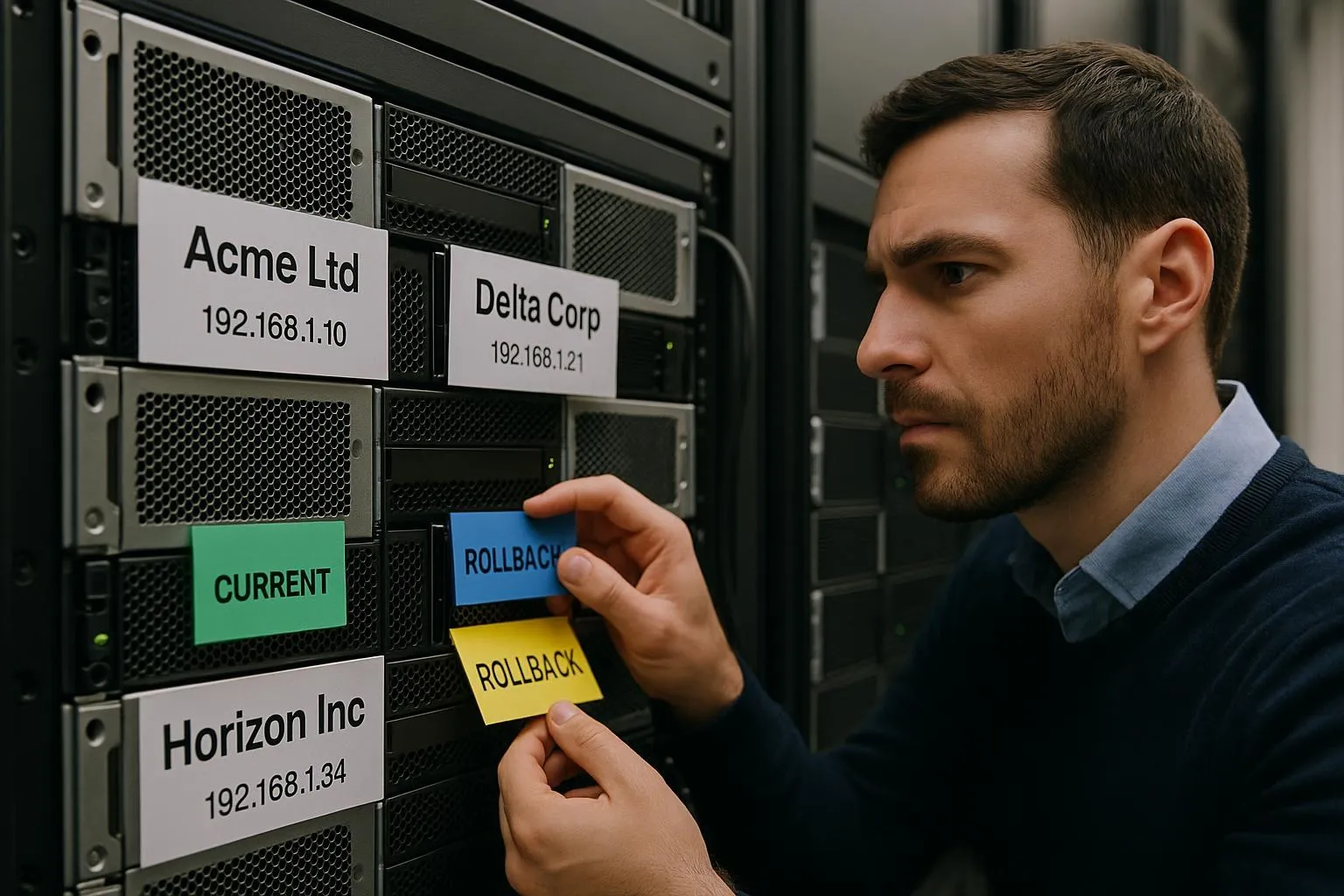
At a glance
138
merged changes
23
code projects involved
Underlined terms are explained: just hover or tap.
Imagine deploying a critical update to a customer environment, only to realize that hostname literals and container image tags are hardcoded, reused, or colliding across tenants. The rollback path is unclear, and the blast radius of a misconfigured deploy spans multiple customers. This is not a theoretical risk: as the stack grew, the need for genuine customer isolation and safe, auditable rollback became an operational bottleneck. Today, that bottleneck breaks. The engineering work completed introduces parameterized hostnames and public URLs, per-customer rollback image retention, and contract-driven environment variable rendering-concretely closing the gap between multi-tenant theory and real-world, per-customer operational safety.
01Why it matters
Why This Day Mattered
For operators and platform integrators, the days of manually patching hostnames, URLs, and image tags for each customer deployment are over. The stack now guarantees that a deployment for customer A cannot pollute, overwrite, or unintentionally couple to customer B’s environment, even in the face of rapid rollouts or emergency rollbacks. This enables safer blue/green deploys, faster incident recovery, and true tenant isolation-not just in application logic, but in every deployment artifact and network surface. Developers building on the stack can now depend on deterministic, per-customer hostnames and URLs being rendered into every relevant service, meaning environment-specific bugs, cache collisions, and cross-tenant leakage are structurally eliminated. For end users, this means their environments are not just logically but operationally isolated: their data, authentication flows, and service URLs are never at risk of accidental overlap or exposure due to deployment missteps.
The closed UTC day 2026-09-22 resolved into 138 merged PRs across 23 repos.
02What changed
What Actually Changed
The deployment system, spanning jhf-deployment, jhf-lantern, jhf-warp, jhf-keystore, and helpifyr-fabric, now consumes explicit parameters for hostnames, public URLs, and domain literals. These are threaded through environment files, service manifests, and deployment scripts, ensuring that every stack instance-whether for a pilot, a production customer, or an internal test-receives a unique, contractually-scoped set of network endpoints and identity values. In parallel, the container build and deploy process now retains a single rollback image tag per service, making rollback a first-class, auditable operation. No more guessing which tag was last deployed or risking image drift: the system ensures that rollback is both possible and safe, with explicit retention and rotation logic. Environment variable rendering is now contract-driven, with customer-specific host_env values injected directly from the customer profile, closing the loop between customer intent and deployment reality.
03Why it holds better now
Why It Holds Better Now
The system is now resistant to the two most common classes of multi-tenant operational failure: accidental cross-customer leakage and unsafe rollback. Parameterized hostnames and URLs mean that there is no longer any risk of hardcoded values being reused across tenants-a guarantee enforced by deployment contracts, not operator discipline. This eliminates subtle bugs (such as authentication callback collisions, cache key overlaps, or log aggregation mixups) that previously required manual review or postmortem-driven fixes. Rollback is now explicit and bounded: by retaining exactly one rollback image tag per service, operators can revert to the last-known-good state with confidence, without image tag confusion or the risk of reverting to an unintended version. The deployment contract ensures that every service receives the exact set of environment variables, hostnames, and URLs intended for its customer context, closing the gap between what is deployed and what is actually running. This is not just a configuration improvement-it is a structural guarantee that every customer environment is isolated by design, and that operational safety is built into the deployment lifecycle.
04Food for thought
Want to Know More?
With parameterized hostnames and rollback retention now in place, what further automation can be layered on top? Can zero-downtime blue/green deploys be generalized across all stack services, or can per-customer canary rollouts become the default? For developers, how might these contracts be surfaced as type-safe interfaces or validated in CI to prevent misconfiguration before a deployment even begins? And for operators, what new monitoring or audit tooling becomes possible when every environment variable, hostname, and image tag is now contractually scoped and versioned?
Terms in this post
- rollback
- Returning to the last working state.
- drift
- Target and actual state silently moving apart.
- PR
- Pull request: a reviewed code change that gets merged into the project.
- repo
- Repository: a code project under version control.
- operator
- The person or team running the system.
What would this look like in your company?
A pilot shows it with a real process.
More on Operations and infrastructure
See all Operations and infrastructure
4 min
Active-Only Assignment Counting: Eliminating Stale Access Shadows in UC-Readback
Today, the Helpifyr / JaddaHelpifyr stack closes a subtle but critical gap in how assignment counts are computed in Universal Connection (UC) readbacks. By shifting to active-only assignment evaluation, the platform now guarantees that access and entitlement signals reflect the real, live state of user permissions, not a ghosted sum of historical grants. This change tightens downstream contract enforcement and unlocks safer automation for both operators and integrators.
Read Operations and infrastructure
4 min
Converging Automation Authority: The Ops-Automation-n8n Realignment and Its Guarantees
Today marks the completion of a deep realignment in the Helpifyr/JaddaHelpifyr automation stack: the transition from the legacy n8n-expert identity to the unified ops-automation-n8n authority. This is not a simple rename, but the culmination of a multi-week migration that rewires provenance, ownership, and runtime contracts for all automation flows. The result is a single, auditable source of truth for automation provenance and deployment, eliminating legacy ambiguity and unlocking new guarantees for operators and integrators.
Read Operations and infrastructure
4 min
Offline Recovery, Forward Migration, and Airgap: Unlocking Evidence Continuity for Helpifyr/JaddaHelpifyr Operators
Today's engineering work advances the Helpifyr/JaddaHelpifyr stack's ability to project, recover, and forward-migrate evidence and contract states in environments with partial or fully offline operation. By landing new checkpoint, bundle, and migration projections in jhf-beam-pirn and binding these to updated provenance and readiness gates in helpifyr-fabric, the stack now supports seamless airgap recovery, deterministic evidence handoff, and forward-safe artifact continuity.
Read