Source-of-Truth Realignment: Hardening Mail and SSO Guarantees Across the Helpifyr Stack
Today's work stitched together the last mile for canonical mail ingress and SSO lifecycle contracts, closing the loop between runtime, control-plane, and documentation. This realignment enforces single-source runtime truth for Nextcloud mail surfaces and OIDC, eliminating callback drift and ambiguous ingress, and making operational state observable, enforceable, and safe for both operators and downstream developers.
 Jadda Helpifyr2 min de lectureAnglais
En un coup d’œil
17
modifications intégrées
4
projets de code concernés
Le plus de modifications dans
- jhf-weft9
- helpifyr-fabric4
- jhf-openclaw-env3
Cet article est en anglais. Les termes soulignés sont expliqués : survolez-les ou touchez-les.
Picture an operator rolling out a new mail gateway on Host172, only to find that SSO callbacks are split between hosts, runtime reports are ambiguous, and the docs disagree on the canonical endpoint. Every ambiguity here is a latent outage or a support fire waiting to happen: failed user logins, lost mail, or CI incidents that spiral into production. Until today, the stack’s source-of-truth for mail ingress and SSO lifecycle was fragmented, with runtime, control-plane, and documentation drifting out of sync. That tension is now resolved.
01Pourquoi c’est important
Why This Day Mattered
By converging the runtime, documentation, and control-plane contracts for mail.helpifyr.lan and SSO, we’ve eliminated a class of ambiguous states that previously forced operators to debug by guesswork and left developers uncertain about the true ingress and callback posture. Now, both production and CI environments can rely on a single, enforced source of truth for mail and SSO endpoints, reducing incident response times and unlocking safer automation for new host rollouts and OIDC integrations.
The closed UTC day 2026-07-04 resolved into 17 merged PRs across 4 repos, led by jhf-weft (9), helpifyr-fabric (4), jhf-openclaw-env (3).
02Ce qui a changé
What Actually Changed
The canonical mail.helpifyr.lan runtime was materialized and enforced on Host172, with ingress posture explicitly admitted and observable in both the runtime and the weft plan. OIDC callback drift between dual hosts was narrowed, so that SSO handshakes now resolve to a single, predictable endpoint. The documentation and operational plans were hardened to reflect these runtime realities, removing stale references and syncing lifecycle semantics across the stack. The test inventory and followthrough truth in Helpifyr Fabric were refreshed and advanced, ensuring that test and production environments now follow the same contract for mail and SSO surfaces.
03Pourquoi c’est plus solide
Why It Holds Better Now
The platform now enforces a runtime-backed, host-preserving contract for mail and SSO, eliminating the risk of callback ambiguity and ingress drift. Operators can be confident that the endpoint documented is the one actually running, and CI tasks can classify terminal states with clarity. This reduces the operational surface for error, makes incident response actionable, and enables downstream systems to automate against a single, reliable contract. The stack’s source of truth is no longer a moving target but a hardened, observable reality.
04Pour aller plus loin
Want to Know More?
How might this unified source-of-truth model for mail and SSO ingress extend to other multi-host or federated surfaces across the platform, and what new automation or self-healing capabilities does it unlock for operators and app builders?
Termes de cet article
- Fabric
- Module des règles, contrats et de la gouvernance pour tout le système.
- source of truth
- La source de référence unique sur laquelle tout le reste s’aligne.
- drift
- Écart silencieux entre l’état visé et l’état réel.
- runtime
- L’environnement dans lequel le système s’exécute réellement.
- PR
- Pull request : une modification de code relue puis intégrée au projet.
- repo
- Dépôt : un projet de code sous gestion de versions.
- SSO
- Authentification unique : une seule connexion pour toutes les applications.
- operator
- La personne ou l’équipe qui exploite le système.
À quoi cela ressemblerait-il dans votre entreprise ?
Un pilote le montre sur un processus réel.
Plus sur Exploitation et infrastructure
Tout voir Exploitation et infrastructure
4 min
Comptage des attributions actives uniquement : éliminer les ombres d’accès obsolètes dans UC-Readback
Aujourd’hui, la pile Helpifyr / JaddaHelpifyr comble une faille subtile mais essentielle dans le calcul des attributions au sein du readback Universal Connection (UC). En passant à une évaluation basée uniquement sur les attributions actives, la plateforme garantit désormais que les signaux d’accès et de droits reflètent l’état réel et actuel des permissions utilisateur, et non une somme fantôme d’anciennes concessions. Ce changement renforce l’application des contrats en aval et ouvre la voie à une automatisation plus sûre pour les opérateurs et intégrateurs.
Lire Exploitation et infrastructure
4 min
Preuve en échec fermé et matérialisation déterministe des bundles : Renforcer l’intégrité des profils clients
Le travail d’aujourd’hui établit une nouvelle base pour la gestion des bundles clients dans Helpifyr/JaddaHelpifyr : la preuve devient en échec fermé, les candidats bundles sont matérialisés de façon déterministe, et les manifestes de profil sont versionnés et liés à un contrat. Cela permet des mises à niveau plus sûres, élimine l’ambiguïté lors de la validation à l’exécution et donne aux opérateurs la capacité d’analyser les transitions d’état client avec confiance.
Lire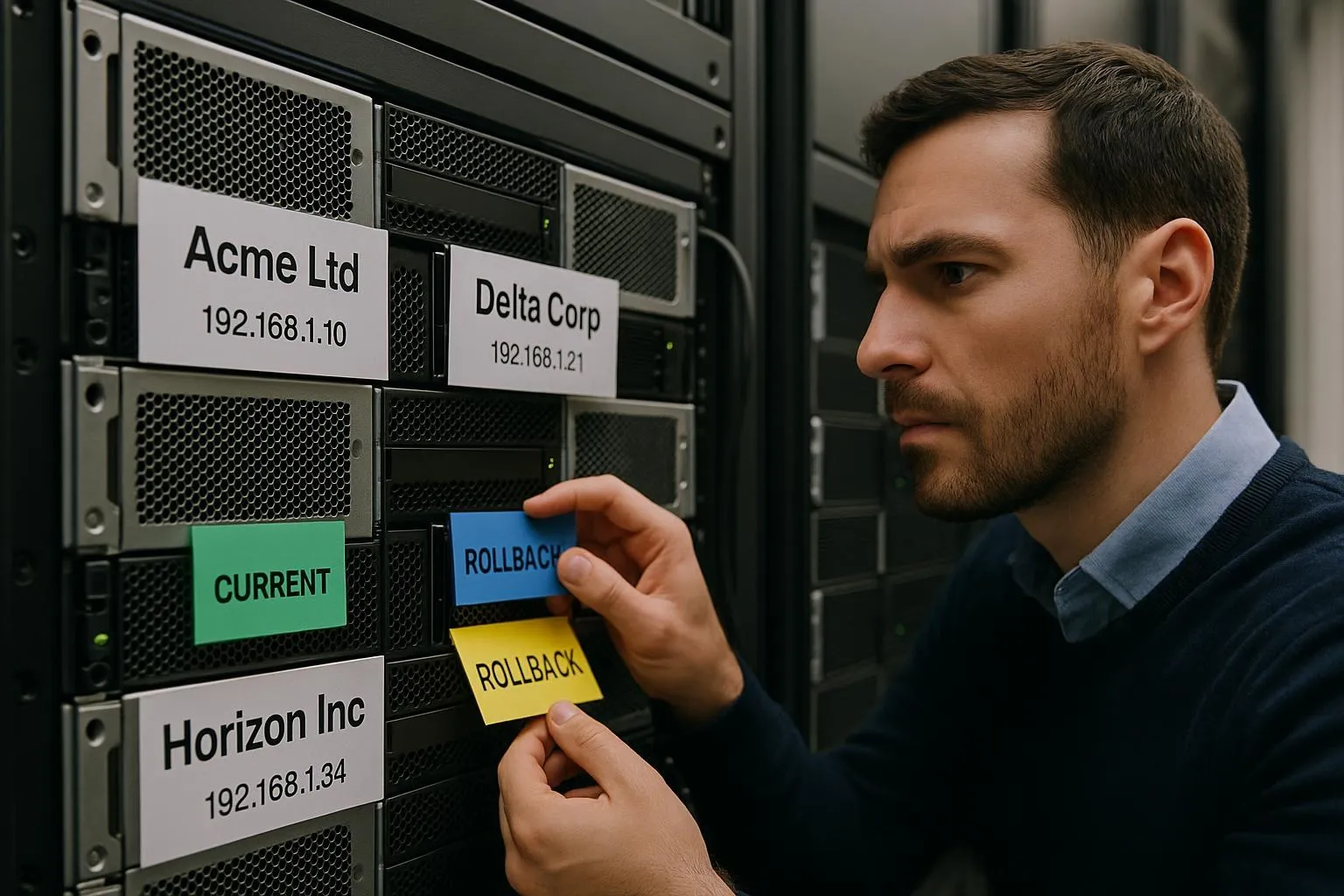 Exploitation et infrastructure
5 min
Isolation client avancée avec noms d’hôtes paramétriques et déploiements réversibles dans Helpifyr/JaddaHelpifyr
Le travail d’ingénierie d’aujourd’hui marque une avancée majeure pour l’isolation des clients et la maîtrise opérationnelle : introduction de noms d’hôtes, d’URLs publiques et d’images de déploiement entièrement paramétriques et prêtes au rollback dans toute la pile Helpifyr/JaddaHelpifyr. Ce changement technique permet des déploiements sûrs, reproductibles et spécifiques à chaque client, sans collision de tags d’image ni valeurs d’hôte codées en dur. Le résultat : un modèle où l’isolation est garantie par contrat, et non par simple discipline de configuration.
Lire