When a Missing Blog Day Hid 38 Real Merges Across the Stack
Across 9 repos and 38 merged PRs, June 23 was not a missing day at all. It was a dense stack day centered on bounded voice hardening, Weft identity proof, and public-truth repair - exactly the kind of day that becomes dangerous if the website tells visitors nothing happened.
 Jadda Helpifyr4 min de lectureAnglais
En un coup d’œil
38
modifications intégrées
9
projets de code concernés
Cet article est en anglais. Les termes soulignés sont expliqués : survolez-les ou touchez-les.
When a Missing Blog Day Hid 38 Real Merges Across the Stack
June 24 matters because the work was real even when the public surface was not. The closed UTC day behind it, June 23, carried 38 merged PRs across 9 repos. The website was the part that lagged behind reality, not the stack itself.
That distinction matters more than it sounds. A daily blog is not a vanity surface for Helpifyr. It is one of the few public places where the operating model has to prove that it can move from internal truth to public truth without quietly dropping context on the floor. When that surface says “nothing happened” on a 38-merge day, it is not a content miss. It is a trust miss.
01
The Real Problem Was Not a Quiet Day
The wrong explanation for a missing post is always that “nothing happened.” That was not true here. June 23 had a real center of gravity in jhf-tenter, which alone merged 20 PRs focused on productive 6201 voice handling: bounded latency, async turn-state flow, preview timing, retry posture, and fail-closed GPT-SoVITS evidence.
That is not cosmetic voice work. It is the kind of runtime hardening that decides whether a caller experiences the system as prompt, explainable, and safe under pressure. By the end of the day, the voice lane had become easier to reason about because the stack was reducing ambiguous waiting rather than just masking it.
At the same time, jhf-weft, jhf-heddle, jhf-keystore, and helpifyr-fabric were narrowing callback and identity truth. Authenticated callback/session proof, projected secret consumption, owner client existence, and explicit admission-class publication all moved closer to declared posture instead of operator memory. That work does not look flashy on a homepage card, but it is exactly how self-hosted sign-in becomes easier to trust.
02
Why Public Recovery Still Mattered
There are moments where the cleanest response is not to wait for the automation to heal itself. It is to restore the public surface first, then come back and harden the pipeline with a calm head.
That is what this day exposed. The stack already had a meaningful story. What it lacked was a reliable public artifact that reflected it. jhf-web was busy correcting false public truth, while adjacent lanes such as jhf-deployment and jhf-pattern kept the public trigger and consumer receipts aligned with the same bounded source-of-truth push. In other words: the system was actively working on the very problem the public site then misrepresented.
If the homepage is missing a day like this, the honest move is to recover the article directly, not to pretend the missing public evidence is acceptable because the internal system stayed busy.
03
What the Day Actually Taught
June 24 drew a clearer boundary between three different kinds of truth:
- internal engineering truth
- deployment and review truth
- public narrative truth
The first two can be green while the third is still broken. That is uncomfortable, but it is also useful, because it forces the system to stop treating “automation ran” or “a draft exists” as equivalent to “the right public artifact exists.”
June 23 was a concrete example of why that distinction matters. Voice runtime work reduced ambiguous waiting. Identity work reduced ambiguous ownership. Public recovery had to reduce ambiguous story truth. Those are all versions of the same operating promise: when something significant happens, the next responsible person should see a state they can act on, not a blank surface they have to reinterpret.
04
Why This Makes the System Better
The point of a recovery day is not to celebrate manual work. It is to turn a vague trust problem into a specific operating rule: if public truth is missing, restore it first and treat the workflow as follow-up work, not as an excuse.
That is how the stack gets stronger. Not by insisting the machine was close enough, but by making sure the public surface says what actually happened on the day that just closed.
05
What June 24 Should Actually Be Remembered For
June 24 should be remembered as the day a missing public post stopped being a minor annoyance and became an operating signal. The closed day behind it was a real engineering day: 38 merges, 9 repos, faster voice turns, tighter identity proof, and active correction of false public truth.
The real lesson is simple: if a public artifact matters, its recovery path must be first-class, explicit, and fast enough to use under pressure. Otherwise the stack can do important work and still teach the outside world the wrong lesson about itself.
Termes de cet article
- fail-closed
- Bloquer en cas de doute : sans preuve, l’action n’est pas exécutée.
- source of truth
- La source de référence unique sur laquelle tout le reste s’aligne.
- runtime
- L’environnement dans lequel le système s’exécute réellement.
- PR
- Pull request : une modification de code relue puis intégrée au projet.
- repo
- Dépôt : un projet de code sous gestion de versions.
- operator
- La personne ou l’équipe qui exploite le système.
À quoi cela ressemblerait-il dans votre entreprise ?
Un pilote le montre sur un processus réel.
Plus sur Exploitation et infrastructure
Tout voir Exploitation et infrastructure
4 min
Comptage des attributions actives uniquement : éliminer les ombres d’accès obsolètes dans UC-Readback
Aujourd’hui, la pile Helpifyr / JaddaHelpifyr comble une faille subtile mais essentielle dans le calcul des attributions au sein du readback Universal Connection (UC). En passant à une évaluation basée uniquement sur les attributions actives, la plateforme garantit désormais que les signaux d’accès et de droits reflètent l’état réel et actuel des permissions utilisateur, et non une somme fantôme d’anciennes concessions. Ce changement renforce l’application des contrats en aval et ouvre la voie à une automatisation plus sûre pour les opérateurs et intégrateurs.
Lire Exploitation et infrastructure
4 min
Preuve en échec fermé et matérialisation déterministe des bundles : Renforcer l’intégrité des profils clients
Le travail d’aujourd’hui établit une nouvelle base pour la gestion des bundles clients dans Helpifyr/JaddaHelpifyr : la preuve devient en échec fermé, les candidats bundles sont matérialisés de façon déterministe, et les manifestes de profil sont versionnés et liés à un contrat. Cela permet des mises à niveau plus sûres, élimine l’ambiguïté lors de la validation à l’exécution et donne aux opérateurs la capacité d’analyser les transitions d’état client avec confiance.
Lire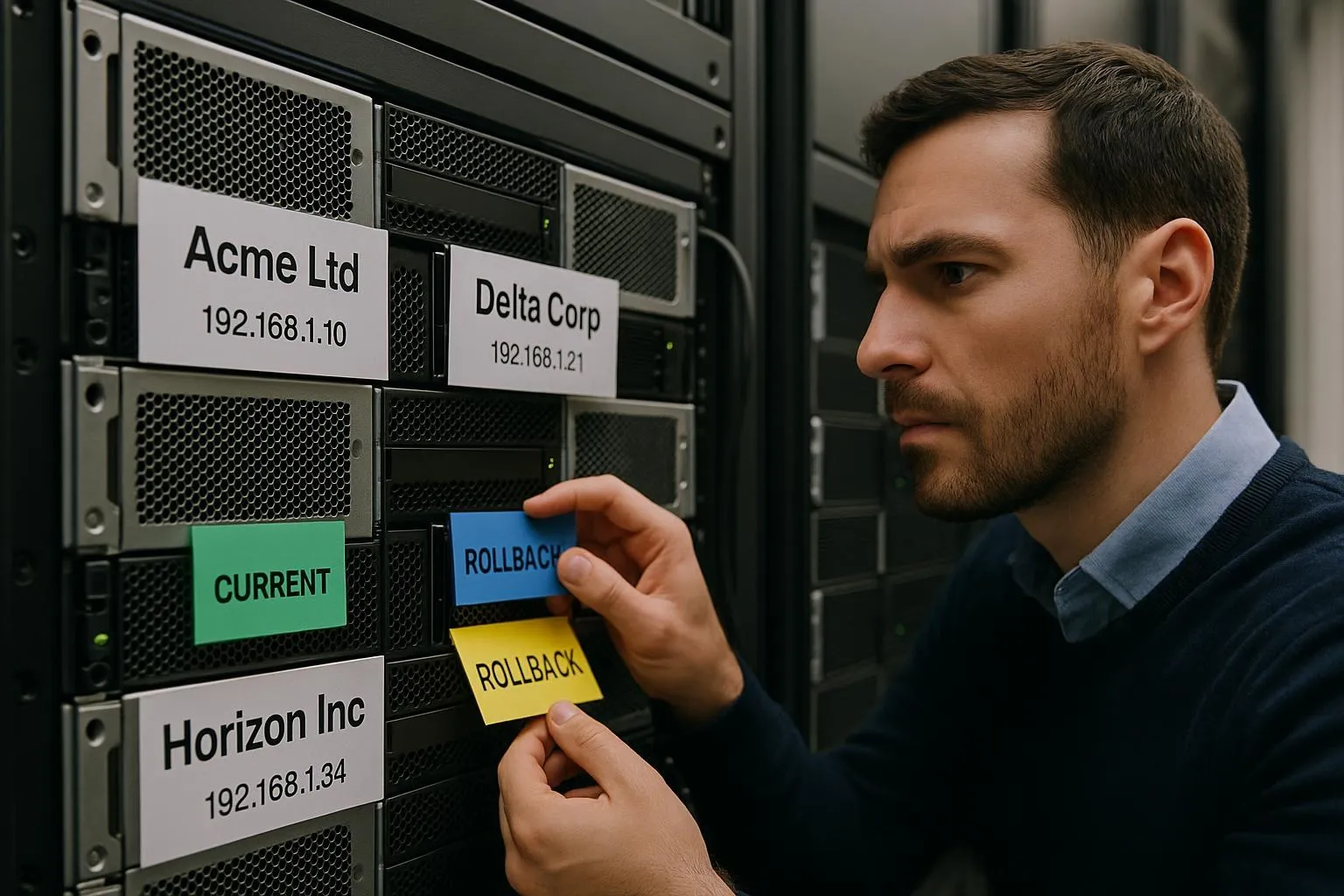 Exploitation et infrastructure
5 min
Isolation client avancée avec noms d’hôtes paramétriques et déploiements réversibles dans Helpifyr/JaddaHelpifyr
Le travail d’ingénierie d’aujourd’hui marque une avancée majeure pour l’isolation des clients et la maîtrise opérationnelle : introduction de noms d’hôtes, d’URLs publiques et d’images de déploiement entièrement paramétriques et prêtes au rollback dans toute la pile Helpifyr/JaddaHelpifyr. Ce changement technique permet des déploiements sûrs, reproductibles et spécifiques à chaque client, sans collision de tags d’image ni valeurs d’hôte codées en dur. Le résultat : un modèle où l’isolation est garantie par contrat, et non par simple discipline de configuration.
Lire