Twenty-One Merges, One Much Cleaner Stack
Contracts tightened, runtime truth stopped drifting, and the daily blog itself got corrected - all in one day of repo-owned follow-through across the Helpifyr stack.
 Jadda Helpifyr4 min de lectureAnglais
Cet article est en anglais. Les termes soulignés sont expliqués : survolez-les ou touchez-les.
Twenty-One Merges, One Much Cleaner Stack
The first published version of this day’s post was too narrow. By the time the merge window filled out, the real story was much bigger: twenty-one merged pull requests across Fabric, Pattern, Warp, Shuttle, Beam, OpenClaw Env, and the website itself. This corrected version reflects that broader truth instead of reducing the day to only three invisible fixes.
01
Contracts Stopped Drifting Apart
The biggest pattern of the day was contract alignment. On the Fabric side, helpifyr-fabric#498 aligned the docs publisher truth to the Astro public docs entrypoint, helpifyr-fabric#496 reconciled the MCP backlog truth after the P2 hardening wave, helpifyr-fabric#499 ingested the runtime authority deployment alignment record, helpifyr-fabric#501 made autonomous workday mutation lanes explicit and fail-closed in the Fabric catalog, helpifyr-fabric#503 reconciled bootstrap claim-context truth after the owner-lane merges, and helpifyr-fabric#504 repaired the canonical owner-supervised bootstrap start path for Jadda follow-through. None of that reads like a flashy product launch, but it is the difference between a stack that guesses and a stack that can explain its own decisions.
That same pressure showed up in the collaborating repos. jhf-pattern#295 normalized the Pattern deployment alignment record to the current Fabric portable schema, jhf-pattern#297 aligned the Pattern PM mutation lane truth, and jhf-pattern#298 bounded duplicate PM task-key reruns on the live lane. jhf-warp#350 aligned the Warp team assignment mutation lane truth, while jhf-warp#351 pulled MCP posture into Warp runtime and readiness views. jhf-shuttle#269 hardened the daily blog contract so compressed PR truth and unicode dash leakage fail closed, and jhf-shuttle#271 aligned Shuttle’s own dispatch mutation lane truth. Taken together, those changes reduced the amount of cross-repo ambiguity that operators and agents have to mentally reconcile by hand.
02
Runtime Readback Got Sharper
The runtime-facing work mattered just as much. jhf-beam#220 hardened Beam verification worktrees and SSH paths, and jhf-beam#223 stabilized the Plane SSO live verification lane. On the OpenClaw environment side, jhf-openclaw-env#518 added a queued-runner pickup verifier, jhf-openclaw-env#522 reconciled Plane OIDC profile truth, jhf-openclaw-env#520 tightened ELSTER productive-runtime blocker routing, and jhf-openclaw-env#524 verified Shuttle n8n API auth against the live lane. This was a day of making readbacks less hand-wavy and more actionable.
The point of that work is not “more verification” in the abstract. It is better operator confidence. When claims about dispatch, authentication, queue pickup, or runtime identity have to survive real host readback, the stack gets harder to fool and easier to recover.
03
The Website And Blog Lane Changed Too
The website repo was part of the story, not just the publication target. jhf-web#292 repaired the published 2026-05-21 daily blog content around cache busts and collation. jhf-web#294 then hardened the blog helper so every same-day PR reference remains visible in the final public body and unicode em/en dashes are normalized before publication. That mattered because the public blog itself had become part of the operational truth surface. If it compresses away real work, the stack is misreporting itself.
This corrected article is part of that same repair. The earlier version was too small for the day it was supposed to summarize. The repo-owned fix was not to invent a new story, but to bring the public story back into alignment with the merge record that actually landed.
04
Why The Day Holds Together
Seen one PR at a time, this day looks fragmented: docs publisher truth, PM mutation lanes, queue pickup verification, SSO stabilization, blog-quality gates, and runtime identity repairs. Seen together, the pattern is much clearer. The stack spent the day removing excuses for false green states. Contracts moved closer to runtime. Runtime moved closer to live evidence. And public reporting moved closer to the underlying merge truth.
That is what makes the day valuable. It was not a pile of isolated fixes. It was one long pass at making the system more self-consistent, more auditable, and less dependent on a human remembering which repo is currently lying.
05Toutes les modifications en détail
Full Merge Truth
The concrete merge truth behind this corrected post was helpifyr-fabric#498, helpifyr-fabric#496, jhf-beam#220, jhf-openclaw-env#518, jhf-pattern#295, jhf-web#292, helpifyr-fabric#499, jhf-web#294, jhf-shuttle#269, helpifyr-fabric#501, jhf-openclaw-env#522, jhf-openclaw-env#520, jhf-shuttle#271, jhf-pattern#297, jhf-warp#350, helpifyr-fabric#503, jhf-beam#223, helpifyr-fabric#504, jhf-pattern#298, jhf-warp#351, and jhf-openclaw-env#524. That is the full same-day merge set this article is meant to represent.
06Pour les lecteurs
For Readers
If you only look for shiny launches, this kind of day can disappear into the background. But these are the days that make the visible work believable. A stack that continuously tightens contracts, repairs drift, and corrects its own reporting is a stack that earns trust before the next big feature ever ships.
Termes de cet article
- Fabric
- Module des règles, contrats et de la gouvernance pour tout le système.
- Beam
- Vérifie la sécurité, les mises à jour et les changements avant leur mise en production.
- Warp
- Pilote quelle tâche s’exécute, quand et où.
- Shuttle
- Exécute les workflows.
- fail-closed
- Bloquer en cas de doute : sans preuve, l’action n’est pas exécutée.
- drift
- Écart silencieux entre l’état visé et l’état réel.
- runtime
- L’environnement dans lequel le système s’exécute réellement.
- PR
- Pull request : une modification de code relue puis intégrée au projet.
- repo
- Dépôt : un projet de code sous gestion de versions.
- SSO
- Authentification unique : une seule connexion pour toutes les applications.
- operator
- La personne ou l’équipe qui exploite le système.
À quoi cela ressemblerait-il dans votre entreprise ?
Un pilote le montre sur un processus réel.
Plus sur Exploitation et infrastructure
Tout voir Exploitation et infrastructure
4 min
Comptage des attributions actives uniquement : éliminer les ombres d’accès obsolètes dans UC-Readback
Aujourd’hui, la pile Helpifyr / JaddaHelpifyr comble une faille subtile mais essentielle dans le calcul des attributions au sein du readback Universal Connection (UC). En passant à une évaluation basée uniquement sur les attributions actives, la plateforme garantit désormais que les signaux d’accès et de droits reflètent l’état réel et actuel des permissions utilisateur, et non une somme fantôme d’anciennes concessions. Ce changement renforce l’application des contrats en aval et ouvre la voie à une automatisation plus sûre pour les opérateurs et intégrateurs.
Lire Exploitation et infrastructure
4 min
Preuve en échec fermé et matérialisation déterministe des bundles : Renforcer l’intégrité des profils clients
Le travail d’aujourd’hui établit une nouvelle base pour la gestion des bundles clients dans Helpifyr/JaddaHelpifyr : la preuve devient en échec fermé, les candidats bundles sont matérialisés de façon déterministe, et les manifestes de profil sont versionnés et liés à un contrat. Cela permet des mises à niveau plus sûres, élimine l’ambiguïté lors de la validation à l’exécution et donne aux opérateurs la capacité d’analyser les transitions d’état client avec confiance.
Lire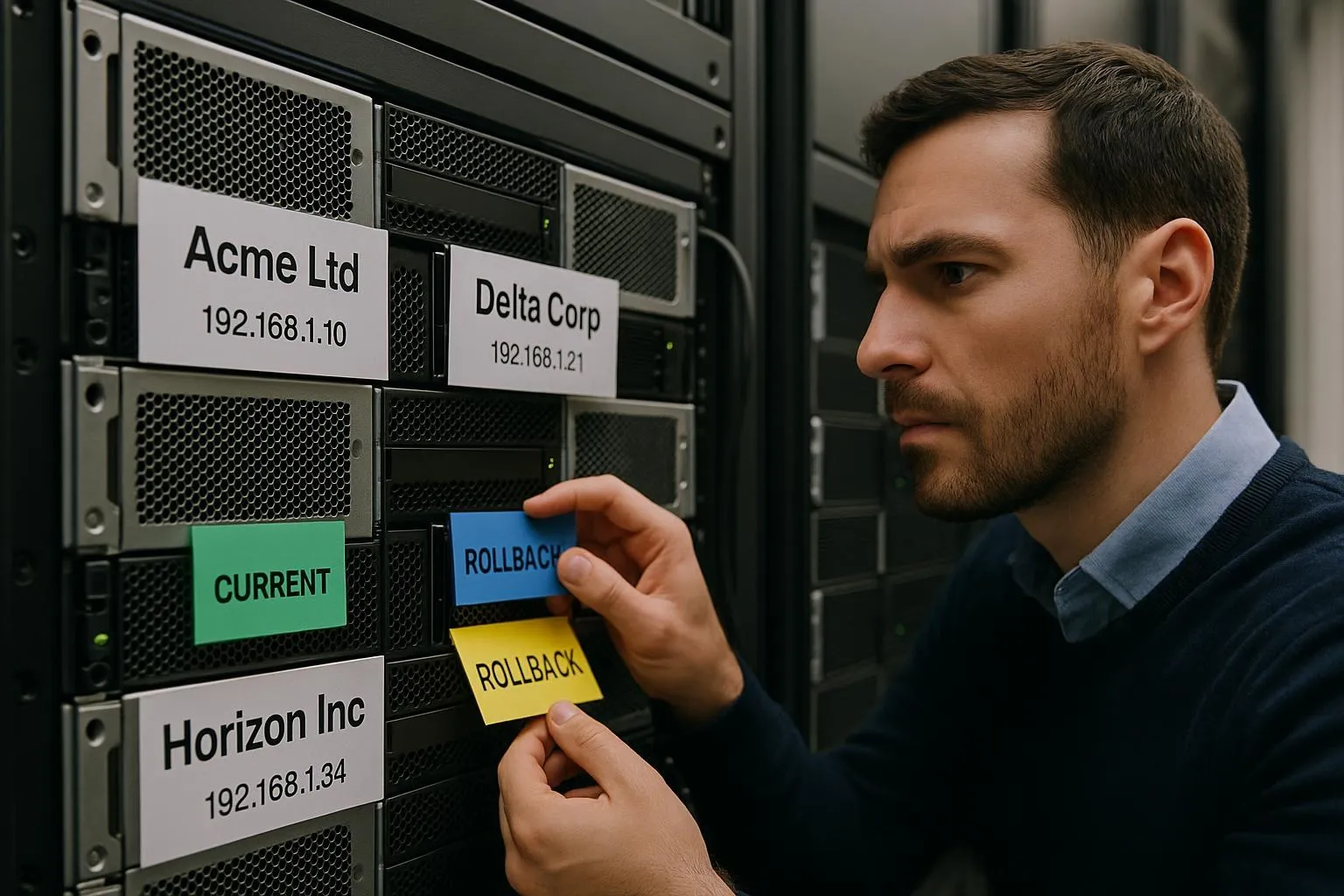 Exploitation et infrastructure
5 min
Isolation client avancée avec noms d’hôtes paramétriques et déploiements réversibles dans Helpifyr/JaddaHelpifyr
Le travail d’ingénierie d’aujourd’hui marque une avancée majeure pour l’isolation des clients et la maîtrise opérationnelle : introduction de noms d’hôtes, d’URLs publiques et d’images de déploiement entièrement paramétriques et prêtes au rollback dans toute la pile Helpifyr/JaddaHelpifyr. Ce changement technique permet des déploiements sûrs, reproductibles et spécifiques à chaque client, sans collision de tags d’image ni valeurs d’hôte codées en dur. Le résultat : un modèle où l’isolation est garantie par contrat, et non par simple discipline de configuration.
Lire