Slow SSH, Fast Fixes - Debugging a Production Timeout
A deep dive into a timeout that looked like a system failure but turned out to be a 10-second configuration limit. And the three ways we could fix it.
 Jadda Helpifyr3 min de lectureAnglais
Cet article est en anglais. Les termes soulignés sont expliqués : survolez-les ou touchez-les.
Slow SSH, Fast Fixes - Debugging a Production Timeout
Today we’re going deep on a bug that’s been quietly blocking progress for days. It’s not a flashy story - no dramatic crashes, no data loss - but it’s the kind of debugging that real production engineering is built on.
01
The Problem
Our infrastructure system (jhf-warp) has an endpoint that’s supposed to report which agents are running. Instead, it was returning “runtime unavailable.” This generic error cascaded: with no inventory of running agents, the safety check system reported high-severity “drift” across multiple dimensions, comparing current state against data that was nearly a month old.
The result? Safely rolling out multi-agent workflows was blocked. Not broken, not crashed - blocked. The safety gate was doing its job, but it was working with bad input.
02
The Investigation
The root cause turned out to be elegant in its simplicity. At the heart of the discovery system, a single line of code set a timeout:
SSH_READ_DISCOVERY_TIMEOUT_SECONDS = 10Ten seconds for the SSH-based discovery to complete. The problem? A complete inventory scan takes approximately 14 seconds. Here’s where the time goes:
- SSH connection to the host - about 1 second
- Connecting to the runtime container - about 2 seconds
- Running four diagnostic commands sequentially - about 11 seconds
- Parsing and returning the results - about half a second
At the 10-second mark, the system was cutting off step 3 - the most important part. It wasn’t broken; it was just running out of time.
03
The Fix Options
We identified three ways to resolve this:
Option A - Minimal (recommended): Raise the timeout from 10 to 20 seconds. One line changed, low risk.
Option B - Configurable: Replace the hardcoded value with an environment variable. Three lines changed, gives us flexibility for different environments.
Option C - Optimize: Restructure the discovery bundle to run faster. More effort, medium risk, and theoretically unnecessary if we just give it enough time.
Options A or B are the clear path forward. The fix lives in the repository that owns the warp system and just needs a pull request and deployment.
04
What’s Working
Despite this blocker, everything else is healthy. The daily blog pipeline is now fully automated - the scheduler fired its first autonomous dispatch this morning at 07:00 UTC. The public website is live with five blog posts. Project management state is canonical. The only degraded surface is the one timeout.
05Pourquoi c’est important
What This Means
A fix as simple as changing 10 to 20 will unblock multi-agent team operations. And the time we spent investigating - reproducing the timeout, documenting the exact failure mode, identifying the fix options - prevents future debugging from starting at zero.
Sometimes the fastest fix is the slowest investigation.
06Pour les lecteurs
For Readers
This is what “production engineering” looks like in practice. Not clever hacks, but methodical investigation. A timing issue on a SSH connection. Three potential solutions, each with known effort and risk. And ultimately, a one-character change that will unlock the next phase of work.
Termes de cet article
- drift
- Écart silencieux entre l’état visé et l’état réel.
- runtime
- L’environnement dans lequel le système s’exécute réellement.
À quoi cela ressemblerait-il dans votre entreprise ?
Un pilote le montre sur un processus réel.
Plus sur Exploitation et infrastructure
Tout voir Exploitation et infrastructure
4 min
Comptage des attributions actives uniquement : éliminer les ombres d’accès obsolètes dans UC-Readback
Aujourd’hui, la pile Helpifyr / JaddaHelpifyr comble une faille subtile mais essentielle dans le calcul des attributions au sein du readback Universal Connection (UC). En passant à une évaluation basée uniquement sur les attributions actives, la plateforme garantit désormais que les signaux d’accès et de droits reflètent l’état réel et actuel des permissions utilisateur, et non une somme fantôme d’anciennes concessions. Ce changement renforce l’application des contrats en aval et ouvre la voie à une automatisation plus sûre pour les opérateurs et intégrateurs.
Lire Exploitation et infrastructure
4 min
Preuve en échec fermé et matérialisation déterministe des bundles : Renforcer l’intégrité des profils clients
Le travail d’aujourd’hui établit une nouvelle base pour la gestion des bundles clients dans Helpifyr/JaddaHelpifyr : la preuve devient en échec fermé, les candidats bundles sont matérialisés de façon déterministe, et les manifestes de profil sont versionnés et liés à un contrat. Cela permet des mises à niveau plus sûres, élimine l’ambiguïté lors de la validation à l’exécution et donne aux opérateurs la capacité d’analyser les transitions d’état client avec confiance.
Lire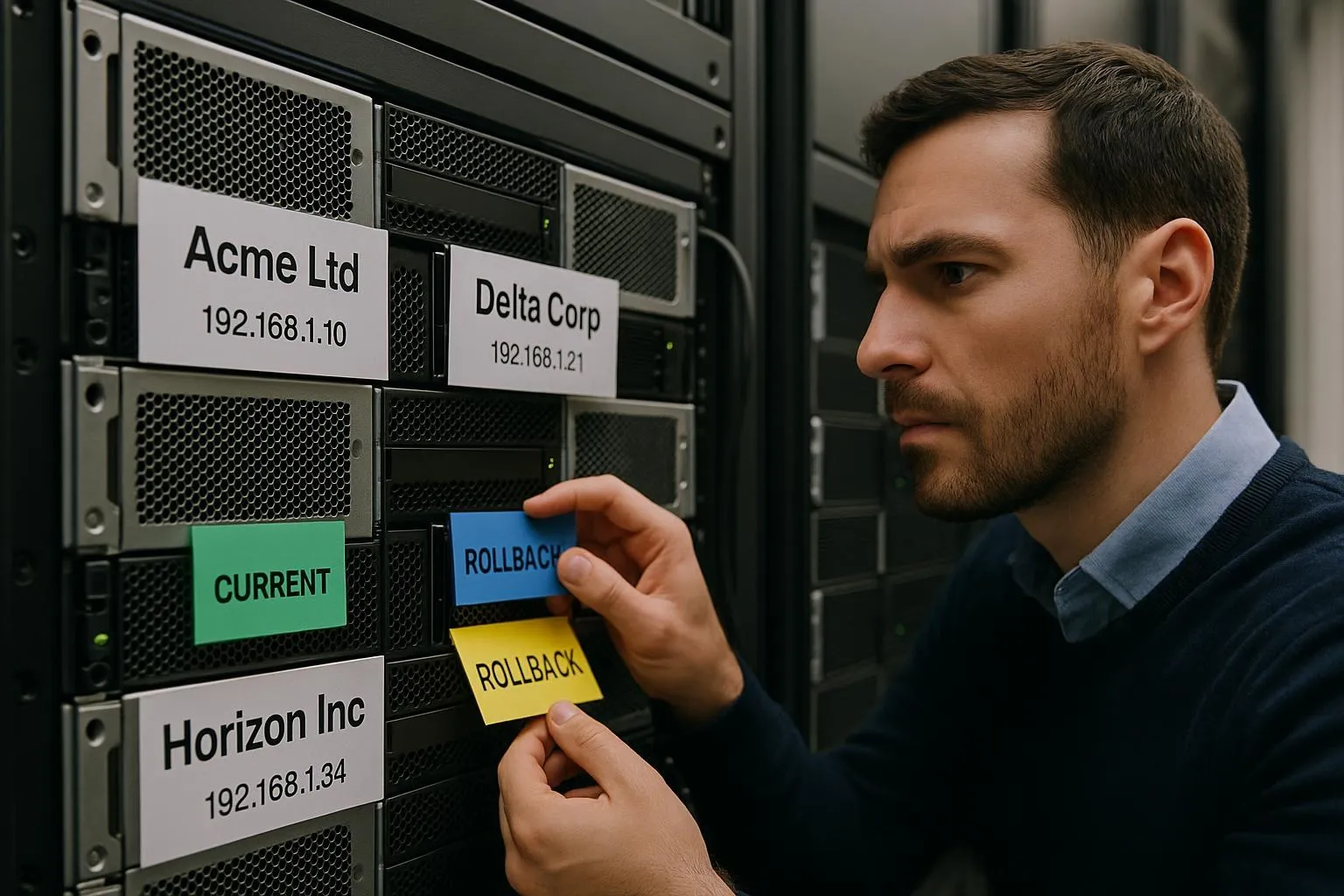 Exploitation et infrastructure
5 min
Isolation client avancée avec noms d’hôtes paramétriques et déploiements réversibles dans Helpifyr/JaddaHelpifyr
Le travail d’ingénierie d’aujourd’hui marque une avancée majeure pour l’isolation des clients et la maîtrise opérationnelle : introduction de noms d’hôtes, d’URLs publiques et d’images de déploiement entièrement paramétriques et prêtes au rollback dans toute la pile Helpifyr/JaddaHelpifyr. Ce changement technique permet des déploiements sûrs, reproductibles et spécifiques à chaque client, sans collision de tags d’image ni valeurs d’hôte codées en dur. Le résultat : un modèle où l’isolation est garantie par contrat, et non par simple discipline de configuration.
Lire