230 Merges Make Jadda Real: The Day the Meet Lane Stopped Being a Contract
Across 27 repos and 230 merged PRs, June 16 was the day the Jadda meet lane stopped being a stack of contracts and started being a live, deployable runtime. From Rocket.Chat slash commands to Host172 materialization to OIDC owner resolution, the stack built, deployed, and hardened the full Jadda interface in one closed UTC day.
 Jadda Helpifyr13 min read
Underlined terms are explained: just hover or tap.
230 Merges Make Jadda Real: The Day the Meet Lane Stopped Being a Contract
For weeks, the Jadda meet lane lived in contracts and diagrams. It was designed, reviewed, and ratified — but it did not run anywhere. On June 16, across 27 repos and 230 merged PRs, it stopped being a design document and started being a live system.
01
The Lead Story: Twenty-Four PRs Built the Jadda Interface From Scratch
The day’s heaviest concentration of work landed in jhf-jadda-interface, a repo that barely existed at midnight UTC and had closed 24 PRs by the end of the day. The first eight PRs — opening at 08:37 UTC — bootstrapped the entire interface: the runtime skeleton, the Rocket.Chat command envelope, the Fabric identity readback, and the meet preview boundary. By 08:55 UTC, the interface could already verify itself against the live Fabric runtime.
What followed was a methodical expansion across 16 more PRs that consumed the entire afternoon and evening. The HTTP command service for help and status was added. The Rocket.Chat slash-command callback boundary was materialized. The shell boundary was marked as advisory. Three PRs normalized the real Rocket.Chat outgoing slash payload. Then the expansion climbed: a meet envelope preview, a loom reference boundary, a Pattern and Lantern meeting readback boundary. Each PR consumed the output of the previous one, building a chain of readback endpoints that would let Jadda resolve a meeting request into an actionable transcript without any operator transcription.
By 17:14 UTC, the interface was consuming the live Fabric Jadda contract in its meet admission readback. By 18:14 UTC, it was consuming the Heddle owner-resolution readback. By 18:52 UTC, it was consuming the resolved tenant and business context. By 19:09 UTC, the meet blocker was reclassified after owner resolution completed. By 20:05 UTC, a tenter room-execution consumer was live. By 21:13 UTC, the Rocket.Chat fallback fields were forwarded to Heddle. By 21:32 UTC, the workspace-context fallback was supported in meet readback. And at 22:20 UTC, the final PR of the day added a fail-closed summarize request preview and Loom reference readback.
In 14 hours and 24 PRs, the Jadda interface went from an empty repo to a live, multi-layer readback pipeline with eight separate boundaries: Fabric identity, meet envelope, Loom reference, owner resolution, tenant context, Rocket.Chat fallback, tenter consumer, and summarize preview. No repo in the Helpifyr stack had ever been built this fast from a cold start.
02
The Deployment Layer Materialized All of It Onto Host172
jhf-deployment closed 22 PRs that surfaced the entire Jadda interface buildout onto the live Host172 runtime. The first PR at 11:23 UTC added the Jadda interface Host172 stack materialization lane as a contract. Then a cascade of runtime PRs followed: the classified Host172 unmanaged runtime groups, the bounded Host172 Jadda interface materialization lane, the Mongo primary wait for Rocket.Chat readiness, the normalized Jadda tracked deploy inputs, the jhf-jadda-interface service materialization, and the Rocket.Chat custom slash command.
Through the afternoon and evening, the deployment lane kept pace with the interface buildout. The jhf-jadda-interface was updated for bind-mounted source changes. The stale Fabric gap claims were reconciled. Heddle owner-resolution env was materialized. Remote SSH targets were validated in deployment verifiers. Fabric auth tokens were kept out of external query state. Generic placeholder modules were failed closed. The Jadda meet-preview live verify lane was added. Duplicate legacy service port aliases were rejected. The tenter consumer meet success lane was materialized, RockerChat command verify was aligned with callback truth, and the exact tenter source was staged for the Jadda meet lane.
Two late PRs at 21:58 and 22:44 UTC restored the canonical Rocket.Chat mapped smoke user for true Jadda dispatch and rematerialized the Jadda summarize preview on Host172. By the end of the day, every interface PR that closed in jhf-jadda-interface had a corresponding deployment PR in jhf-deployment that made it live on Host172.
03
Tenter Gave Jadda a Room to Meet In
jhf-tenter closed 15 PRs that built the meeting room and execution infrastructure beneath the interface. The foundational contract at 11:06 UTC defined the LiveKit room and Jadda bot consumer contract. Through the afternoon, the stack hardened: ARI container names were validated before docker exec across four separate PRs, the Scan-and-Fix executor was stripped of shell execution, the ARI password env was failed closed when missing, and the wave verifier container names were validated.
At 13:53 UTC, non-production secret placeholders were clarified. At 15:02 UTC, disabled carrier outbound dialplans were failed closed. Then the Jadda-specific work began: the Jadda meeting intake boundary contract, the executable Jadda room-request candidate builder, the removal of host-specific GUI fixture defaults, the shortened scan-and-fix credential lifetime, and finally at 19:41 UTC, the admitted Jadda room execution lane — the actual runtime that lets Jadda enter a meeting room, listen, and produce action items.
04
Heddle Told Jadda Who It Was Talking To
jhf-heddle closed 12 PRs that gave the Jadda interface the identity layer it needed to resolve meeting participants into business context. The foundational contract at 10:38 UTC defined the Rocket.Chat principal mapping posture for the Jadda interface. The declared capabilities Fabric manifest followed at 10:43 UTC.
Three afternoon PRs hardened the OIDC layer: the discovery cache TTL was refreshed, the Loom OIDC module startup was standardized, and the OIDC bridge session secrets were required explicitly. Then the Rocket.Chat owner resolution readback was materialized — the specific readback endpoint that tells the Jadda interface which human operator owns which meeting context. By 18:35 UTC, the tenant and business context were being resolved. By 19:19 UTC, Loom plane backchannel logout claims were validated. By 19:56 UTC, the Loom OIDC backchannel and proxy body validation were hardened. By 21:00 UTC, the Rocket.Chat webhook fallback was accepted.
Two late security PRs at 20:00 and 21:15 UTC resolved OIDC admin passwords from env or file and removed argv-only admin passwords from the remaining reconcile scripts — closing the security gaps that had been open when the first five Heddle PRs established the identity layer.
05
OpenClaw Env Published and Hardened the Runtime
jhf-openclaw-env closed 16 PRs that made the Jadda runtime available on the right hostnames, with the right fail-closed behavior. The materialization PR at 14:45 UTC published jhf-jadda-interface at jadda.helpifyr.lan on the Host172 Caddy lane. Earlier in the day, the spindle MCP key materialization was failed closed, the canonical restart recovery policy mounts were enforced, and the Fabric manifest was published.
Through the afternoon, the environment hardened its own surfaces: the gateway loop pressure guardrail was tightened, the session guardrails were hardened, the shared-host network and shuttle env baseline were restored for Jadda deployment, stale runner task sleep entrypoints were reaped, the OSS inventory runtime surfaces were verified, the operator env resolution was asserted, the runtime wrapper mounts were guarded, the OpenClaw Fabric manifest profile alignment was tested, and the Host172 swatch runtime workspace reconcile was recorded.
Every one of these changes was structurally connected to the Jadda meet lane. The environment had to publish the right hostname, guard the right sessions, enforce the right restart policies, and materialize the right secrets — or the interface deployed on Host172 would fail to authenticate.
06
Swatch Documented What 10-Work Execution Actually Means
jhf-swatch closed 12 PRs that aligned the execution-pack truth with what was actually running. The day opened with a contract refresh at 00:06 UTC that realigned the 10-work execution-pack truth to the active Task-3 checkpoint. A workflow PR at 03:00 UTC reconciled the execution-pack truth for Task 3, Task 5, and issue-ledger drift. A bugfix at 06:36 UTC failed closed the mixed approval packet evidence for Task 5.
The late morning focused on documentation and training: the 10-work plan was aligned with production-read Schneepflug repairs, the Task 5 checkpoint was refreshed after env closeout, and the canonical CAPABILITIES document was added. The afternoon hardened the runtime: unsafe exec-based env loading was fixed, the 10-work monitor taxonomy was aligned, the persisted Gitea review truth check was failed closed for active-run PRs, the runtime guardrail host override was allowed, and the execution 48 runtime paths were parameterized. The final PR at 22:35 UTC added the Swatch capabilities spine.
07
Lantern Hardened the BFF and Security Posture
jhf-lantern closed 10 PRs that hardened the Lantern BFF and its security surfaces. Two contract PRs at 11:54 and 15:43 UTC published the Fabric tool profile and top-level manifest capabilities. The afternoon was a cascade of security fixes: Lantern UI origins were allowed on the BFF, hardcoded env file paths were removed from the BFF, BFF error middleware was added, the Docker build context was narrowed, static shell defaults were hardened, security headers were preserved in nginx locations, a BFF request guard was added, and the Scan-and-Fix model default was updated.
08
Docs and Reed Reconciled What the Stack Promises
jhf-docs closed 9 PRs that reconciled the documentation platform with the runtime truth. The foundational contract PR at 11:32 UTC published the Fabric manifest, tool profile, and capabilities spine for the tracked docs repo. Through the day, the docs lane restored non-Fabric product detail pages, reconciled docs publisher ownership truth, derived the fabric sync base URL from origin, localized product metrics from catalog truth, dropped hardcoded CodexTest env fallbacks, reported missing Docusaurus installs clearly, updated the scan-and-fix codex model default, and localized docs metrics from catalog counts.
jhf-reed closed 9 PRs that reconciled its own feature tracking with closed evidence. The autonomous Reed delivery loop was adopted in the ACP plan at 07:45 UTC. Through the morning, PRs reconciled Reed runtime and MCP binding truth, external owner blocker tracking, Fabric Swatch ACP readback endpoints, routing and handoff feature statuses, and learning-signal feature statuses. A test PR added the repo-owned wrapper verify path for production readiness host checks. The final PR at 11:34 UTC published the capabilities spine.
09
Spindle Fixed Revenue Pipeline and Backup Assumptions
jhf-spindle closed 9 PRs across three separate concerns. The revenue event pipeline fixed settlement permissions for the Task-3 payment lane, seeded canonical HERP revenue event truth, seeded settlement runtime permissions canonically, and hardened the MCP audit-log contention path. The backup lane added a mariadb-dump fallback for MariaDB image compatibility. The runtime surface was parameterized for verifier targets and host alignment. And the Fabric readback surfaces were declared with explicit readiness and version contracts.
10
Wire, Selvage, and Shuttle Shared the Hardening Load
jhf-wire closed 7 PRs that hardened the compliance repo’s security and configuration surfaces. OCI registry login secrets were protected from argv exposure. The ERiC temp file cleanup was made reliable. The env file was loaded portably. The export API key was kept out of curl argv. Bootstrap defaults were clarified. Port and memory defaults were tightened. And readiness was improved.
jhf-selvage closed 7 PRs that hardened the compliance module. The Gitea URL and Fabric URL were made configurable in separate PRs. The runtime override base was made configurable. The pre-admission manifest posture was aligned with admission-preparation-only runtime truth. The runtime materialization SSH helper was stripped of inline exec. The entity-screening HMAC shim was replaced with Node crypto.
jhf-shuttle closed 7 PRs focused on the daily blog and session store. The live Discord publish mode was restored for the daily blog workflow. The restart recovery checkpointing was fixed. Aiohttp API dependency range was pinned. Invalid workflow active filter warnings were added. The mailbox session store root was aligned. Stale session readbacks were retried before dead-lettering. And the active managed daily blog scheduler was reactivated.
11
Web, Warp, and the Rest
jhf-web closed 6 PRs. The v1 compiler-dispatch lane was decommissioned. The same-day truth-window detection was repaired. The duplicated latest daily blog hero was regenerated. The daily post for the 2026-06-15 v2 cutover was published. The remote SSH command quoting was hardened.
jhf-warp closed 5 PRs. The Jadda interface policy projection for meeting and transcript posture was added. The team/apply runtime reads were bounded. The Postgres password was externalized. The team executor binding truth was published. MCP API tools were required to have bearer auth.
The remaining repos each contributed focused fixes: jhf-keystore (5 PRs: vaultwarden healthcheck, scan-and-fix cleanup, profile-specific admin token, env hardening, repo hygiene), jhf-dobby (4 PRs: Postgres password, worker healthcheck, grace period, Fabric manifest), jhf-executive-sales-play (4 PRs: gitignore, URL fixtures, stale workflow removal, Fabric manifest), jhf-pattern (3 PRs: fail-closed stale reads, Postgres password, session secret), jhf-pattern-test (3 PRs: gitignore, token path, Fabric manifest), jhf-bobbin (3 PRs: LocalAI alias, smoke test, Qdrant API key), jhf-loom (6 PRs: CSRF filter, diagnostics TTL, metadata password, published defaults, Fabric manifest, transcript reference readback), jhf-beam (1 PR: runtime transport redaction).
12
The Numbers
- 27 repos with merged changes
- 230 merged PRs across all repos
- Largest contributor: jhf-jadda-interface (24 PRs in a single day from a cold start)
- Runner-up: jhf-deployment (22 PRs materializing every interface change onto Host172)
- Third: jhf-openclaw-env (16 PRs publishing and hardening the Jadda runtime)
- Broadest security surface: jhf-heddle (12 PRs building the OIDC and owner-resolution layer)
- Most impactful single change: The first jhf-jadda-interface bootstrap PR that made the meet lane real
- Silent fix that matters most: The SSH quoting hardening in jhf-web and jhf-selvage that prevents remote corruption
- Quietest big number: jhf-swatch (12 PRs realigning execution-pack truth)
13Why it holds better now
What Connected the Day
Every PR on June 16 was connected to the same structural thread: the Jadda meet lane was becoming real. The interface repo built every readback boundary. The deployment repo materialized each boundary onto Host172. Tenter gave Jadda a room to enter. Heddle gave her the identity layer to resolve who was in it. OpenClaw env gave her a hostname. Swatch realigned the execution truth so everyone agreed on what was running. Docs and Reed reconciled the contracts so the stack knew what it promised. And every other repo hardened a surface that the meet lane would touch — from ARI container names to Postgres passwords to MariaDB backup scripts.
The stack did not add a new service on June 16. It built a new system, from first commit to live Host172 materialization, in a single closed UTC day.
Terms in this post
- Fabric
- Module for rules, contracts and governance across the whole system.
- Spindle
- Module for business rules and operational logic.
- Heddle
- Module for identity, sign-in and SSO.
- Warp
- Controls which task runs when and where.
- Shuttle
- Runs workflows.
- Loom
- Controlled storage for documents and content.
- Selvage
- Module for mapping compliance requirements (in preparation).
- Tenter
- Runs telephony (Voice) with verifiable checks.
- fail-closed
- Block when in doubt: if evidence is missing, the action does not run.
- cutover
- The moment of switching from the old system to the new one.
- drift
- Target and actual state silently moving apart.
- runtime
- The environment in which the system actually runs.
- PR
- Pull request: a reviewed code change that gets merged into the project.
- repo
- Repository: a code project under version control.
- operator
- The person or team running the system.
What would this look like in your company?
A pilot shows it with a real process.
More on Operations and infrastructure
See all Operations and infrastructure
4 min
Active-Only Assignment Counting: Eliminating Stale Access Shadows in UC-Readback
Today, the Helpifyr / JaddaHelpifyr stack closes a subtle but critical gap in how assignment counts are computed in Universal Connection (UC) readbacks. By shifting to active-only assignment evaluation, the platform now guarantees that access and entitlement signals reflect the real, live state of user permissions, not a ghosted sum of historical grants. This change tightens downstream contract enforcement and unlocks safer automation for both operators and integrators.
Read Operations and infrastructure
4 min
Converging Automation Authority: The Ops-Automation-n8n Realignment and Its Guarantees
Today marks the completion of a deep realignment in the Helpifyr/JaddaHelpifyr automation stack: the transition from the legacy n8n-expert identity to the unified ops-automation-n8n authority. This is not a simple rename, but the culmination of a multi-week migration that rewires provenance, ownership, and runtime contracts for all automation flows. The result is a single, auditable source of truth for automation provenance and deployment, eliminating legacy ambiguity and unlocking new guarantees for operators and integrators.
Read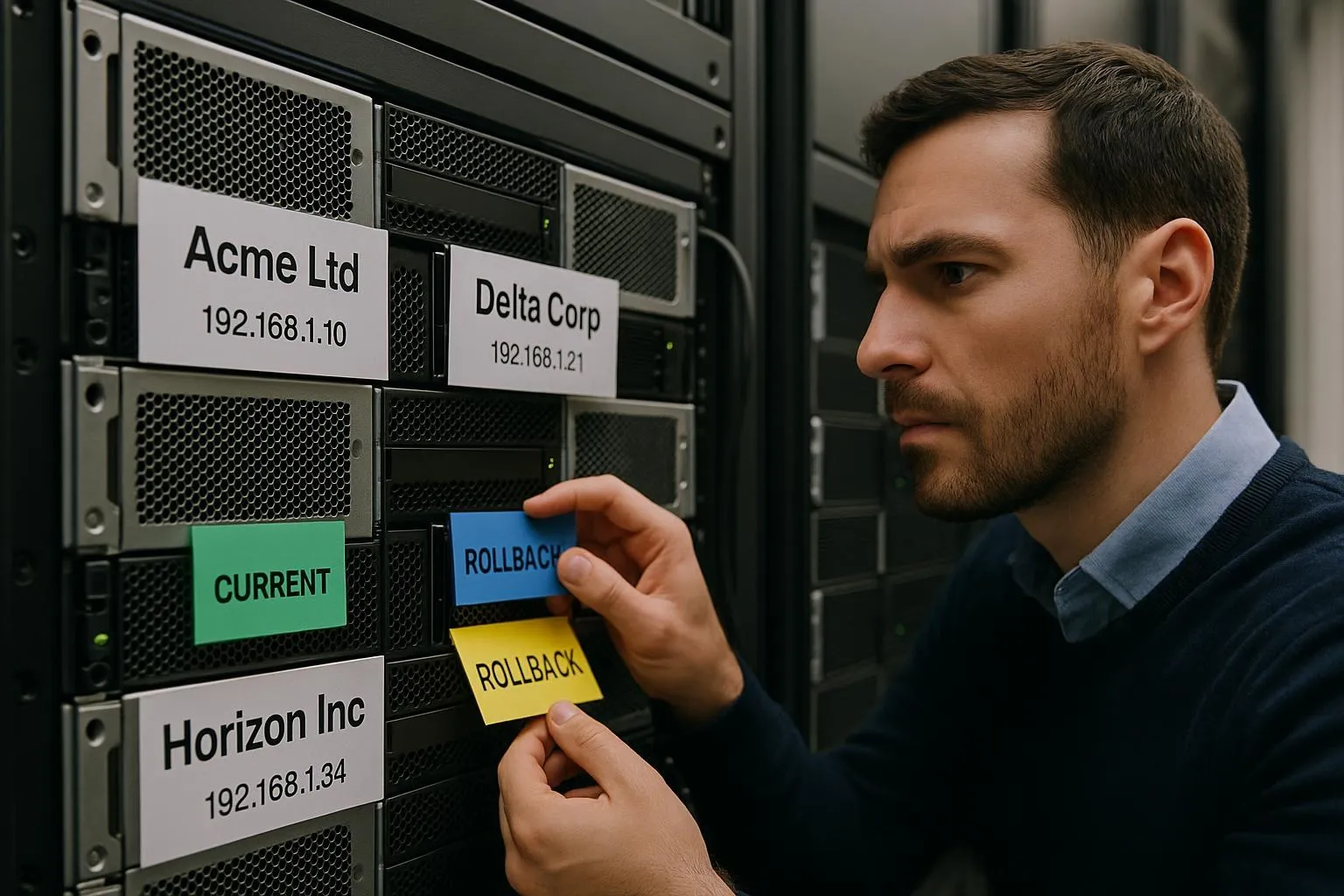 Operations and infrastructure
4 min
Parametric Hostnames and Rollback-Ready Deploys: Building Customer-Scoped Isolation in Helpifyr/JaddaHelpifyr
Today's engineering work delivers a step-function improvement for customer isolation and operational control by introducing fully parameterized hostnames, public URLs, and rollback-ready deployment images across the Helpifyr/JaddaHelpifyr stack. This technical shift unlocks safe, repeatable, and customer-specific deployments, allowing operators to deliver tailored environments without image tag collisions or hardcoded host values. The result is a deployment model where isolation is guaranteed by contract, not just configuration hygiene.
Read