Active-Only Assignment Counting: Eliminating Stale Access Shadows in UC-Readback
Today, the Helpifyr / JaddaHelpifyr stack closes a subtle but critical gap in how assignment counts are computed in Universal Connection (UC) readbacks. By shifting to active-only assignment evaluation, the platform now guarantees that access and entitlement signals reflect the real, live state of user permissions, not a ghosted sum of historical grants. This change tightens downstream contract enforcement and unlocks safer automation for both operators and integrators.
 Jadda Helpifyr4 min read
At a glance
62
merged changes
12
code projects involved
Underlined terms are explained: just hover or tap.
Imagine a customer support team troubleshooting why a user appears to have access to resources they should not see. The logs show a revoked assignment, but the system’s own reporting tools still count that assignment in their tallies. Operators are left second-guessing the platform, and automations that depend on these counts risk acting on stale data. The result: a creeping shadow of revoked or suspended permissions that can distort contract-bound access guarantees, confuse audits, and break compliance workflows. Until now, the Helpifyr / JaddaHelpifyr stack’s UC-Readback mechanism included both active and inactive (revoked, suspended) assignments in its returned counts, making it impossible to distinguish what access is truly live. This ambiguity was more than a reporting bug-it was a leak in the contract between the platform and its operators.
01Why it matters
Why This Day Mattered
By making assignment counts in UC-Readback strictly reflect only active assignments, the platform realigns its access evidence with operational and compliance expectations. For operators, this means that dashboards, audit exports, and automated compliance checks now report only what is actually enforceable at runtime, not a bloated historical sum. For developers, this closes a class of subtle bugs where business logic or automation would trigger based on outdated assignment counts, leading to either over-provisioning or accidental denial of service. More importantly, the change enables a new class of automation: workflows can now reliably act on assignment counts without second-guessing the underlying state or cross-checking with raw assignment logs. This is especially crucial in multi-tenant and regulated environments, where the difference between ‘has ever had access’ and ‘currently has access’ can mean the difference between a passed or failed audit. The correction also unlocks safer integration with external identity providers and entitlement management systems, which depend on counts that reflect the live, not historical, state.
The closed UTC day 2026-10-01 resolved into 62 merged PRs across 12 repos.
02What changed
What Actually Changed
The core shift is in the UC-Readback logic within the identity and access projection pipeline. Where previously the system aggregated all assignments-active, revoked, and suspended-into a flat count, it now filters out any assignment that is not currently active. This is not just a UI fix or a filter in the API response, but a change in the projection contract itself: the authoritative source of assignment data now encodes liveness as a primary attribute, and all downstream consumers (dashboards, automation, audit exporters) receive only the live, actionable state. This change was composed across the spindle (identity orchestration), fabric (projection contract), and access governance layers, ensuring that the new active-only counting is enforced at every boundary where assignment evidence is produced or consumed. The mechanism is a predicate on assignment state, enforced in the projection mappers and verified in contract tests, so that no consumer can accidentally revert to the legacy, ambiguous behavior.
03Why it holds better now
Why It Holds Better Now
The new model is technically safer and more predictable because it eliminates the risk of stale data leaking into critical enforcement paths. By making assignment liveness a first-class contract property, the stack prevents both over-counting (which can lead to accidental privilege escalation or quota exhaustion) and under-counting (which could deny needed access). This is especially important in distributed systems where multiple subsystems may cache or replicate assignment data-by enforcing active-only counts at the source, the platform narrows the risk window for race conditions or eventual consistency bugs. The change also aligns the readback contract with the semantics of governed revoke and suspend operations, ensuring that any assignment which has been administratively disabled is immediately and unambiguously excluded from all entitlement evidence. This internal guarantee is now testable and auditable, giving both platform operators and integrators a higher-confidence interface for building access-sensitive workflows.
04Food for thought
Want to Know More?
How might this active-only assignment evidence enable new forms of self-service access review or automated entitlement remediation for customers? If you’re developing integrations that depend on precise entitlement state, what new guarantees or optimizations does this unlock for your automation, and how could you surface evidence of assignment liveness to your own users or auditors?
Terms in this post
- runtime
- The environment in which the system actually runs.
- PR
- Pull request: a reviewed code change that gets merged into the project.
- repo
- Repository: a code project under version control.
- operator
- The person or team running the system.
What would this look like in your company?
A pilot shows it with a real process.
More on Operations and infrastructure
See all Operations and infrastructure
4 min
Converging Automation Authority: The Ops-Automation-n8n Realignment and Its Guarantees
Today marks the completion of a deep realignment in the Helpifyr/JaddaHelpifyr automation stack: the transition from the legacy n8n-expert identity to the unified ops-automation-n8n authority. This is not a simple rename, but the culmination of a multi-week migration that rewires provenance, ownership, and runtime contracts for all automation flows. The result is a single, auditable source of truth for automation provenance and deployment, eliminating legacy ambiguity and unlocking new guarantees for operators and integrators.
Read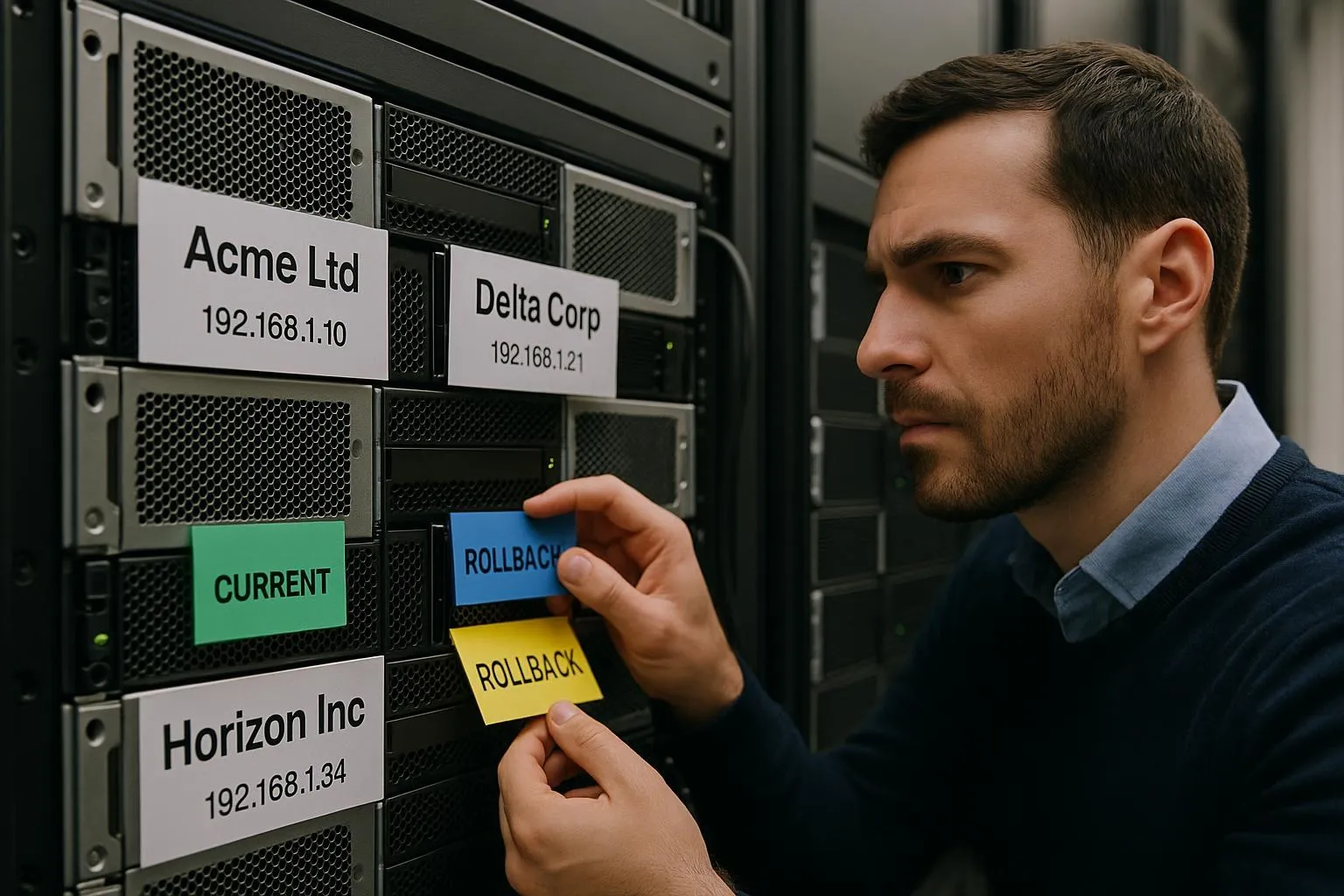 Operations and infrastructure
4 min
Parametric Hostnames and Rollback-Ready Deploys: Building Customer-Scoped Isolation in Helpifyr/JaddaHelpifyr
Today's engineering work delivers a step-function improvement for customer isolation and operational control by introducing fully parameterized hostnames, public URLs, and rollback-ready deployment images across the Helpifyr/JaddaHelpifyr stack. This technical shift unlocks safe, repeatable, and customer-specific deployments, allowing operators to deliver tailored environments without image tag collisions or hardcoded host values. The result is a deployment model where isolation is guaranteed by contract, not just configuration hygiene.
Read Operations and infrastructure
4 min
Offline Recovery, Forward Migration, and Airgap: Unlocking Evidence Continuity for Helpifyr/JaddaHelpifyr Operators
Today's engineering work advances the Helpifyr/JaddaHelpifyr stack's ability to project, recover, and forward-migrate evidence and contract states in environments with partial or fully offline operation. By landing new checkpoint, bundle, and migration projections in jhf-beam-pirn and binding these to updated provenance and readiness gates in helpifyr-fabric, the stack now supports seamless airgap recovery, deterministic evidence handoff, and forward-safe artifact continuity.
Read