Operational Silence Detection: K-Wache and Doubtfire Control Raise the Bar for Lane Monitoring
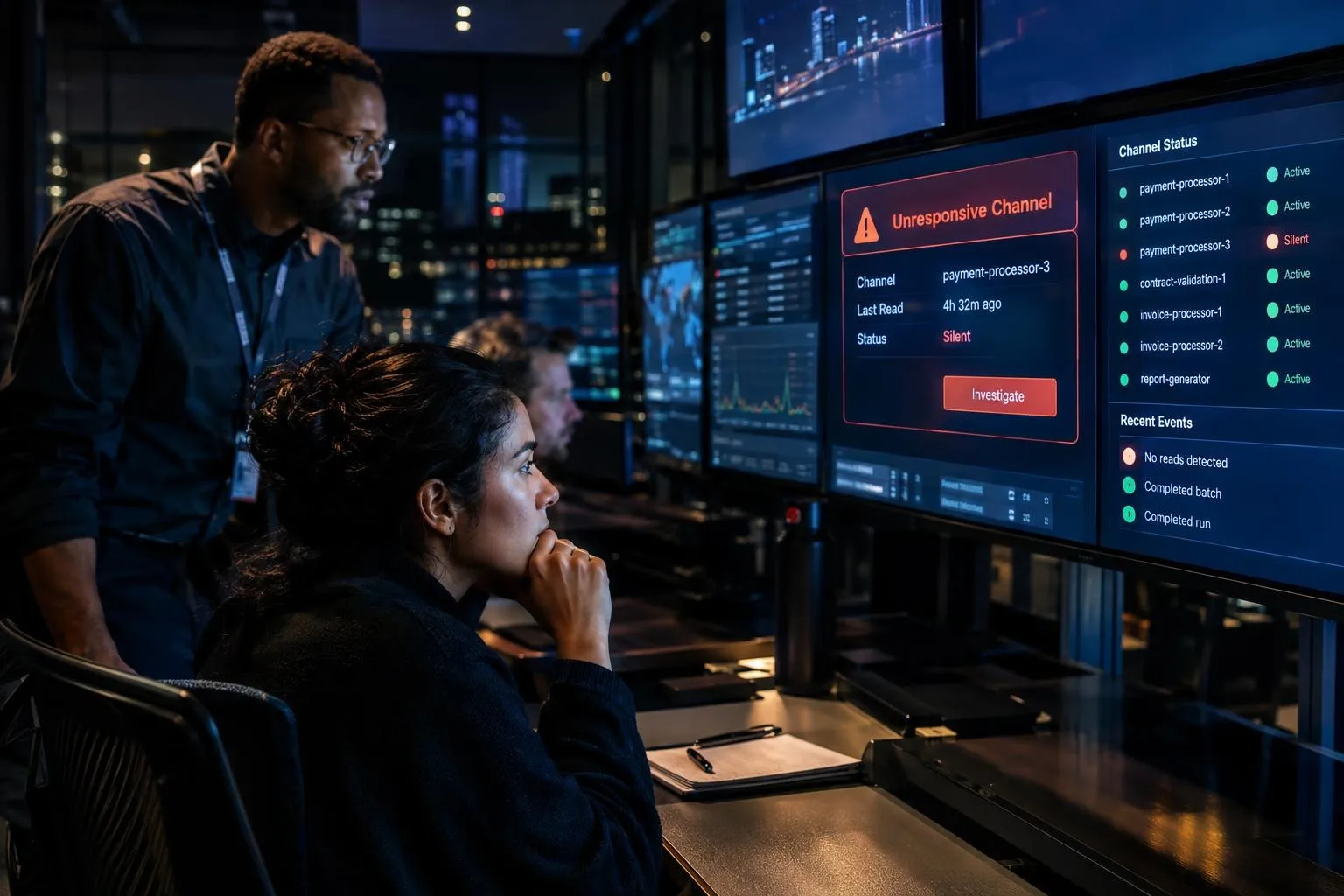
Today's engineering work delivers a new layer of automated operational safety for live payment and contract-processing lanes. By introducing the K-Wache silent-read detector and the Doubtfire Control timer/ledger system, the Helpifyr/JaddaHelpifyr stack now proactively identifies and reacts to unresponsive or stalled lanes. This shift not only prevents silent data loss and operational blind spots, but also unlocks new guarantees for operators and developers who depend on timely, accountable pipeline progress.
 Jadda Helpifyr3 min read
At a glance
44
merged changes
11
code projects involved
Underlined terms are explained: just hover or tap.
Imagine a payment or contract-processing lane quietly stalling in production: no errors, no alerts, just a silent halt in throughput. Until now, the platform’s monitoring could only react to explicit failures or missing data after the fact-often when users or operators noticed something was wrong. The risk: silent stalls could accumulate, delaying payouts or contract execution, eroding user trust, and creating operational fire drills. Today’s work changes this dynamic by wiring up a new operational sense: the ability to detect, in real time, when a lane is not merely slow but has gone silent-stuck in a state where no observable progress is being made, yet no explicit error is thrown.
01Why it matters
Why This Day Mattered
For operators and users, undetected pipeline stalls represent a hidden liability: delays compound, troubleshooting windows shrink, and the root cause often remains obscure until after user impact. By embedding silent lane detection directly into the operations layer, the platform now surfaces problems before they escalate. This means operators can intervene proactively-rerouting, restarting, or escalating lanes before deadlines are missed or data is lost. For developers, this unlocks a more reliable substrate: automation can now assume that pipeline health is continuously observed, not just at the boundaries or when errors are thrown. This enables higher-level automation, tighter SLAs, and more confident rollout of features that depend on timely lane progression. The direct beneficiaries are users whose payments, contracts, or documents now move with greater predictability and transparency, even in the face of transient infrastructure hiccups.
The closed UTC day 2026-11-11 resolved into 44 merged PRs across 11 repos.
02What changed
What Actually Changed
The core advancement is the introduction of the K-Wache (‘silent-guard’) process, which continuously monitors payment and contract-processing lanes for periods of ‘lesende Stille’-read-only silence, where no new data or events are observed. This is not a simple heartbeat check: K-Wache distinguishes between lanes that are merely idle (with no work to do) and those that should be making progress but are not. On top of this, the Doubtfire Control layer adds a timer and ledger mechanism, tracking live lane status and enforcing deadlines. If a lane exceeds its allowed silence window, Doubtfire Control can trigger alerts, escalate to operators, or even automate remediation steps. The technical mechanism involves a combination of event stream analysis, deadline tracking, and integration with the platform’s operational escalation logic. This is not a bolt-on monitor, but a deeply integrated operational contract: every lane is now covered by these guarantees.
03Why it holds better now
Why It Holds Better Now
Previously, the system relied on downstream error detection or the absence of output to infer problems, which introduced latency and ambiguity-was a lane simply idle, or was it stuck? The new K-Wache and Doubtfire Control mechanisms provide direct, positive evidence of liveness: they know not just when something is broken, but when nothing is happening that should be. This is technically superior because it closes the gap between observed output and expected progress, dramatically reducing mean time to detection for silent failures. The ledger/timer architecture ensures that every lane’s state is explicitly tracked, and operational logic can respond in real time. This means less manual investigation, fewer false positives, and a much tighter feedback loop between code, operations, and user experience. For developers, this lowers the risk of introducing new automation or complex multi-stage flows, since the platform itself now guarantees that silent stalls will be surfaced and actionable.
04Food for thought
Want to Know More?
How might these new operational guarantees enable more aggressive automation of remediation or even self-healing lanes? For developers building custom flows, what new hooks or APIs could expose lane liveness data directly, enabling smarter orchestration or user-facing status indicators? As the platform evolves, how can these mechanisms be extended to cover not just payment and contract lanes, but other critical workflows where silence could be catastrophic?
Terms in this post
- PR
- Pull request: a reviewed code change that gets merged into the project.
- repo
- Repository: a code project under version control.
- operator
- The person or team running the system.
What would this look like in your company?
A pilot shows it with a real process.
More on Blog and automation
See all Blog and automation
3 min
Filtered Admission Surfaces: Raising the Floor for Daily Publication Security
Today, we advanced the Helpifyr / JaddaHelpifyr stack's daily publication process by enforcing filtered admission surfaces across core Boost and JHF components. This move tightens the evidence contract for what can be published each day, reducing the attack surface and eliminating accidental leakage paths by making every surface explicit, reviewable, and testable.
Read Blog and automation
2 min
Self-Healing Blog Dispatch: Eliminating Silent Failures in Automated Publishing
Today's engineering work closes a subtle but critical gap in Helpifyr's automated blog publishing. By rooting out dispatch hangs, SHA mismatches, and timeout regressions in the n8n-driven shuttle, we convert what were once silent, hard-to-debug failures into explicit, actionable outcomes. This shift ensures that the daily engineering blog, a key artifact for developer and operator alignment, is always reliably published or explicitly fails closed.
Read Blog and automation
2 min
Fail-Closed Documentation: Enforcing Canonical Truth Across Surfaces and Publishers
Today we closed the last gaps between what is published as public documentation and the actual, canonical state of the Helpifyr and JaddaHelpifyr stack. Admission docs now fail-closed against repo drift, publisher claims are strictly enforced, and every public page records its materialization lineage. This is more than hygiene: it's a technical guarantee that every operator, integrator, and builder sees exactly what the platform promises, no more, no less.
Read