Plan Progress as a First-Class Signal: Enforcing Measurable Delivery Across the Platform Plane
Today, the Helpifyr/JaddaHelpifyr stack formally codifies plan progress as a source-of-truth, introducing a strict, schema-backed measurement system that separates intent from delivery and exposes the actual state of platform initiatives. This shift arms developers, operators, and stakeholders with verifiable, environment-aware progress signals, breaking through the fog of coordination and surfacing real delivery risks and wins.
 Jadda Helpifyr3 min read

At a glance
83
merged changes
22
code projects involved
Underlined terms are explained: just hover or tap.
Imagine coordinating a multi-team platform project where status updates are at best anecdotal and at worst, misleading. A feature is ‘almost done,’ a migration is ‘making progress,’ but no one can say with certainty what code is live, what is still in review, and what is only wishful thinking. In this environment, delivery risk is invisible until it bites, and the gap between plan and reality grows unchecked. Today, the Helpifyr/JaddaHelpifyr stack crosses a threshold: plan progress is no longer a matter of opinion or scattered tickets, but a rigorously measured, contractually enforced signal. With the rollout of PLAN_PLAN_PROGRESS_TRACKING_v1 and the first strict measurement paths, every major component now exposes its delivery progress as a verifiable, environment-separated metric, backed by schema and enforced rules.
01Why it matters
Why This Day Mattered
For operators and product owners, this is the difference between steering by guesswork and steering by instrument. Instead of chasing down status in meetings or combing through ad hoc documentation, stakeholders now have a single, authoritative, and machine-readable progress feed for every tracked initiative. This enables earlier detection of stalls, more accurate cross-team planning, and a shared understanding of what is truly delivered versus what is in flight. For developers, the clear separation of plan, contract, live, and issues states means less time spent justifying status and more time building. For downstream integrators and customers, it means expectations are set by facts, not promises. This change reduces friction in every handoff and makes platform delivery a matter of evidence, not faith.
The closed UTC day 2026-10-22 resolved into 83 merged PRs across 22 repos.
02What changed
What Actually Changed
The platform now treats plan progress as a first-class contract, not just a byproduct of development. The new PLAN_PLAN_PROGRESS_TRACKING_v1 specification introduces a schema for measuring and reporting progress, with strict rules that count only merged, environment-qualified delivery, and explicitly exclude non-authoritative changes such as direct commits or unreviewed merges. This is not just a documentation update; it is an architectural shift. Each major stack component (from fabric core to partner portals and automation harnesses) now emits its own progress signal, tracked against a central plan graph. The measurement path is separated by environment (e.g., staging, production), ensuring that progress reflects actual deployment, not just code in a repository. The system enforces these rules through both documentation and CI workflows, catching deviations early.
03Why it holds better now
Why It Holds Better Now
By making plan progress measurable and schema-validated, the platform eliminates the ambiguity and drift that plague large-scale delivery. Progress cannot be inflated or misrepresented: only actual, merged, environment-specific delivery counts. This removes the temptation to ‘green-light’ features that are not truly live, and it exposes gaps between plan and reality as soon as they occur. The environment separation is critical: it prevents confusion between what is ready in dev/test and what is actually serving users. The central plan graph, with its strict measurement rules, is now the source-of-truth for both internal and external reporting. Automated enforcement via CI ensures that regressions or manual workarounds are caught before they pollute the record. In short, the platform now has a self-healing, evidence-driven delivery signal that scales with the organization.
04Food for thought
Want to Know More?
How will downstream automation-such as release orchestration, automated rollout blockers, or real-time risk dashboards-leverage this new, contractually enforced progress signal? For teams building on Helpifyr/JaddaHelpifyr, what new opportunities does a source-of-truth progress contract unlock for their own delivery guarantees or customer-facing status indicators?
Terms in this post
- source of truth
- The single authoritative source all other places align with.
- drift
- Target and actual state silently moving apart.
- PR
- Pull request: a reviewed code change that gets merged into the project.
- repo
- Repository: a code project under version control.
- operator
- The person or team running the system.
What would this look like in your company?
A pilot shows it with a real process.
More on Evidence and verification
See all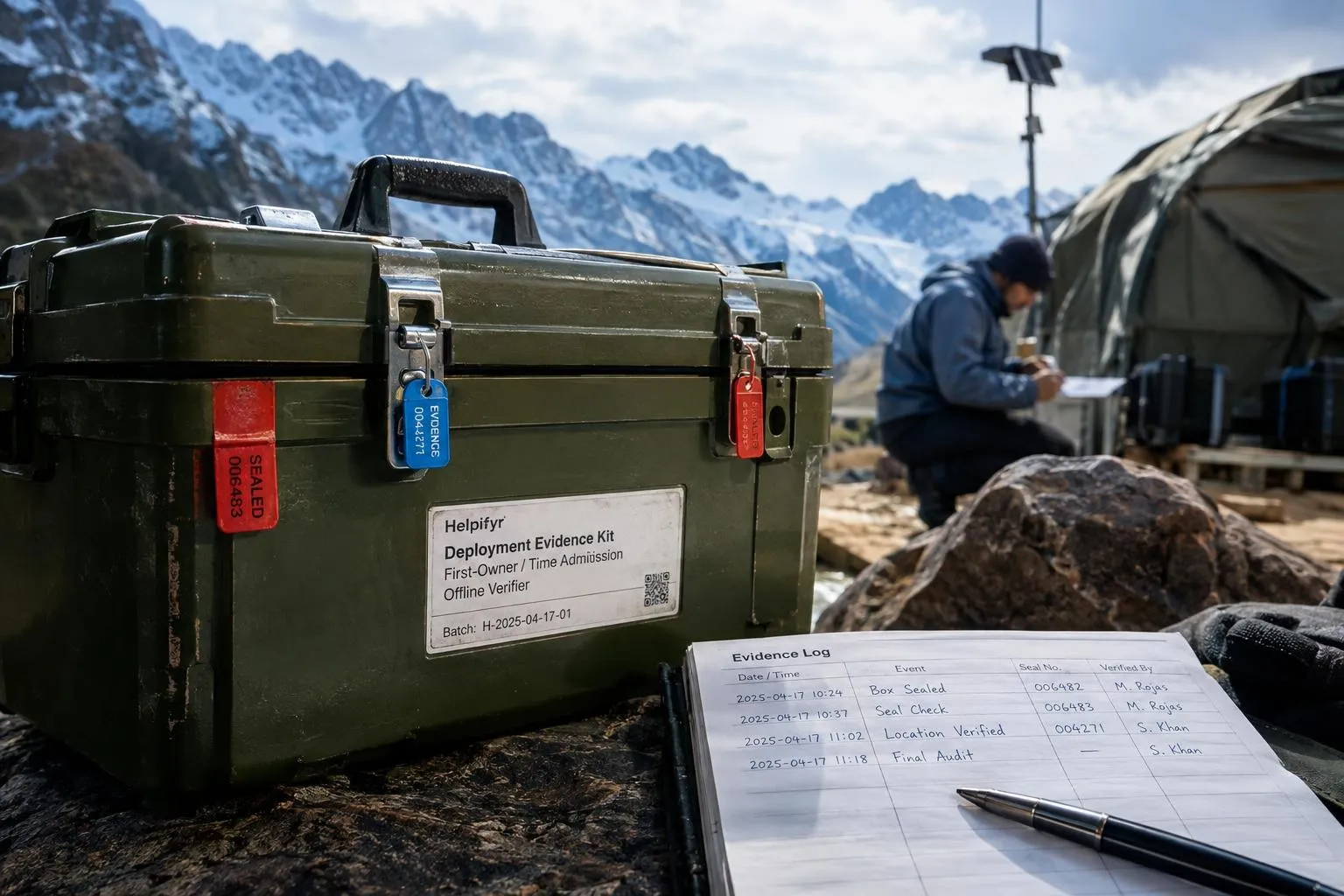 Evidence and verification
4 min
Offline Admission Verifiers: Locking Down First-Owner and Time Guarantees in Autonomous Deployment
Today's engineering work closes a critical trust gap in Helpifyr / JaddaHelpifyr's deployment pipeline by introducing offline verifiers for first-owner claims and time-based admissions. These new mechanisms enforce contract-level evidence and one-use challenge protocols, making the system provably strict even in isolated or adversarial environments. This elevates the platform's operating model from best-effort checks to cryptographically anchored, auditable invariants at every stage of the bootstrap and admission lifecycle.
Read Evidence and verification
4 min
Domain Separation for Zimbra Admission: A New Line of Defense in UC Contract Integrity
Today’s engineering work delivers domain-level isolation for Zimbra-based admissions, unlocking a stronger, more auditable contract boundary for user communication (UC) flows. By introducing a concrete domain separator into the Zimbra Admission process, we’ve enabled precise compartmentalization of authentication and lifecycle events, ensuring that cross-domain ambiguity is structurally impossible. This architectural hardening not only closes subtle attack surfaces but also empowers platform operators and integrators with new guarantees about the provenance and scope of each admission event.
Read Evidence and verification
4 min
Offline Core Issue Auditing: Closing the Loop on Historical Data Integrity
Today, the Helpifyr and JaddaHelpifyr stack gains a foundational guarantee for the long-term integrity of critical core issue data, with new mechanisms for offline audit, closure logic, and plan-basis reconciliation. This work arms operators with tools to detect and resolve discrepancies in historical records, unlocks safer data migrations, and gives developers a deterministic contract for the lifecycle of sensitive issues and plans.
Read