Scheme Registry and Swiss QR-Bill: Composable Payment QR Generation with Hardened Contracts
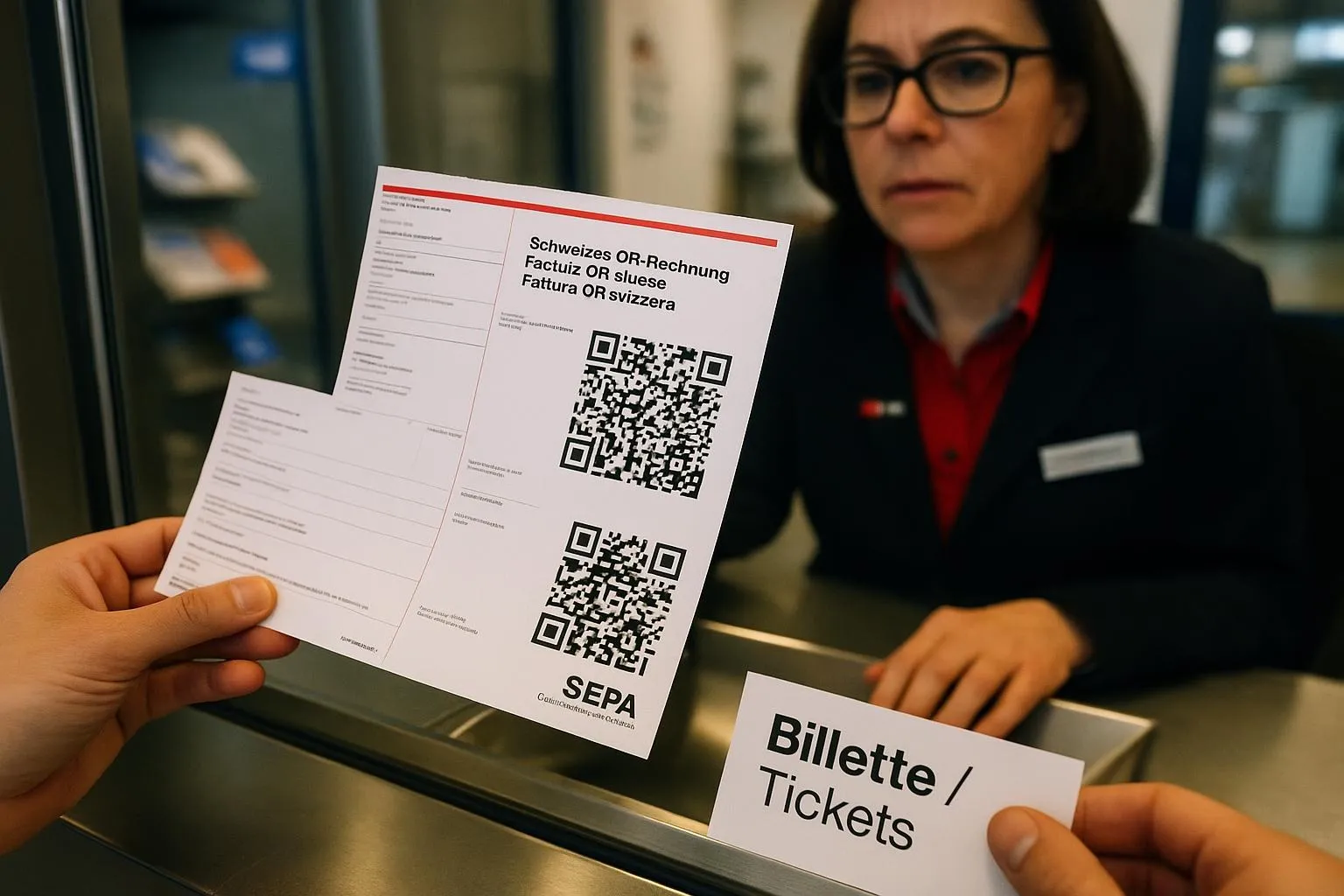
A composable scheme registry and robust contract hardening now anchor Helpifyr's payment QR core, unlocking multi-scheme QR generation-including Swiss QR-bill-in a testable, independently verifiable pipeline. This day’s work shifts QR code generation from ad-hoc logic to a selectable, auditable, and integration-ready core, raising the bar for downstream reliability and extensibility.
 Jadda Helpifyr4 min read
At a glance
38
merged changes
7
code projects involved
Underlined terms are explained: just hover or tap.
Imagine a payment workflow where every new QR format, regulatory update, or bank-specific scheme forces a rewrite of core logic-each change a risk to existing flows, each integration a minefield for subtle regressions. That was the reality for teams working with payment QR codes in the Helpifyr stack until today. The cost wasn’t just developer time spent on brittle code, but the real-world risk that a failed scan or rejected payment could break the trust of users or partners relying on these flows. The stakes are high: payment QR codes must not only be correct, but verifiably so, and ready to adapt as new standards emerge. Today, the payment QR core takes a decisive step away from this high-friction past.
01Why it matters
Why This Day Mattered
This work matters because it fundamentally changes how payment QR generation is built, extended, and verified across the platform. By introducing a scheme registry and selection rule, the payment QR core now supports pluggable schemes-starting with the EPC (European Payments Council) standard and, crucially, the Swiss QR-bill format (SIX IG v2.4). For operators and developers, this means that adding support for a new market or bank no longer requires invasive changes or risky rewrites; instead, schemes are registered, selected, and composed through a stable contract. This composability is not just an internal win: it directly enables partners and downstream teams to build on a predictable, testable foundation, reducing onboarding friction and unlocking new payment experiences. The addition of real-site integration tests and independent decoder round-trips further raises confidence that what is generated can be consumed reliably by external parties-critical when payment failures are not an option.
The closed UTC day 2026-10-14 resolved into 38 merged PRs across 7 repos.
02What changed
What Actually Changed
At the heart of the shift is the introduction of a scheme registry and a selection rule mechanism within the payment QR core. Rather than hardcoding logic for each supported QR format, the core now exposes an explicit registry where each scheme-such as EPC or Swiss QR-bill-registers its encoder and validation contract. Selection rules allow the system or integrators to choose the correct scheme at runtime, based on context or configuration, enabling true multi-scheme support. Contract hardening ensures that each scheme’s requirements are enforced at the boundary, with clear error signaling and no silent fallback to incorrect defaults. The Swiss QR-bill implementation is not just a static encoder: it follows the SIX implementation guidelines v2.4, emits the required payment and receipt sections, and is validated both by contract and by independent round-trip decoding (using zxing-cpp). Integration tests at the real-site level confirm that the emitted QR codes function end-to-end in the environments where they matter most. The architecture now supports safe extension, rigorous testing, and external auditability.
03Why it holds better now
Why It Holds Better Now
The new architecture is technically stronger on several fronts. First, the scheme registry makes the set of supported QR formats explicit and discoverable, preventing accidental drift or shadow logic. Selection rules decouple the core from format-specific branching, so new schemes can be added or updated without endangering existing flows. Contract hardening at the registry and encoder boundaries means that malformed inputs or unsupported scenarios are caught early, with no risk of generating ambiguous or invalid QR codes. The use of independent, round-trip decoder tests (with zxing-cpp) ensures that what is generated is not only syntactically correct but actually machine-readable by industry-standard libraries-a crucial guarantee for interoperability. Real-site integration tests anchor these guarantees in the environments where payment failures are most costly. Altogether, the system now provides a stable, auditable surface for both internal and external integrators, reducing risk while supporting rapid extension to new payment standards.
04Food for thought
Want to Know More?
If you’re building on Helpifyr or integrating payment QR flows, the next frontier is leveraging the scheme registry for dynamic, user-driven scheme selection-imagine letting users or partners specify their preferred QR format at runtime, or enabling conditional logic based on geolocation or account profile. How might downstream systems use the contract-hardened registry to validate or transform QR payloads before emission? And as new payment standards emerge, what does it look like to onboard a new scheme with zero risk to existing flows? The foundation is here; the next step is to see how composability and contract rigor unlock new business and developer possibilities.
Terms in this post
- drift
- Target and actual state silently moving apart.
- runtime
- The environment in which the system actually runs.
- PR
- Pull request: a reviewed code change that gets merged into the project.
- repo
- Repository: a code project under version control.
- operator
- The person or team running the system.
What would this look like in your company?
A pilot shows it with a real process.
More on Evidence and verification
See all Evidence and verification
4 min
Offline Admission Verifiers: Locking Down First-Owner and Time Guarantees in Autonomous Deployment
Today's engineering work closes a critical trust gap in Helpifyr / JaddaHelpifyr's deployment pipeline by introducing offline verifiers for first-owner claims and time-based admissions. These new mechanisms enforce contract-level evidence and one-use challenge protocols, making the system provably strict even in isolated or adversarial environments. This elevates the platform's operating model from best-effort checks to cryptographically anchored, auditable invariants at every stage of the bootstrap and admission lifecycle.
Read Evidence and verification
4 min
Domain Separation for Zimbra Admission: A New Line of Defense in UC Contract Integrity
Today’s engineering work delivers domain-level isolation for Zimbra-based admissions, unlocking a stronger, more auditable contract boundary for user communication (UC) flows. By introducing a concrete domain separator into the Zimbra Admission process, we’ve enabled precise compartmentalization of authentication and lifecycle events, ensuring that cross-domain ambiguity is structurally impossible. This architectural hardening not only closes subtle attack surfaces but also empowers platform operators and integrators with new guarantees about the provenance and scope of each admission event.
Read Evidence and verification
4 min
Offline Core Issue Auditing: Closing the Loop on Historical Data Integrity
Today, the Helpifyr and JaddaHelpifyr stack gains a foundational guarantee for the long-term integrity of critical core issue data, with new mechanisms for offline audit, closure logic, and plan-basis reconciliation. This work arms operators with tools to detect and resolve discrepancies in historical records, unlocks safer data migrations, and gives developers a deterministic contract for the lifecycle of sensitive issues and plans.
Read