Canonical Reapply: Making Stack Source-of-Truth Deterministic for Semantic Operations
Today, the Helpifyr / JaddaHelpifyr stack closes the loop on a longstanding source-of-truth ambiguity for semantic operations: every reapply, recovery, and schema-init now deterministically binds to the canonical source and schema artifacts, with fail-closed admission on any drift or dirty state. This shift eliminates a class of silent misconfigurations and makes every semantic operation provably tied to the intended stack identity.
 Jadda Helpifyr3 min read
At a glance
112
merged changes
18
code projects involved
Most changes in
- jhf-openclaw-env29
- helpifyr-fabric17
- jhf-bobbin12
Underlined terms are explained: just hover or tap.
Picture the operator reapplying a critical stack after a schema evolution-expecting the system to pick up the canonical source, but instead, an outdated or mutated artifact slips through, quietly poisoning the semantic state. For months, even minor drift in source or schema artifacts could go undetected, with subtle breakages surfacing only downstream. Today, that uncertainty ends: the stack’s reapply, source, and schema-init flows now enforce deterministic, fail-closed gates on source-of-truth identity, making every semantic operation auditable and predictable.
01Why it matters
Why This Day Mattered
For operators and developers, this means every semantic reapply, recovery, or schema-init is now guaranteed to act on the precise, intended source and schema-no more ghost bugs from stale or mutated artifacts, no more race conditions between worktree states. Platform users gain a new level of confidence that their workloads and migrations reflect exactly what was committed, not whatever happened to be lying around. For downstream integrations and data consumers, this closes the last loophole where silent schema drift or artifact mismatch could propagate into production.
The closed UTC day 2026-07-18 resolved into 112 merged PRs across 18 repos, led by jhf-openclaw-env (29), helpifyr-fabric (17), jhf-bobbin (12).
02What changed
What Actually Changed
The semantic stack’s reapply and artifact materialization pipeline now deterministically binds to the canonical source and schema-init generation, verified cross-shell and preserved across compose boundaries. Dirty or mismatched sources trigger immediate fail-closed admission, and every reapply operation is now cross-checked for clean-source identity before materialization proceeds. Artifact bootstrap and identity are preserved through explicit project directories and compose identities, ensuring that any reapply or recovery references only the intended and committed source-of-truth. Recovery of persisted credentials and schema artifacts is now gated on this same canonical reference, closing the loop on drift and mutation.
03Why it holds better now
Why It Holds Better Now
By enforcing cross-shell, deterministic clean-source gates, the stack now guarantees that semantic operations cannot proceed on mutated, outdated, or ambiguous artifacts. This is not just a runtime guardrail: it is a structural contract that makes every artifact, schema-init, and reapply operation auditable and reproducible. The fail-closed path eliminates the class of bugs where drift or local mutation would silently pass through, and explicit identity preservation across compose and materializer boundaries ensures that even complex multi-generation flows remain tied to the intended stack state.
04Food for thought
Want to Know More?
How could this deterministic source-of-truth enforcement unlock new forms of automated audit, forensic traceability, or self-healing for semantic migrations and stack upgrades?
Terms in this post
- fail-closed
- Block when in doubt: if evidence is missing, the action does not run.
- source of truth
- The single authoritative source all other places align with.
- drift
- Target and actual state silently moving apart.
- runtime
- The environment in which the system actually runs.
- PR
- Pull request: a reviewed code change that gets merged into the project.
- repo
- Repository: a code project under version control.
- operator
- The person or team running the system.
What would this look like in your company?
A pilot shows it with a real process.
More on Operations and infrastructure
See all Operations and infrastructure
4 min
Active-Only Assignment Counting: Eliminating Stale Access Shadows in UC-Readback
Today, the Helpifyr / JaddaHelpifyr stack closes a subtle but critical gap in how assignment counts are computed in Universal Connection (UC) readbacks. By shifting to active-only assignment evaluation, the platform now guarantees that access and entitlement signals reflect the real, live state of user permissions, not a ghosted sum of historical grants. This change tightens downstream contract enforcement and unlocks safer automation for both operators and integrators.
Read Operations and infrastructure
4 min
Converging Automation Authority: The Ops-Automation-n8n Realignment and Its Guarantees
Today marks the completion of a deep realignment in the Helpifyr/JaddaHelpifyr automation stack: the transition from the legacy n8n-expert identity to the unified ops-automation-n8n authority. This is not a simple rename, but the culmination of a multi-week migration that rewires provenance, ownership, and runtime contracts for all automation flows. The result is a single, auditable source of truth for automation provenance and deployment, eliminating legacy ambiguity and unlocking new guarantees for operators and integrators.
Read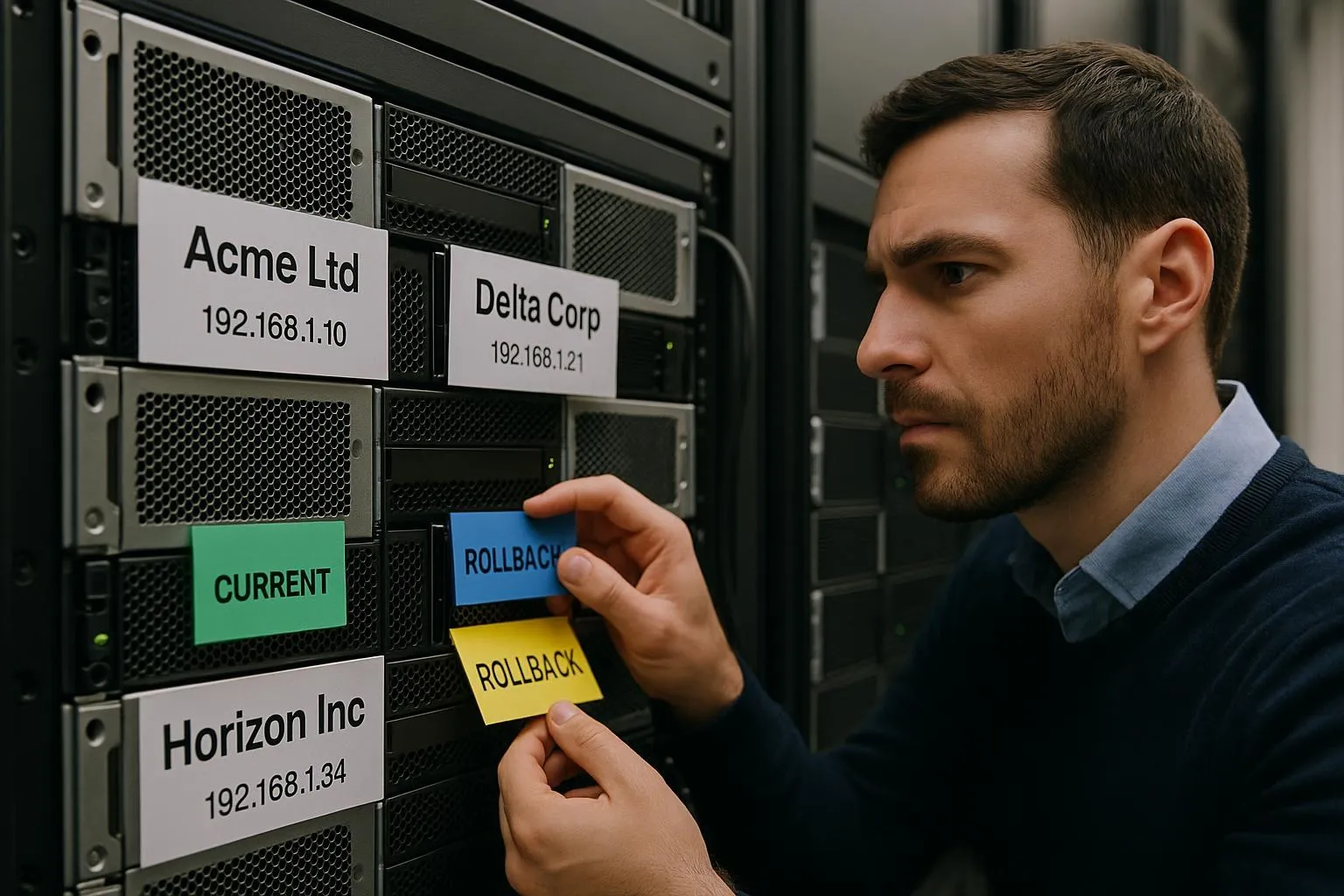 Operations and infrastructure
4 min
Parametric Hostnames and Rollback-Ready Deploys: Building Customer-Scoped Isolation in Helpifyr/JaddaHelpifyr
Today's engineering work delivers a step-function improvement for customer isolation and operational control by introducing fully parameterized hostnames, public URLs, and rollback-ready deployment images across the Helpifyr/JaddaHelpifyr stack. This technical shift unlocks safe, repeatable, and customer-specific deployments, allowing operators to deliver tailored environments without image tag collisions or hardcoded host values. The result is a deployment model where isolation is guaranteed by contract, not just configuration hygiene.
Read