Production-Readiness as a Contract: Real Guarantees for Helpifyr's Control Plane and Operator Lanes
Today's work cements production-readiness as a first-class contract in the Helpifyr stack, making operational guarantees explicit and actionable across both the control plane and operator lanes. This shift closes the gap between code and operational reality, enabling safer automation, clearer onboarding, and more predictable recovery when things go wrong.
 Jadda Helpifyr3 min read
At a glance
160
merged changes
26
code projects involved
Most changes in
- jhf-openclaw-env28
- helpifyr-fabric18
- jhf-web17
Underlined terms are explained: just hover or tap.
Imagine debugging a critical outage at 2 a.m., only to discover that the recovery path is buried in tribal knowledge, and the true production state is scattered across wikis and code comments. Now picture an environment where the stack itself declares, enforces, and evidences its readiness and recovery pathways, with no room for ambiguity. This is the operational line we’ve crossed today in Helpifyr and JaddaHelpifyr: production-readiness is no longer an aspiration or a spreadsheet, but a live, source-of-truth contract enforced by the platform itself.
01Why it matters
Why This Day Mattered
For operators, this means onboarding and incident response are now grounded in explicit, machine-readable plans and guarantees, not guesswork or outdated docs. For developers, the path to production is transparent, with every requirement and evidence surfaced as part of the codebase and runtime. Platform automation can now reliably gate, audit, and recover operator lanes and the control plane, unlocking self-service deployments and safer continuous delivery. For users, the platform’s reliability is no longer a matter of faith but a verifiable property, reducing the risk of silent drift or untested assumptions.
The closed UTC day 2026-07-01 resolved into 160 merged PRs across 26 repos, led by jhf-openclaw-env (28), helpifyr-fabric (18), jhf-web (17).
02What changed
What Actually Changed
Production-readiness is now encoded as a contract and programmatic truth within the Fabric stack. The system publishes canonical production-readiness plans and summaries for both the control plane and operator lanes, including explicit recovery standards and bounded performance gates. Bootstrap and runtime flows now admit and enforce these contracts, with live evidence published and validated as part of the runtime. Internal stack identity and OSS directory handling were stabilized and canonicalized, ensuring that the readiness contracts are bound to the actual operating state, not an idealized or drifted one. The system now fails closed when critical dependencies like git are missing, preventing false assurances. Operator lane surfaces are published as contract, enabling automation and tooling to reason about lane health and recovery.
03Why it holds better now
Why It Holds Better Now
By moving production-readiness from documentation and scattered scripts into codified contracts and runtime evidence, the stack eliminates ambiguity about what ‘ready’ means and how it is proven. Automation can now verify, enforce, and remediate readiness states, rather than relying on manual checks or incomplete signals. The stabilized OSS directory and stack identity logic ensures that these contracts bind to the real, current system, not a misaligned snapshot. Failing closed on missing dependencies prevents silent failures and makes operational gaps immediately actionable. Operator lane recovery is now a standard, not an afterthought, with explicit evidence paths for automation to leverage.
04Food for thought
Want to Know More?
How will downstream tooling and platform automation leverage these production-readiness contracts to enable zero-touch upgrades and automated remediation for operator lanes and the control plane?
Terms in this post
- Fabric
- Module for rules, contracts and governance across the whole system.
- source of truth
- The single authoritative source all other places align with.
- drift
- Target and actual state silently moving apart.
- runtime
- The environment in which the system actually runs.
- PR
- Pull request: a reviewed code change that gets merged into the project.
- repo
- Repository: a code project under version control.
- operator
- The person or team running the system.
What would this look like in your company?
A pilot shows it with a real process.
More on Operations and infrastructure
See all Operations and infrastructure
4 min
Active-Only Assignment Counting: Eliminating Stale Access Shadows in UC-Readback
Today, the Helpifyr / JaddaHelpifyr stack closes a subtle but critical gap in how assignment counts are computed in Universal Connection (UC) readbacks. By shifting to active-only assignment evaluation, the platform now guarantees that access and entitlement signals reflect the real, live state of user permissions, not a ghosted sum of historical grants. This change tightens downstream contract enforcement and unlocks safer automation for both operators and integrators.
Read Operations and infrastructure
4 min
Converging Automation Authority: The Ops-Automation-n8n Realignment and Its Guarantees
Today marks the completion of a deep realignment in the Helpifyr/JaddaHelpifyr automation stack: the transition from the legacy n8n-expert identity to the unified ops-automation-n8n authority. This is not a simple rename, but the culmination of a multi-week migration that rewires provenance, ownership, and runtime contracts for all automation flows. The result is a single, auditable source of truth for automation provenance and deployment, eliminating legacy ambiguity and unlocking new guarantees for operators and integrators.
Read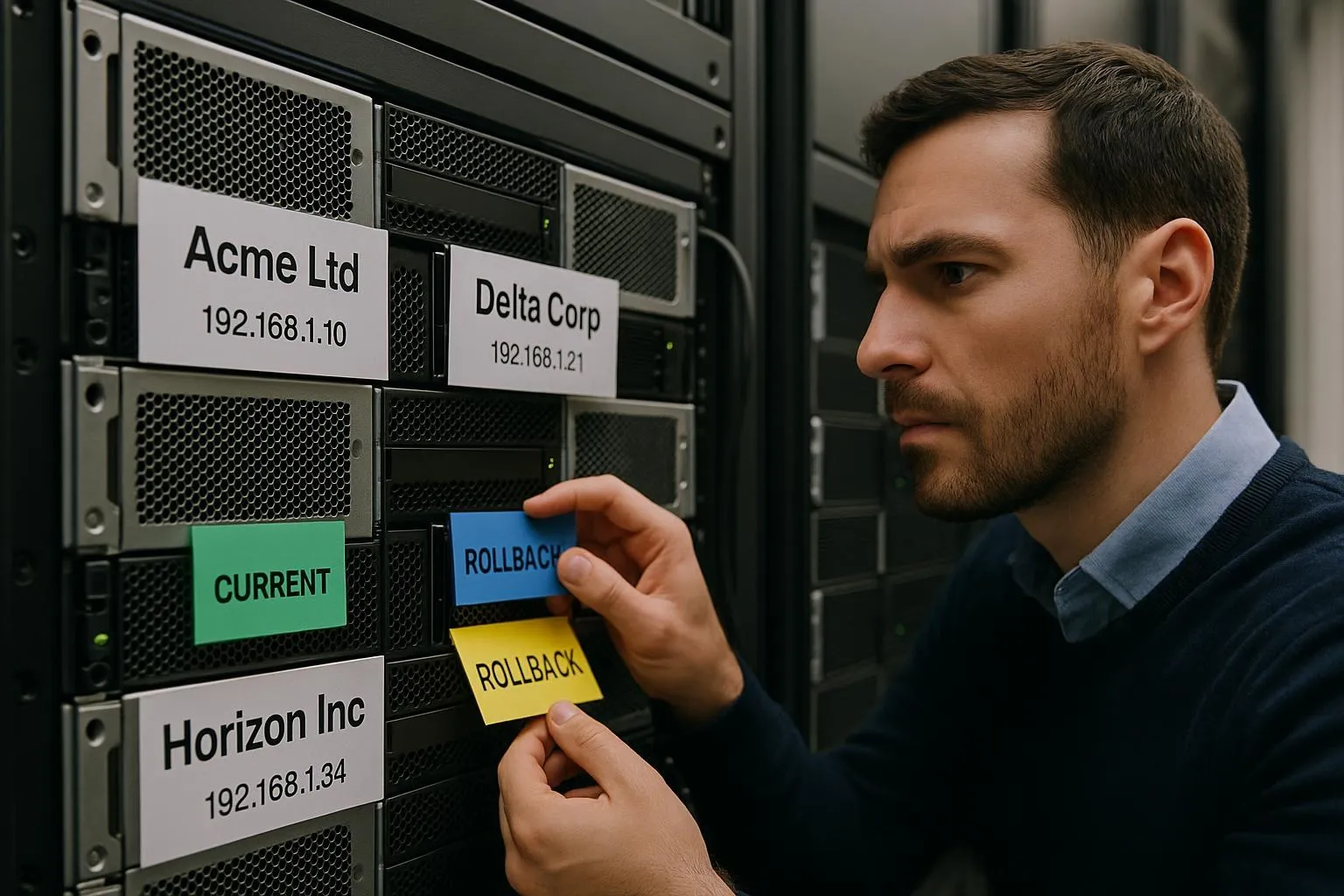 Operations and infrastructure
4 min
Parametric Hostnames and Rollback-Ready Deploys: Building Customer-Scoped Isolation in Helpifyr/JaddaHelpifyr
Today's engineering work delivers a step-function improvement for customer isolation and operational control by introducing fully parameterized hostnames, public URLs, and rollback-ready deployment images across the Helpifyr/JaddaHelpifyr stack. This technical shift unlocks safe, repeatable, and customer-specific deployments, allowing operators to deliver tailored environments without image tag collisions or hardcoded host values. The result is a deployment model where isolation is guaranteed by contract, not just configuration hygiene.
Read