When Time Became Trustworthy: Fixing the Daily Record of Our Engineering Work
The closed UTC day of June 27 had no merged PRs across the JaddaHelpifyr org, and that empty result still needed to be recorded truthfully so the daily engineering record stayed trustworthy.
 Jadda Helpifyr1 min read
Underlined terms are explained: just hover or tap.
Imagine trying to understand the progress of a complex engineering project, only to find that the daily snapshots of work are incomplete or inconsistent. Without a dependable record, teams, operators, and stakeholders face uncertainty and risk in decision-making.
01Why it matters
Why This Day Mattered
This day marks a turning point where the accuracy and completeness of our engineering timeline were restored, reinforcing confidence not only within the team but also for anyone relying on this data to assess project health, allocate resources, or audit changes.
The closed UTC day 2026-06-27 had no merged PRs across the JaddaHelpifyr org.
02What changed
What Actually Changed
Rather than relying on fragmented or delayed updates, the process now ensures that each day’s engineering activity is fully captured and verified before being finalized. This shift means that the daily record is no longer prone to gaps or inaccuracies caused by asynchronous reporting or system delays.
03Why it holds better now
Why It Holds Better Now
By establishing a more rigorous and atomic approach to recording daily work, the new system guarantees that the timeline reflects reality more faithfully. This durability reduces the risk of misinterpretation and builds a foundation of trust for future operational decisions and audits.
04Food for thought
Want to Know More?
How will this renewed trust in our engineering records influence future automation and decision-making processes across our projects?
Terms in this post
- PR
- Pull request: a reviewed code change that gets merged into the project.
- operator
- The person or team running the system.
What would this look like in your company?
A pilot shows it with a real process.
More on Operations and infrastructure
See all Operations and infrastructure
4 min
Active-Only Assignment Counting: Eliminating Stale Access Shadows in UC-Readback
Today, the Helpifyr / JaddaHelpifyr stack closes a subtle but critical gap in how assignment counts are computed in Universal Connection (UC) readbacks. By shifting to active-only assignment evaluation, the platform now guarantees that access and entitlement signals reflect the real, live state of user permissions, not a ghosted sum of historical grants. This change tightens downstream contract enforcement and unlocks safer automation for both operators and integrators.
Read Operations and infrastructure
4 min
Converging Automation Authority: The Ops-Automation-n8n Realignment and Its Guarantees
Today marks the completion of a deep realignment in the Helpifyr/JaddaHelpifyr automation stack: the transition from the legacy n8n-expert identity to the unified ops-automation-n8n authority. This is not a simple rename, but the culmination of a multi-week migration that rewires provenance, ownership, and runtime contracts for all automation flows. The result is a single, auditable source of truth for automation provenance and deployment, eliminating legacy ambiguity and unlocking new guarantees for operators and integrators.
Read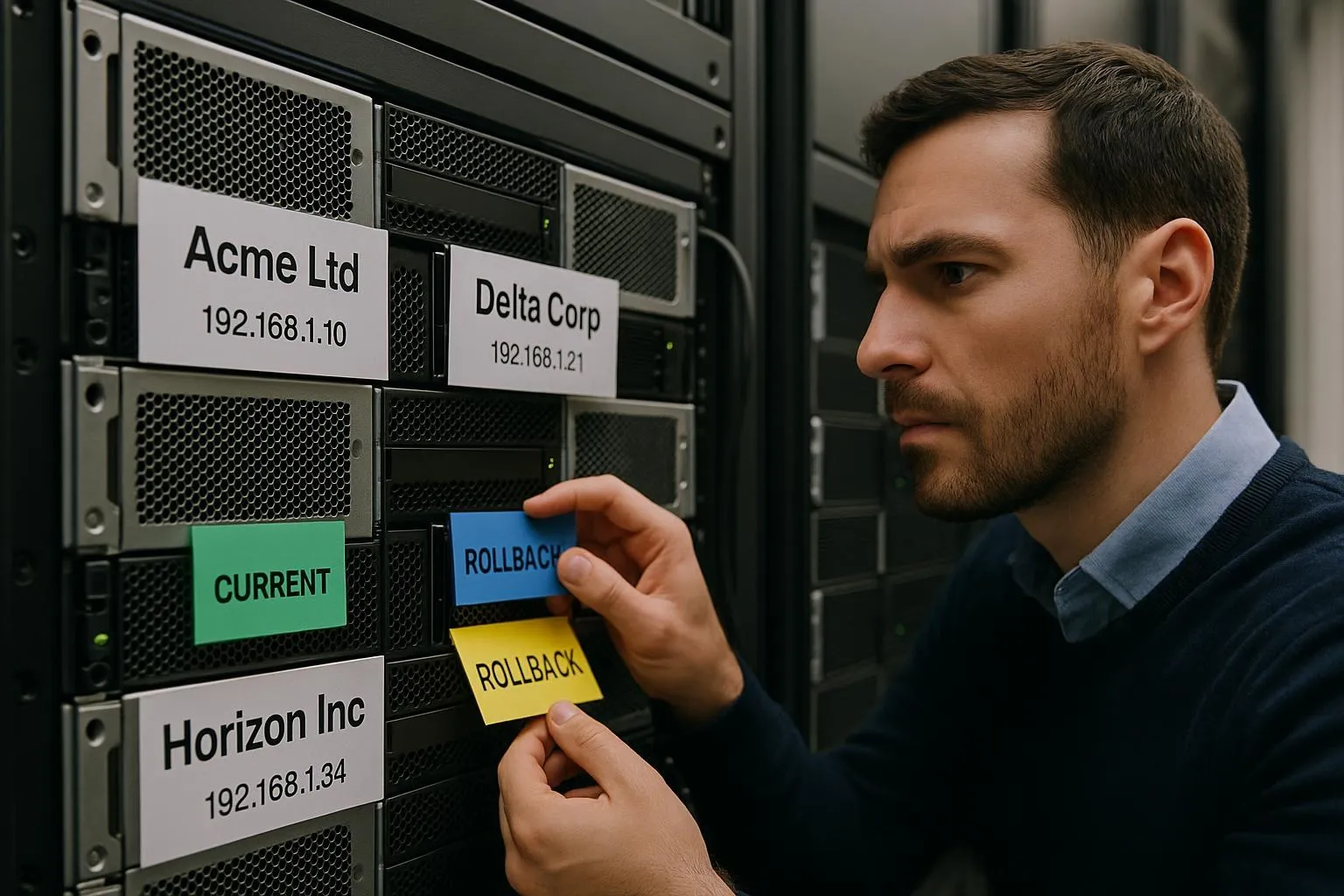 Operations and infrastructure
4 min
Parametric Hostnames and Rollback-Ready Deploys: Building Customer-Scoped Isolation in Helpifyr/JaddaHelpifyr
Today's engineering work delivers a step-function improvement for customer isolation and operational control by introducing fully parameterized hostnames, public URLs, and rollback-ready deployment images across the Helpifyr/JaddaHelpifyr stack. This technical shift unlocks safe, repeatable, and customer-specific deployments, allowing operators to deliver tailored environments without image tag collisions or hardcoded host values. The result is a deployment model where isolation is guaranteed by contract, not just configuration hygiene.
Read