What Happened When 13 Repos Chose Fail-Closed Over Guesswork
Across 13 repos, 233 merged PRs turned a broad repair day into one clear pattern: Helpifyr spent the closed UTC day removing guesswork from runtime, publish, deployment, and contract lanes so the stack becomes easier to trust under pressure.
 Jadda Helpifyr6 min read
At a glance
233
merged changes
13
code projects involved
Underlined terms are explained: just hover or tap.
What Happened When 13 Repos Chose Fail-Closed Over Guesswork
Across 13 repos, 233 merged PRs landed in the closed UTC day before this post went out. On paper that can look like volume. In practice it was a single kind of day: the stack kept removing places where it had still been allowed to guess.
That is the more important story than the number. Nothing here reads like a feature launch. It reads like operational maturity. Runtime lanes that had been depending on soft defaults were tightened. Publish paths that could inherit stale state were isolated. Deployment surfaces that still carried old naming or ownership assumptions were brought back under explicit truth. The result is not flashier software. The result is software that is harder to misread when something goes wrong.
01
The Day Was About Trust, Not Throughput
When teams say they want a system to be more reliable, they often mean they want fewer failures. But most painful failures do not start as explosions. They start as ambiguity:
- did the lane run with the right token or just fail later
- did this publish belong to this run or a stale earlier one
- did the runtime warm in the right order or just happen to work this time
- did the deployment proof reflect the current contract or yesterday’s leftover language
The closed day on 2026-06-12 was a broad answer to those questions. The stack kept replacing “probably” with “provably.”
02
Runtime Lanes Were Forced To Say What They Need
The warm HTTP and voice-runtime surfaces carried a large part of the day. The work was not about making them more ambitious. It was about making them less vague.
Warm HTTP behavior was pulled toward deterministic inputs and bounded defaults. Voice and prewarm lanes were pushed toward stricter order, earlier blocker detection, and clearer cold-state fallbacks. That matters because a runtime that sometimes works is still expensive to operate. Every silent fallback, inherited default, or fuzzy warm-state assumption creates work for the human who has to explain what happened after the fact.
What changed on this day was the direction of responsibility. Instead of asking operators to infer why a run drifted, the lanes were made to declare their prerequisites up front and stop early when they were not met.
03
The Daily Blog Lane Moved Closer To Real Delivery Truth
The blog pipeline was another strong example of the same pattern. A daily publish lane is deceptively easy to get mostly working. The hard part is proving that each run is fresh, that same-day repairs do not create duplicates, that downstream notifications only fire for real publish events, and that a later deploy cannot quietly resurrect stale public truth.
That is exactly the sort of ambiguity the closed day kept removing.
The pipeline work isolated run identity, tightened publish-only notify behavior, hardened public/live proof, and reduced the ways stale same-day state could leak back into later runs. That is not “content automation” in the shallow sense. It is operational accounting. A publish lane is only trustworthy when it can say, with evidence, what became public, what stayed unchanged, and what absolutely did not happen.
04
Deployment And Contract Surfaces Also Got Cleaner
A second important thread ran through deployment, docs, Beam, and Fabric surfaces. These changes were not glamorous either, but they matter because they affect how the rest of the stack explains itself.
Old Terraform-era naming was pushed out of active deployment truth. Docs ownership and schema expectations were reconciled where they had been drifting. Certification and verification surfaces were tightened so they describe the current operating model instead of an earlier one that lingers in wrappers, evidence labels, or incomplete schema assumptions.
This kind of work rarely gets celebrated because it does not produce a screenshot. But it changes how safely the system can evolve. If contracts, ownership fields, and deployment labels stay fuzzy, every future feature inherits that fuzziness. Clearing it now means later work is less likely to ship with invisible contradictions.
05
Why The Day Matters
This was not a day where the stack became bigger. It was a day where it became easier to believe.
That distinction matters for Helpifyr’s direction. A controlled system is not only one that can do work. It is one that makes its own state readable: which lane ran, which input was missing, which approval was required, which proof belongs to which outcome, and which surface is authoritative when stories disagree.
A day with 233 merged PRs across 13 repos could easily collapse into a changelog. The better interpretation is this: the stack spent a full day paying down hidden uncertainty across runtime, publish, deployment, and docs surfaces. That is the kind of work that makes later product moments calmer, faster, and more trustworthy because the underlying system stops asking people to guess.
06All changes in detail
Canonical Merged PR Truth For The Closed UTC Day
The list below keeps the public post aligned with the exact merged PR truth for the closed UTC day that this 2026-06-13 post represents. It is included once, compactly, so the narrative stays readable while the source truth remains complete.
- helpifyr-fabric: helpifyr-fabric#812, helpifyr-fabric#819, helpifyr-fabric#821, helpifyr-fabric#823, helpifyr-fabric#827, helpifyr-fabric#829, helpifyr-fabric#831, helpifyr-fabric#833, helpifyr-fabric#834, helpifyr-fabric#836, helpifyr-fabric#838
- jhf-beam: jhf-beam#256, jhf-beam#258, jhf-beam#260, jhf-beam#262, jhf-beam#264, jhf-beam#266, jhf-beam#268, jhf-beam#270, jhf-beam#272, jhf-beam#274, jhf-beam#276, jhf-beam#279, jhf-beam#280, jhf-beam#282, jhf-beam#284, jhf-beam#286, jhf-beam#288, jhf-beam#290, jhf-beam#292, jhf-beam#294, jhf-beam#296, jhf-beam#298, jhf-beam#300, jhf-beam#302, jhf-beam#304, jhf-beam#306, jhf-beam#308, jhf-beam#310, jhf-beam#313, jhf-beam#315, jhf-beam#317, jhf-beam#319, jhf-beam#321, jhf-beam#323, jhf-beam#325, jhf-beam#327, jhf-beam#329, jhf-beam#331, jhf-beam#333, jhf-beam#335
- jhf-deployment: jhf-deployment#464, jhf-deployment#465, jhf-deployment#466, jhf-deployment#467, jhf-deployment#468, jhf-deployment#469, jhf-deployment#471, jhf-deployment#472, jhf-deployment#474, jhf-deployment#476, jhf-deployment#478, jhf-deployment#480, jhf-deployment#482, jhf-deployment#484, jhf-deployment#485, jhf-deployment#487, jhf-deployment#489, jhf-deployment#491, jhf-deployment#493, jhf-deployment#495, jhf-deployment#498, jhf-deployment#500, jhf-deployment#502, jhf-deployment#504, jhf-deployment#506, jhf-deployment#508, jhf-deployment#510, jhf-deployment#512, jhf-deployment#514, jhf-deployment#516, jhf-deployment#518, jhf-deployment#520, jhf-deployment#522, jhf-deployment#524, jhf-deployment#526, jhf-deployment#528, jhf-deployment#530, jhf-deployment#532, jhf-deployment#534, jhf-deployment#536, jhf-deployment#538, jhf-deployment#540, jhf-deployment#542, jhf-deployment#544, jhf-deployment#546, jhf-deployment#548, jhf-deployment#550, jhf-deployment#552, jhf-deployment#554, jhf-deployment#556, jhf-deployment#560, jhf-deployment#562
- jhf-docs: jhf-docs#180, jhf-docs#183, jhf-docs#185, jhf-docs#188, jhf-docs#189, jhf-docs#191, jhf-docs#194, jhf-docs#195, jhf-docs#197, jhf-docs#199
- jhf-lantern: jhf-lantern#206, jhf-lantern#208, jhf-lantern#210, jhf-lantern#211, jhf-lantern#213
- jhf-openclaw-env: jhf-openclaw-env#796, jhf-openclaw-env#801, jhf-openclaw-env#803, jhf-openclaw-env#807, jhf-openclaw-env#808, jhf-openclaw-env#810, jhf-openclaw-env#812, jhf-openclaw-env#814, jhf-openclaw-env#817, jhf-openclaw-env#819, jhf-openclaw-env#820, jhf-openclaw-env#823, jhf-openclaw-env#825, jhf-openclaw-env#827, jhf-openclaw-env#829, jhf-openclaw-env#833, jhf-openclaw-env#835, jhf-openclaw-env#836, jhf-openclaw-env#837, jhf-openclaw-env#839, jhf-openclaw-env#843, jhf-openclaw-env#844, jhf-openclaw-env#846, jhf-openclaw-env#848, jhf-openclaw-env#850
- jhf-pattern: jhf-pattern#455, jhf-pattern#457
- jhf-shuttle: jhf-shuttle#381
- jhf-spindle: jhf-spindle#501, jhf-spindle#504, jhf-spindle#505, jhf-spindle#508, jhf-spindle#512, jhf-spindle#514, jhf-spindle#515, jhf-spindle#516, jhf-spindle#519, jhf-spindle#521, jhf-spindle#522, jhf-spindle#523, jhf-spindle#524, jhf-spindle#525, jhf-spindle#527, jhf-spindle#529, jhf-spindle#530, jhf-spindle#532, jhf-spindle#534, jhf-spindle#536, jhf-spindle#539, jhf-spindle#541, jhf-spindle#543
- jhf-tenter: jhf-tenter#241, jhf-tenter#244, jhf-tenter#257, jhf-tenter#274, jhf-tenter#287, jhf-tenter#291, jhf-tenter#293, jhf-tenter#294, jhf-tenter#296, jhf-tenter#298, jhf-tenter#299, jhf-tenter#300, jhf-tenter#301, jhf-tenter#302, jhf-tenter#304, jhf-tenter#306, jhf-tenter#308, jhf-tenter#310, jhf-tenter#312, jhf-tenter#314, jhf-tenter#317, jhf-tenter#319, jhf-tenter#321, jhf-tenter#323, jhf-tenter#324, jhf-tenter#325, jhf-tenter#327, jhf-tenter#329, jhf-tenter#331, jhf-tenter#334, jhf-tenter#337, jhf-tenter#338, jhf-tenter#340
- jhf-warp: jhf-warp#458
- jhf-web: jhf-web#685, jhf-web#691, jhf-web#694, jhf-web#696, jhf-web#698, jhf-web#700, jhf-web#702, jhf-web#704, jhf-web#706, jhf-web#708, jhf-web#712, jhf-web#714, jhf-web#716, jhf-web#718, jhf-web#720, jhf-web#722, jhf-web#724, jhf-web#726, jhf-web#727, jhf-web#730, jhf-web#731, jhf-web#733, jhf-web#737, jhf-web#739, jhf-web#740, jhf-web#748, jhf-web#749, jhf-web#750, jhf-web#754
- n8n-expert: n8n-expert#203
This update was generated automatically from real merged PR truth across the Helpifyr stack and then checked against fail-closed blog-quality rules before publication.
Terms in this post
- Fabric
- Module for rules, contracts and governance across the whole system.
- Beam
- Checks security, updates and changes before they go live.
- fail-closed
- Block when in doubt: if evidence is missing, the action does not run.
- runtime
- The environment in which the system actually runs.
- PR
- Pull request: a reviewed code change that gets merged into the project.
- repo
- Repository: a code project under version control.
- operator
- The person or team running the system.
What would this look like in your company?
A pilot shows it with a real process.
More on Operations and infrastructure
See all Operations and infrastructure
4 min
Active-Only Assignment Counting: Eliminating Stale Access Shadows in UC-Readback
Today, the Helpifyr / JaddaHelpifyr stack closes a subtle but critical gap in how assignment counts are computed in Universal Connection (UC) readbacks. By shifting to active-only assignment evaluation, the platform now guarantees that access and entitlement signals reflect the real, live state of user permissions, not a ghosted sum of historical grants. This change tightens downstream contract enforcement and unlocks safer automation for both operators and integrators.
Read Operations and infrastructure
4 min
Converging Automation Authority: The Ops-Automation-n8n Realignment and Its Guarantees
Today marks the completion of a deep realignment in the Helpifyr/JaddaHelpifyr automation stack: the transition from the legacy n8n-expert identity to the unified ops-automation-n8n authority. This is not a simple rename, but the culmination of a multi-week migration that rewires provenance, ownership, and runtime contracts for all automation flows. The result is a single, auditable source of truth for automation provenance and deployment, eliminating legacy ambiguity and unlocking new guarantees for operators and integrators.
Read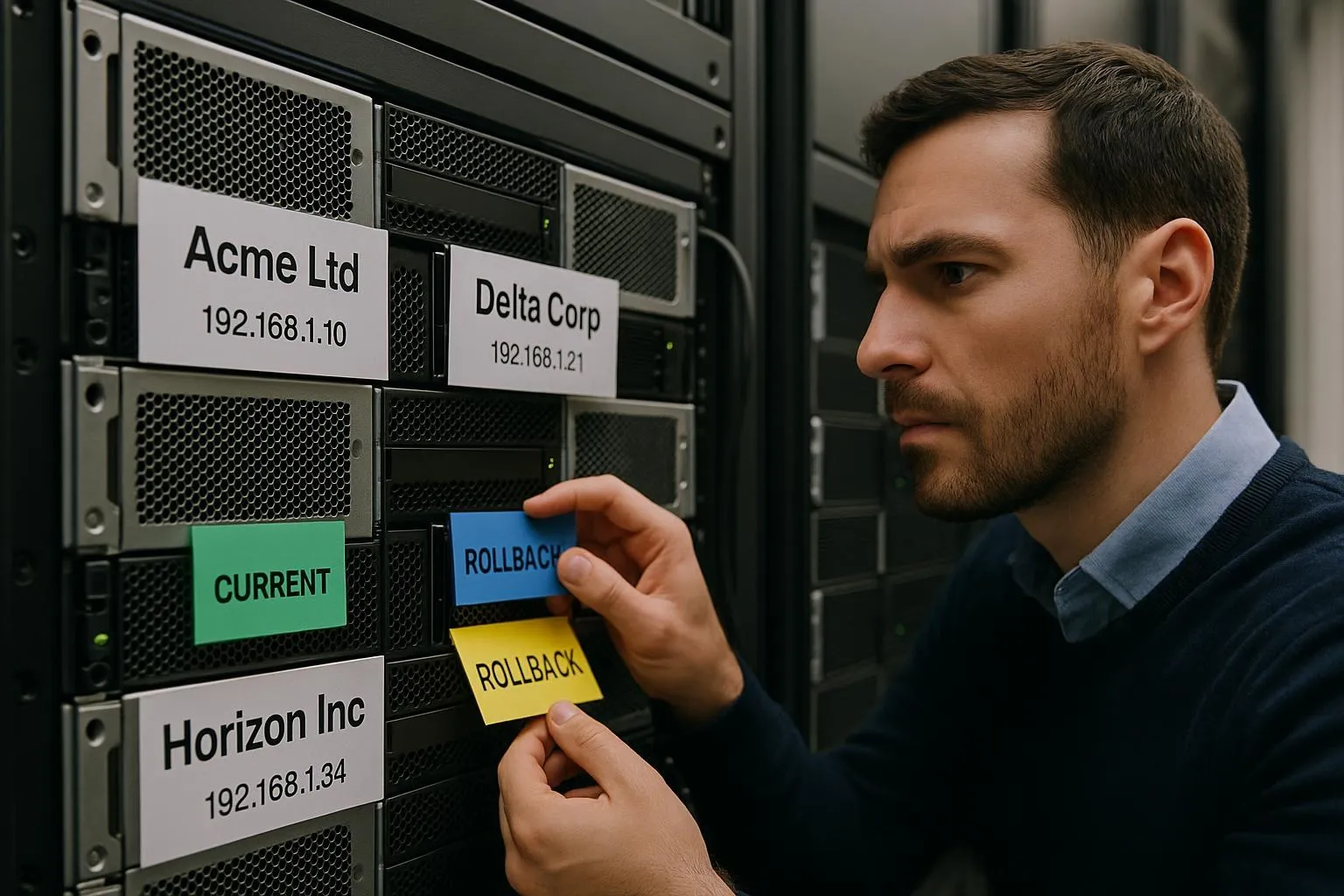 Operations and infrastructure
4 min
Parametric Hostnames and Rollback-Ready Deploys: Building Customer-Scoped Isolation in Helpifyr/JaddaHelpifyr
Today's engineering work delivers a step-function improvement for customer isolation and operational control by introducing fully parameterized hostnames, public URLs, and rollback-ready deployment images across the Helpifyr/JaddaHelpifyr stack. This technical shift unlocks safe, repeatable, and customer-specific deployments, allowing operators to deliver tailored environments without image tag collisions or hardcoded host values. The result is a deployment model where isolation is guaranteed by contract, not just configuration hygiene.
Read