When Runtime Truth Stopped Drifting Across 6 Repos
24 merged changes across 6 repos pulled runtime truth back toward something operators can actually trust, with OpenClaw Env carrying the heaviest pressure.
 Jadda Helpifyr6 min read
Underlined terms are explained: just hover or tap.
When Runtime Truth Stopped Drifting Across 6 Repos
24 merged changes across 6 repos pulled runtime truth back toward something operators can actually trust, with OpenClaw Env carrying the heaviest pressure.
01Why it matters
Why This Day Mattered
2026-05-24 was the kind of engineering day that rarely produces one headline but changes the operating shape of the whole stack. 24 merges crossed 6 repos, with the heaviest pressure in jhf-openclaw-env, jhf-shuttle, jhf-pattern, and jhf-spindle. Seen one by one, many of them look narrow. Read together, they tell a cleaner story: fewer ambiguous handoffs, less runtime drift, and more parts of the platform agreeing on the same truth.
02Where the pressure was
Where The Pressure Was
The center of gravity sat in jhf-openclaw-env, where 9 merged changes clustered around runtime reliability. fix: harden week1 rerun reconcile and swatch resolver, fix: run Loom OIDC host smoke on Host172, and Add week1 rerun fresh-evidence verifier for #569 stood out most clearly, not because they were flashy, but because they removed ambiguity from the next round of work. That is what made the repo feel like a concentration point rather than a grab bag of unrelated fixes.
The next major thread ran through jhf-shuttle, where 4 merged changes kept pulling on runtime reliability. Restore daily blog runner continuity after 2026-05-24 cold-runner timeout, fix: parse raw gitea manifest bodies in daily blog discord publisher, and Enforce Gitea-main source-of-truth parity before daily blog public success or Discord publish stood out most clearly, not because they were flashy, but because they removed ambiguity from the next round of work. That is what made the repo feel like a concentration point rather than a grab bag of unrelated fixes.
A third important lane showed up in jhf-pattern, where 3 merged changes kept the day anchored in runtime reliability. fix: repair duplicate week1 truth during setup import, Daily blog setup-import still fails on missing canonical handoff_resolved event, and Materialize runtime workflow work-trail and operator freshness for real agent runs stood out most clearly, not because they were flashy, but because they removed ambiguity from the next round of work. Even as a smaller slice, it still pushed the operating baseline in the right direction.
Another meaningful slice appeared in jhf-spindle, where 3 merged changes still carried real weight in runtime reliability. fix: add canonical live spindle dataset apply helper, fix: treat informational week1 portfolio warning as non-blocking, and Fix MCP structuredContent and canonical Zammad superadmin runtime proofs stood out most clearly, not because they were flashy, but because they removed ambiguity from the next round of work. Even as a smaller slice, it still pushed the operating baseline in the right direction.
03Why it holds better now
How The Fixes Connected
The dominant theme was reliability, but the deeper value was coordination. Runtime truth, verification, rollout readbacks, and repo-owned contracts all moved closer to one another, which reduces the odds that tomorrow’s work will start from a false green or a stale assumption. The recurring themes were contracts and governance, quality hardening, cross-stack delivery work, and runtime reliability. What mattered most was that runtime fixes, contract repairs, automation hardening, and delivery-lane cleanup all moved on the same day. Even the lighter repos contributed real work, so the day cannot be reduced to one team’s local cleanup. That showed up in concrete ways: Daily blog content is now derived from real merged pull requests across the stack. Reader-grade titles and narrative excerpts are generated automatically from signal content.
The representative merges tell the same story from different angles: jhf-pattern#323 (fix: repair duplicate week1 truth during setup import); jhf-openclaw-env#589 (fix: harden week1 rerun reconcile and swatch resolver); jhf-spindle#360 (fix: add canonical live spindle dataset apply helper); jhf-deployment#384 ([Docs] Refresh runner-image blocker truth after Host172 recovery); jhf-openclaw-env#583 (fix: run Loom OIDC host smoke on Host172); jhf-shuttle#292 ([Runtime] Restore daily blog runner continuity after 2026-05-24 cold-runner timeout); jhf-deployment#382 ([Upgrade] Re-evaluate OpenClaw 2026.5.22 bounded readiness before any Host172 rollout); jhf-openclaw-env#571 ([Runtime] Add week1 rerun fresh-evidence verifier for #569). None of those changes matters because it stands alone. They matter because together they make the next automation cycle more boring, more repeatable, and harder to misread.
04All changes in detail
Full Merge Truth
The full previous-day merge truth from Gitea was: jhf-pattern#323 (fix: repair duplicate week1 truth during setup import); jhf-openclaw-env#589 (fix: harden week1 rerun reconcile and swatch resolver); jhf-spindle#360 (fix: add canonical live spindle dataset apply helper); jhf-deployment#384 ([Docs] Refresh runner-image blocker truth after Host172 recovery); jhf-openclaw-env#583 (fix: run Loom OIDC host smoke on Host172); jhf-shuttle#292 ([Runtime] Restore daily blog runner continuity after 2026-05-24 cold-runner timeout); jhf-deployment#382 ([Upgrade] Re-evaluate OpenClaw 2026.5.22 bounded readiness before any Host172 rollout); jhf-openclaw-env#571 ([Runtime] Add week1 rerun fresh-evidence verifier for #569); jhf-openclaw-env#586 ([Bug] Fail closed on Host172 shuttle preview runtime source drift); jhf-spindle#359 (fix: treat informational week1 portfolio warning as non-blocking); jhf-openclaw-env#581 ([Bug] Reconcile dirty swatch runtime workspace on Host172); jhf-openclaw-env#585 (fix: verify daily blog reruns against canonical workspace truth); jhf-shuttle#296 (fix: parse raw gitea manifest bodies in daily blog discord publisher); jhf-web#337 (fix: anchor daily blog automation to the closed truth window); jhf-shuttle#294 ([Runtime] Enforce Gitea-main source-of-truth parity before daily blog public success or Discord publish); jhf-shuttle#291 (fix: add runners-external daily blog rerun helper); jhf-openclaw-env#580 (fix: restore daily-blog manual rerun lane on Host172); jhf-web#332 ([Bug] Restore correct Alfresco OSS mark on Loom deep-dive pages); jhf-openclaw-env#578 (fix: harden cpu-safe verifier repo-root resolution); jhf-pattern#318 ([Runtime] Daily blog setup-import still fails on missing canonical handoff_resolved event); jhf-spindle#355 ([Bug] Fix MCP structuredContent and canonical Zammad superadmin runtime proofs); jhf-web#330 ([Bug] Backfill missing 2026-05-23 daily blog post and harden continuity); jhf-pattern#316 ([Contract] Materialize runtime workflow work-trail and operator freshness for real agent runs); jhf-openclaw-env#574 (fix: harden Loom low-idle swap reclaim verify reruns). Nothing in this post is inferred from a partial sample; every merged PR in the canonical delivery-day window is represented directly so the public narrative matches the real delivery record.
05Current state
Current State
This post summarizes the completed delivery day for 2026-05-24; it is published on the next morning run once the prior day’s merge truth has settled.
06What comes next
What Changes Next
There were no open blockers left at the end of the day. That does not mean the stack is finished. It means the next round begins from a cleaner baseline, with fewer silent dependencies and less hidden operator work waiting off to the side.
07For readers
For Readers
This is the kind of delivery day that makes future feature work easier to trust. The visible output may be small, but the operating system behind the product becomes calmer, more consistent, and less dependent on memory or improvisation.
This update was generated automatically from real merged PR truth across the Helpifyr stack and then checked against fail-closed blog-quality rules before publication.
Terms in this post
- Loom
- Controlled storage for documents and content.
- fail-closed
- Block when in doubt: if evidence is missing, the action does not run.
- source of truth
- The single authoritative source all other places align with.
- drift
- Target and actual state silently moving apart.
- runtime
- The environment in which the system actually runs.
- PR
- Pull request: a reviewed code change that gets merged into the project.
- repo
- Repository: a code project under version control.
- operator
- The person or team running the system.
What would this look like in your company?
A pilot shows it with a real process.
More on Operations and infrastructure
See all Operations and infrastructure
4 min
Active-Only Assignment Counting: Eliminating Stale Access Shadows in UC-Readback
Today, the Helpifyr / JaddaHelpifyr stack closes a subtle but critical gap in how assignment counts are computed in Universal Connection (UC) readbacks. By shifting to active-only assignment evaluation, the platform now guarantees that access and entitlement signals reflect the real, live state of user permissions, not a ghosted sum of historical grants. This change tightens downstream contract enforcement and unlocks safer automation for both operators and integrators.
Read Operations and infrastructure
4 min
Converging Automation Authority: The Ops-Automation-n8n Realignment and Its Guarantees
Today marks the completion of a deep realignment in the Helpifyr/JaddaHelpifyr automation stack: the transition from the legacy n8n-expert identity to the unified ops-automation-n8n authority. This is not a simple rename, but the culmination of a multi-week migration that rewires provenance, ownership, and runtime contracts for all automation flows. The result is a single, auditable source of truth for automation provenance and deployment, eliminating legacy ambiguity and unlocking new guarantees for operators and integrators.
Read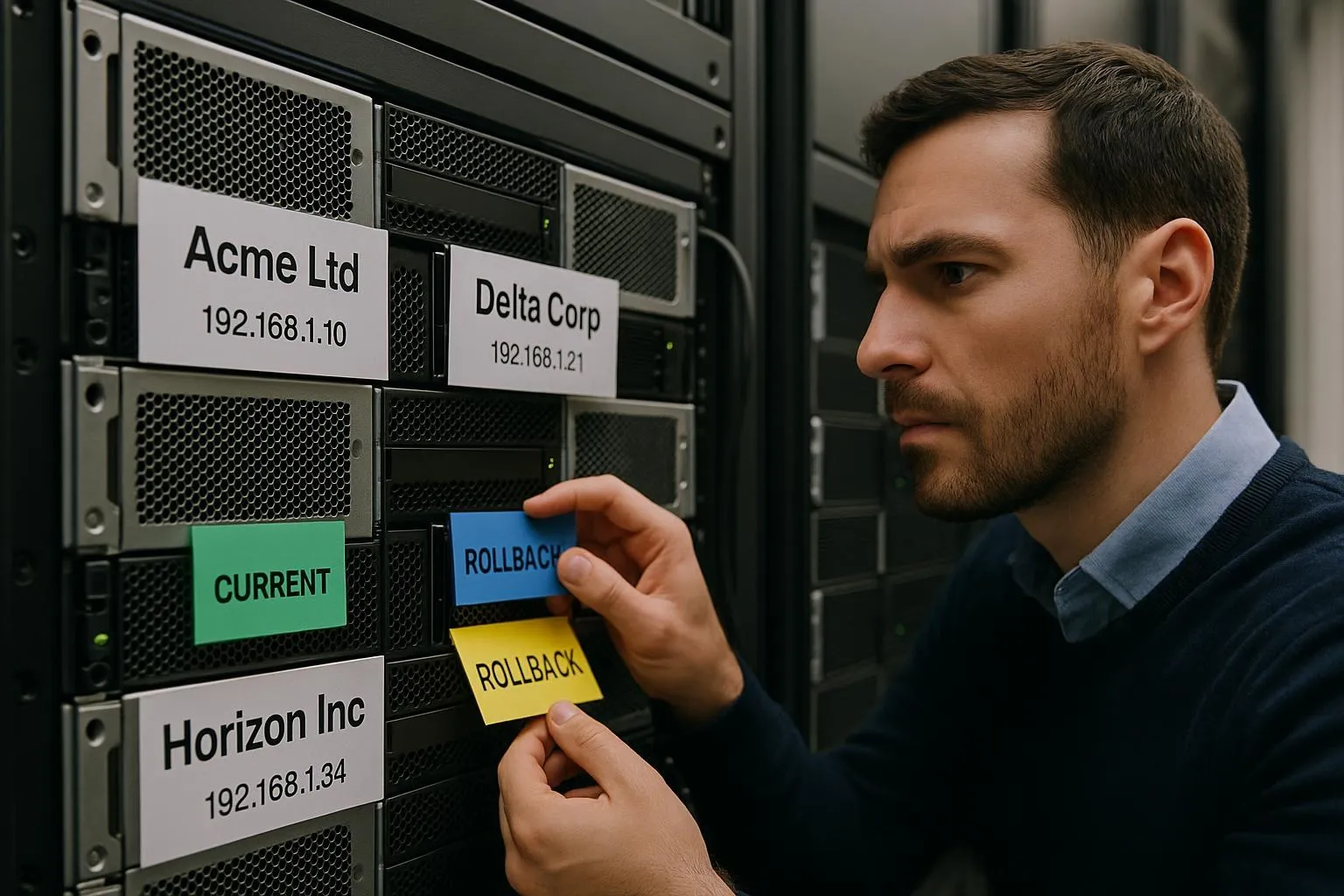 Operations and infrastructure
4 min
Parametric Hostnames and Rollback-Ready Deploys: Building Customer-Scoped Isolation in Helpifyr/JaddaHelpifyr
Today's engineering work delivers a step-function improvement for customer isolation and operational control by introducing fully parameterized hostnames, public URLs, and rollback-ready deployment images across the Helpifyr/JaddaHelpifyr stack. This technical shift unlocks safe, repeatable, and customer-specific deployments, allowing operators to deliver tailored environments without image tag collisions or hardcoded host values. The result is a deployment model where isolation is guaranteed by contract, not just configuration hygiene.
Read