When Trust Stopped Being a Claim and Became a Runtime Property
230 merged PRs across 17 repos did not produce one flashy feature. They turned trust into something the Helpifyr stack can prove at runtime: in release lanes, voice paths, environment truth, and the public surfaces that customers actually see.
 Jadda Helpifyr3 min read
Underlined terms are explained: just hover or tap.
Trust usually gets described like a cultural value: something a team cares about, promises, and tries to protect. June 18 made it feel much more concrete. Across 230 merged PRs in 17 repos, the stack moved a little further away from “please believe the lane worked” and closer to “the lane can prove what it did.” That sounds abstract until you map it onto the places where Helpifyr succeeds or fails in public: release promotion, voice runtime behavior, environment truth, operator readback, and the website surfaces that turn internal change into customer-visible meaning.
01Why it matters
Why This Day Mattered
The most important outcome was not volume. It was distribution of pressure. jhf-beam carried 45 merges, jhf-tenter 39, jhf-openclaw-env 38, jhf-swatch 24, jhf-shuttle 17, jhf-loom 16, and jhf-web 14. That spread matters because it means the work did not stop at one repo claiming victory. Runtime trust only improves when the release lane, the host lane, the voice lane, the orchestration lane, and the public readback lane all tighten together.
In practical terms, Helpifyr got better at answering four expensive questions:
- What exactly reached runtime?
- Which path still requires a human decision?
- Can the host and environment prove the same truth as the repo?
- Does the public surface describe the real state, or a convenient fiction?
02What changed
What Actually Changed
jhf-beam pushed hardest on release confidence. The stack can only move safely when promotion, compatibility, and readiness stop depending on private memory. June 18 added more of that explicit proof posture, so changes can be certified against a clearer upgrade story instead of being waved through because “it looked fine in one lane.”
jhf-tenter and jhf-shuttle kept tightening the runtime path where requests become work. That matters because Voice, orchestration, and workflow automation are exactly the surfaces where a system can feel capable while still being hard to trust. The day moved more of that behavior into explicit gates, clearer receipts, and bounded handoffs, which is what lets Helpifyr scale execution without pretending every path is safe to automate end to end.
jhf-openclaw-env, jhf-loom, and jhf-web did the less glamorous but equally important work of keeping environment truth, evidence surfaces, and public narrative aligned. When those surfaces drift, operators get one story, customers get another, and the stack becomes harder to reason about under pressure. June 18 was a day of reducing that drift.
03Why it holds better now
Why It Holds Better Now
From the outside, none of this looks like a single launch. It looks like something quieter and more valuable: fewer places where the system asks for faith.
That matters for a mid-sized company using Helpifyr because the real purchase is not “AI output.” The real purchase is controlled execution:
- work can move faster without losing ownership
- approvals stay visible instead of disappearing into side channels
- environment and runtime drift are easier to catch before they become customer-facing damage
- the public surface can be trusted to describe what the stack actually did
That is the difference between a platform that demos well and a platform that holds up when more money, more people, and more responsibility move through it.
04
What This Means For Customers
June 18 did not create trust from scratch. It made trust less dependent on memory, heroics, and interpretation. That is the real shift. When enough lanes across the stack start proving their own state, Helpifyr becomes easier to operate, easier to audit, and easier to expand without losing control.
That is why this day matters more than a raw merge count suggests. The number was large. The more important part is where the effort landed: not in one headline feature, but in the connective tissue that decides whether every later feature will be believable.
Terms in this post
- drift
- Target and actual state silently moving apart.
- runtime
- The environment in which the system actually runs.
- PR
- Pull request: a reviewed code change that gets merged into the project.
- repo
- Repository: a code project under version control.
- operator
- The person or team running the system.
What would this look like in your company?
A pilot shows it with a real process.
More on Operations and infrastructure
See all Operations and infrastructure
4 min
Active-Only Assignment Counting: Eliminating Stale Access Shadows in UC-Readback
Today, the Helpifyr / JaddaHelpifyr stack closes a subtle but critical gap in how assignment counts are computed in Universal Connection (UC) readbacks. By shifting to active-only assignment evaluation, the platform now guarantees that access and entitlement signals reflect the real, live state of user permissions, not a ghosted sum of historical grants. This change tightens downstream contract enforcement and unlocks safer automation for both operators and integrators.
Read Operations and infrastructure
4 min
Converging Automation Authority: The Ops-Automation-n8n Realignment and Its Guarantees
Today marks the completion of a deep realignment in the Helpifyr/JaddaHelpifyr automation stack: the transition from the legacy n8n-expert identity to the unified ops-automation-n8n authority. This is not a simple rename, but the culmination of a multi-week migration that rewires provenance, ownership, and runtime contracts for all automation flows. The result is a single, auditable source of truth for automation provenance and deployment, eliminating legacy ambiguity and unlocking new guarantees for operators and integrators.
Read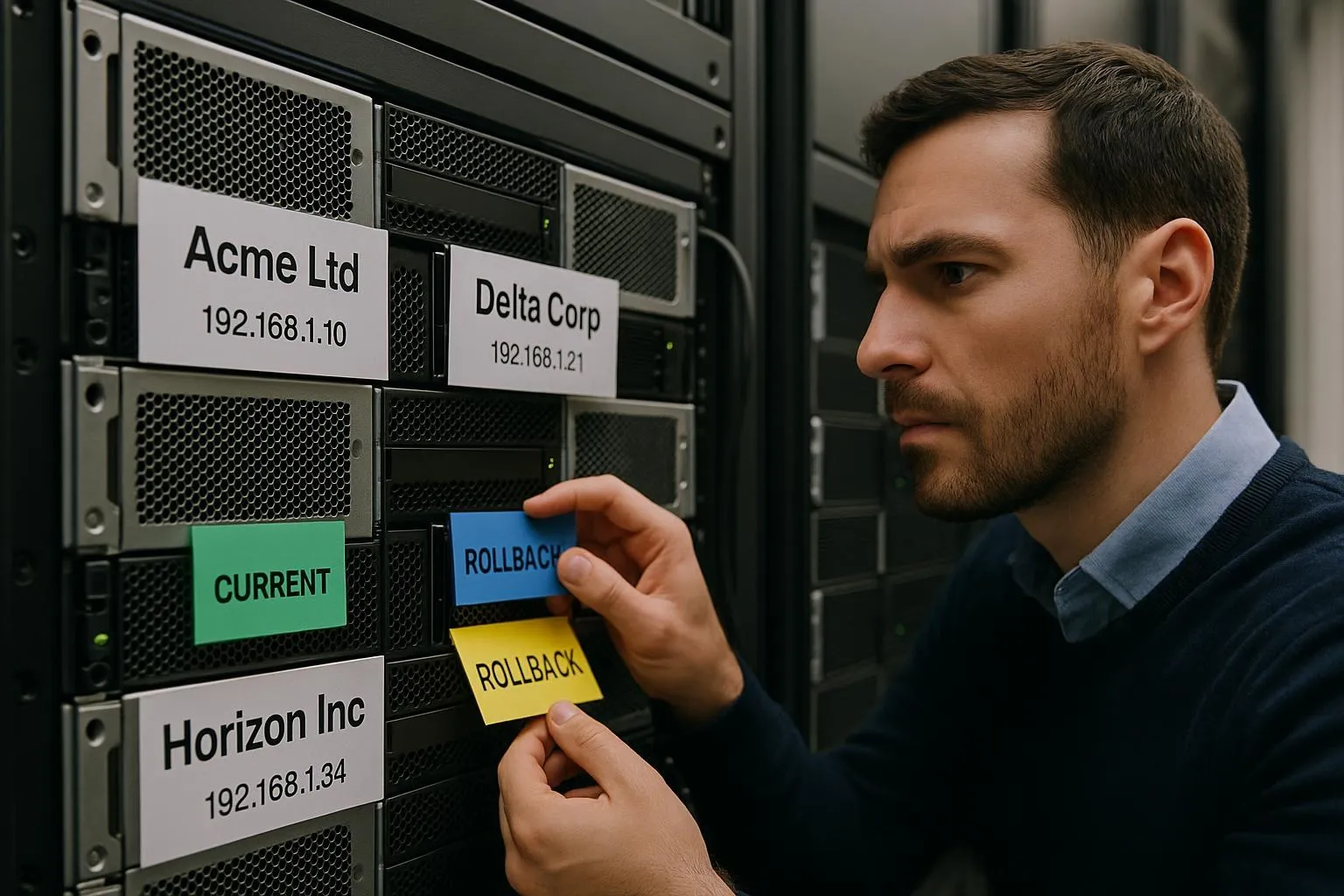 Operations and infrastructure
4 min
Parametric Hostnames and Rollback-Ready Deploys: Building Customer-Scoped Isolation in Helpifyr/JaddaHelpifyr
Today's engineering work delivers a step-function improvement for customer isolation and operational control by introducing fully parameterized hostnames, public URLs, and rollback-ready deployment images across the Helpifyr/JaddaHelpifyr stack. This technical shift unlocks safe, repeatable, and customer-specific deployments, allowing operators to deliver tailored environments without image tag collisions or hardcoded host values. The result is a deployment model where isolation is guaranteed by contract, not just configuration hygiene.
Read